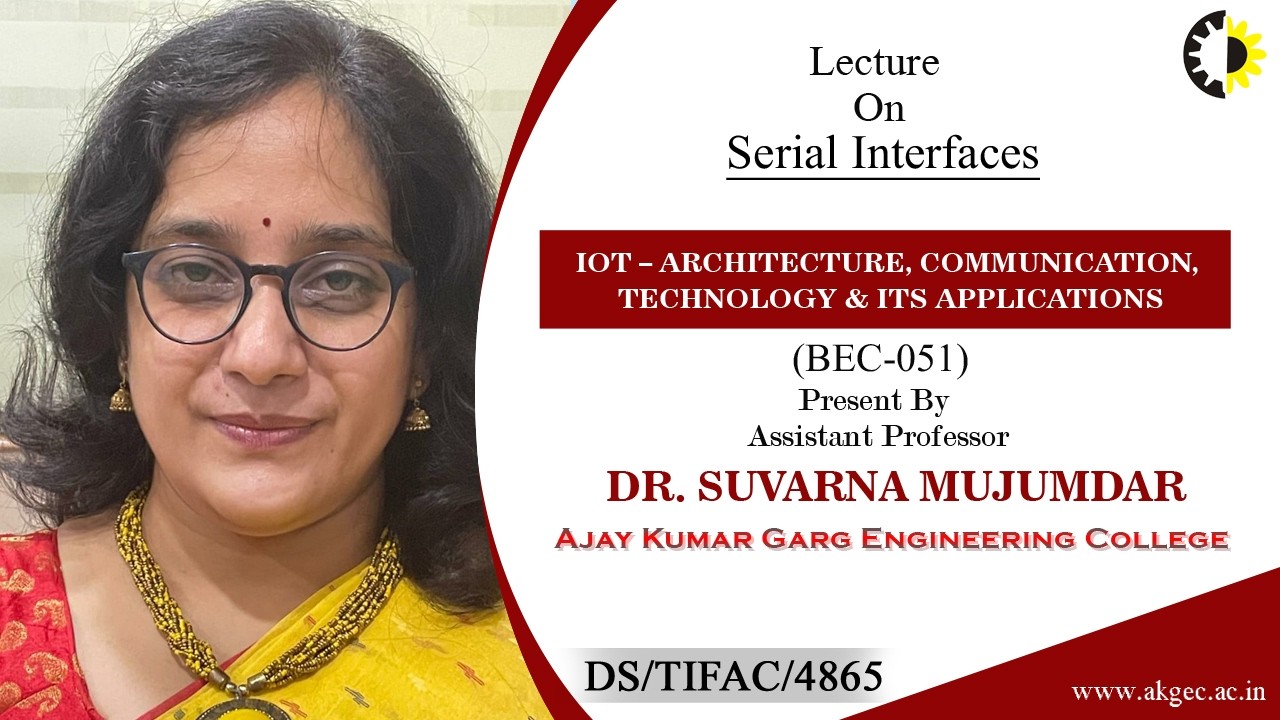
SERIAL INTERFACES | IOT–ARC, COMM, TECH & ITS APP | LECTURE 04 BY MS. SUVARNA MUJUMDAR | AKGEC
Keywords
Summary
128 words
Critical Evaluation
Value of the Information & Strength of the Argument
The lecture provides a clear, concise overview of the three main serial interfaces used in IoT prototyping. The argumentation is structured around each protocol’s characteristics, pinouts, and applications, making it easy for beginners to grasp. However, it lacks depth: no mathematical analysis, no detailed timing diagrams, and minimal discussion of signal integrity or error handling. The explanation of synchronous vs. asynchronous communication is simplified, which may leave students with only a surface understanding. The relevance of each interface is justified with common use cases (GPS, OLED, RFID, etc.), but the presentation is largely descriptive rather than analytical.
Scientific Rigor, Source Quality, Title Accuracy
The presentation is scientifically accurate in its core content, but it contains minor terminology slips (e.g., ‘interintegrated circuit’ instead of ‘Inter-Integrated Circuit’) and occasional pronunciation issues that do not affect understanding. No external academic or technical sources are cited; the material is based on standard engineering knowledge typically found in textbooks and datasheets. The title accurately reflects the lecture’s scope, and the content matches the stated topic thoroughly. The video is part of an educational series from AKGEC, and its quality is consistent with typical university lecture material, though it does not venture beyond textbook fundamentals.
208 words
Title / Content Match
The title accurately reflects the content: a lecture on serial interfaces used in IoT, matching the course and lecture number.
Quality & Reliability
6/10
Basic but accurate presentation of serial interfaces (UART, I2C, SPI) with pinouts and library usage for Arduino and Raspberry Pi. Minor terminology errors (e.g., 'interintegrated' for I2C) but core concepts are correctly explained.
Key Moments
Markers derived by PSI from the transcript: the creator did not define chapters.
- Introduction to serial communication and the lecture structure
- Explanation of UART protocol, pins, and applications on Arduino
- Introduction to I2C: synchronous protocol, multi-master/slave, Arduino pinout
- Detailed description of SPI: full-duplex, four pins, Arduino library usage
- Comparison with Raspberry Pi pinouts and configuration for UART, I2C, SPI
- Summary and guidance on selecting the appropriate serial interface
Cited Sources
- AKGEC Official Website — The institution providing the lecture, referenced in the video description
- IOT – ARCHITECTURE, COMMUNICATION, TECHNOLOGY & ITS APPLICATIONS Playlist — Playlist containing this lecture and related course content, provided in the description
Concurring Sources
- AKGEC Digital School Playlist — The full course playlist, showing the context and sequencing of this lecture
Contribution & Novelties
This lecture offers a straightforward introduction to serial interfaces, valuable for students starting with IoT and embedded systems. Its contribution lies in consolidating information about UART, I2C, and SPI in one place, with practical pin assignments for Arduino and Raspberry Pi. However, it presents no new research or advanced techniques, instead serving as a pedagogical overview.
Pour aller plus loin :
- UART - Wikipedia — Provides detailed technical background on the UART protocol, including framing, baud rate, and error handling.
- I²C - Wikipedia — Covers I2C addressing, arbitration, and speed modes, deepening understanding beyond the lecture.
- Serial Peripheral Interface - Wikipedia — Explains SPI in detail, including modes and multi-slave configurations, useful for high-speed applications.
115 words
Radar Profile
The scores reflect a balanced but modest performance: information quality is acceptable, technical depth is intentionally basic for an introductory audience, and reliability is solid due to the conventional nature of the content. The low quantity score indicates that the lecture covers only three protocols without delving into advanced topics or real-world debugging.