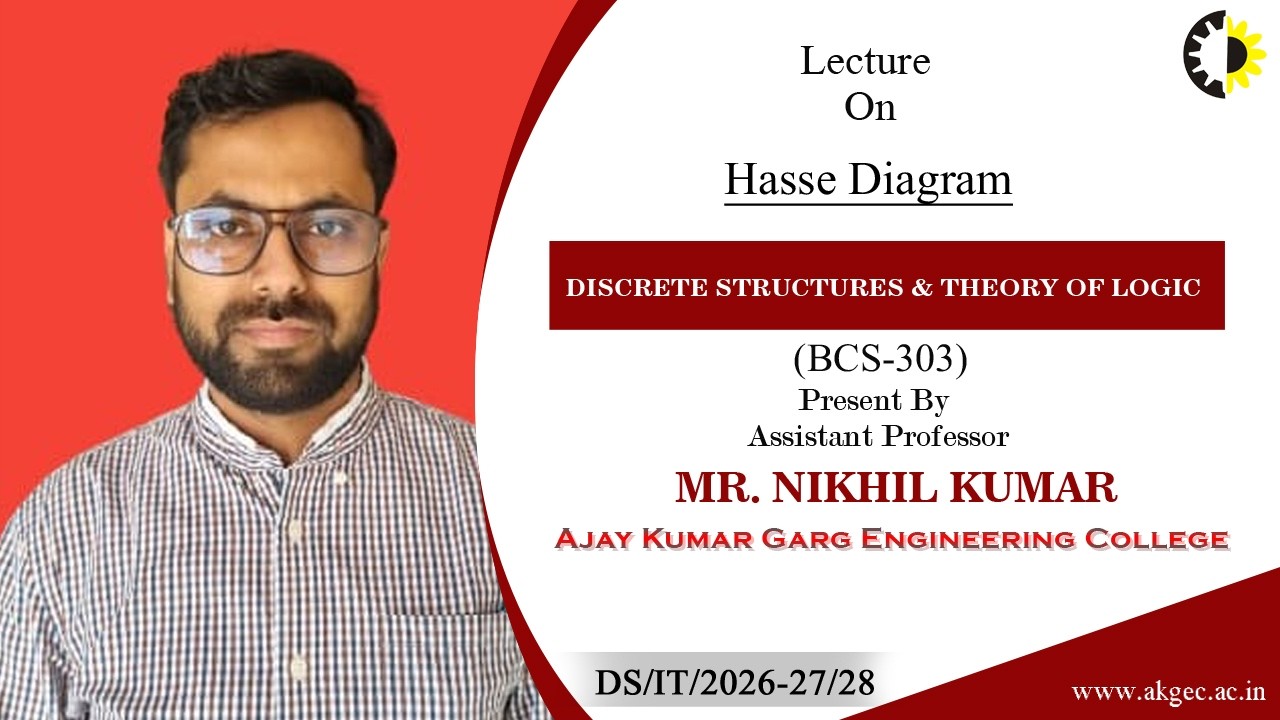
HASSE DIAGRAM | DISCRETE STRUCTURE AND THEORY OF LOGIC | LECTURE 02 BY MR. NIKHIL KUMAR | AKGEC
Keywords
Summary
153 words
Critical Evaluation
Value of the Information & Strength of the Argument
The value of the content lies in its clear pedagogical approach for beginners in discrete mathematics. It walks through the definition of lattices with multiple worked examples, using tables for join and meet operations, which aids understanding. The argumentation is consistent: it builds from definitions to examples and then to a non-example, reinforcing the criteria. However, the presentation is somewhat monotonous and contains verbal stumbles, and the reasoning occasionally becomes muddled (for instance, in explaining bounds for specific pairs). The examples are simple and do not explore edge cases or advanced properties, but they are sufficient for an introductory university lecture.
Scientific Rigor, Source Quality, Title Accuracy
The scientific rigor is moderate. The instructor follows standard definitions from discrete mathematics, but the delivery contains imprecise language (e.g., confusing ’least upper bound’ and ‘greatest lower bound’ in places). No external sources or citations are provided; the content is based on common textbook material. The title accurately indicates the subject and lecture number, but there is a mismatch between the credited author (Nikhil Kumar) and the actual speaker (Anupam Kumar Saini) in the video. The description provides a link to the university website but no additional references. No user comments were provided for trend analysis, so public reception cannot be assessed.
218 words
Title / Content Match
The title accurately reflects the content: a lecture on Hasse diagrams within discrete structures. However, the speaker identifies himself as Anupam Kumar Saini in the video, while the title credits Nikhil Kumar, showing a discrepancy.
Quality & Reliability
6/10
The lecture covers the topic accurately on a fundamental level, but contains occasional slips in terminology and clarity. The instructor demonstrates the concept with tables and examples, but the presentation lacks depth and rigorous formalism. No external sources are cited, relying solely on standard textbook knowledge.
Key Moments
Markers derived by PSI from the transcript: the creator did not define chapters.
- Introduces the topic: lattice from Hasse diagram, for BTech students.
- Defines Hasse diagram and its construction rules.
- Defines lattice: every pair has supremum and infimum (join and meet).
- First example: Hasse diagram with elements A,B,C,D; constructs join and meet tables to verify lattice.
- Second example with elements 1,2,3,4,5 under divisibility; demonstrates lattice.
- Counterexample: elements A,B,C,E,F where some joins/mets are missing, thus not a lattice.
- Discusses applications of posets and Hasse diagrams in scheduling, version control, database optimization, etc.
- Gives a practice exercise: set {1,2,3,4,5,6,12} with divisibility relation; asks to determine if it is a lattice.
Cited Sources
- AKGEC Official Website — Institution providing the lecture; link from video description.
Concurring Sources
- AKGEC Official Website — The institution hosting the lecture, confirming the academic origin.
Contribution & Novelties
The video serves as a straightforward tutorial for understanding lattices via Hasse diagrams, reinforcing standard definitions with worked examples and tables. Its novelty is limited to the pedagogical presentation, not new research or insights. For deeper exploration, one can consult classic texts on discrete mathematics and order theory.
Pour aller plus loin :
- Hasse diagram - Wikipedia — Detailed explanation of Hasse diagrams and their use.
- Lattice (order) - Wikipedia — Formal definition, properties, and examples of lattices.
- Partially ordered set - Wikipedia — Fundamentals of posets, including relations and bounds.
91 words
Radar Profile
The radar profile shows a balanced but moderate coverage across the dimensions. Quantity of information is slightly above average (7), while quality and reliability are at a similar moderate level (6), and technical depth is lower (5). This suggests a lecture that is informative for beginners but not highly rigorous or deep.