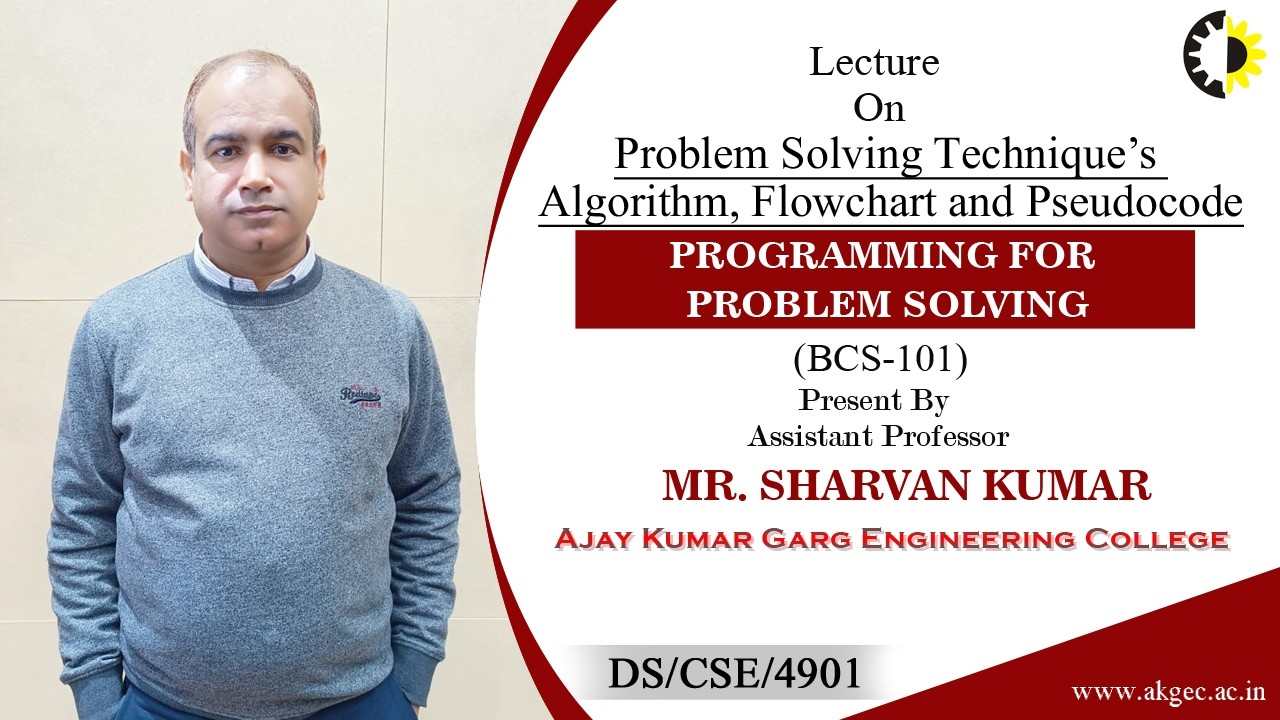
TECHNIQUE’S ALGORITHM, FLOWCHART AND PSEUDOCODE | PPS | LECTURE 06 BY MR. SHARVAN KUMAR | AKGEC
Keywords
Summary
152 words
Critical Evaluation
Value of the Information & Strength of the Argument
The video effectively explains core concepts with clear definitions and concrete examples, making the material accessible. The argumentation is straightforward, building from algorithm properties to flowchart symbols and pseudocode conventions. However, it does not critically evaluate different approaches or discuss edge cases in depth. The logical flow is coherent, and the examples reinforce understanding.
Scientific Rigor, Source Quality, Title Accuracy
The lecture relies on widely accepted definitions and standards (ANSI/ISO symbols) without offering external citations. The title matches the content well. The presentation is systematic, but the lack of references reduces the ability to verify specific claims. Since no comments are provided, public reception cannot be assessed.
116 words
Title / Content Match
The title accurately reflects the lecture's content, covering algorithm, flowchart, and pseudocode.
Quality & Reliability
7/10
The lecture provides clear, standard explanations of algorithms, flowcharts, and pseudocode, based on established computer science concepts. However, it lacks citations or references to specific sources, and the depth is introductory.
Key Moments
Markers derived by PSI from the transcript: the creator did not define chapters.
- Introduction to problem solving technique phases
- Definition of algorithm and its properties (finiteness, definiteness, etc.)
- Examples of algorithm for area of rectangle and voting eligibility
- Introduction to flowchart and standard symbols (ANSI/ISO)
- Advantages and limitations of flowcharts
- Introduction to pseudocode and its conventions
- Control structures (sequence, selection, loop) and conclusion
Cited Sources
- AKGEC Website — Institute's official website, indicating the source institution.
- Programming for Problem Solving Playlist — Playlist containing all units of the course, referenced in the video description.
Concurring Sources
- Algorithm on Wikipedia — General reference supporting the definition and properties of algorithms.
- Flowchart on Wikipedia — Provides symbols and usage that match the video's presentation.
- Pseudocode on Wikipedia — Discusses conventions and examples consistent with the video.
Contribution & Novelties
This video offers a clear, structured introduction to algorithm, flowchart, and pseudocode for beginners. It systematically lists properties of algorithms and flowchart symbols, and provides multiple worked examples. While not presenting new research, it serves as a useful educational resource for students learning programming fundamentals.
Pour aller plus loin:
- Algorithm — Foundational concept explained in detail.
- Flowchart — Symbol conventions and examples.
- Pseudocode — Conventions and usage in programming.
- Donald Knuth — Author of The Art of Computer Programming, which defines algorithm properties.
83 words
Radar Profile
The radar profile shows a balanced but modest assessment, with higher scores for information quantity and quality, moderate technical level, and overall reliability. This reflects a solid introductory tutorial with no outstanding weaknesses but also no deep innovation.