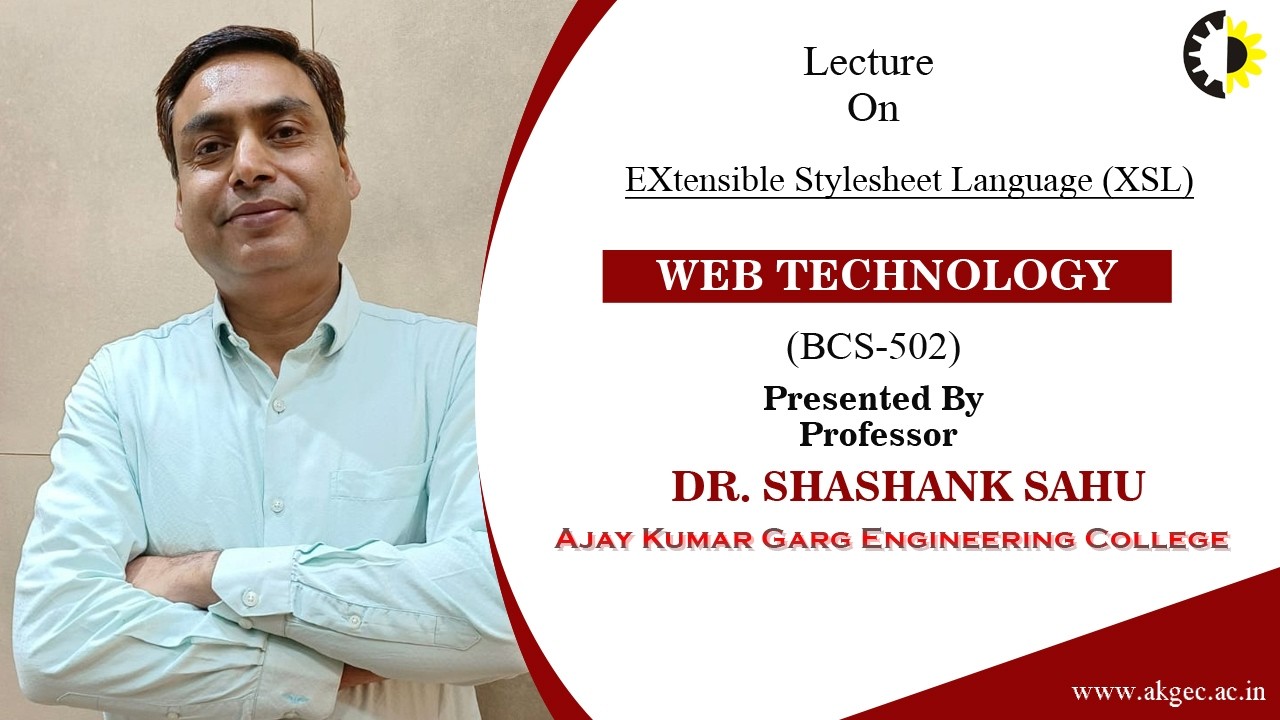
STREAM API | OBJECT ORIENTED PROGRAMMING WITH JAVA | LECTURE 01 BY DR. SHASHANK SAHU | AKGEC
Keywords
Summary
233 words
Critical Evaluation
Value of the Information & Strength of the Argument
The informational value lies in a compact and well-sequenced conceptual map of the Stream API rather than in novel content. Within a single session the speaker covers the definition of a stream, the non-storage and non-mutation property, the terminal/intermediate dichotomy, laziness, the stateless/stateful distinction, the object-reference restriction and the three primitive specialisations, then anchors all of it in two worked programs. The pedagogical value is reinforced by repeated emphasis on the points students most often get wrong: that a consumed stream cannot be reused, that a new stream must therefore be obtained from the source after a terminal operation, and that a stream must be created before any stream operation can be applied. The demonstration of chaining is effective because the same four-step pipeline (stream, filter, map, collect) is first decomposed line by line and then shown as one expression, making the equivalence between pipeline and sequential code explicit. The argumentation, however, is almost entirely declarative: assertions are stated and illustrated but rarely justified by reference to the language specification, and the boundaries of certain claims are left fuzzy. The treatment of stateless versus stateful operations is correct in substance but hedged (‘we cannot say all the filter operations are stateless’), without naming distinct() or limit() as the standard examples of stateful intermediate operations. The link to parallel processing is asserted rather than demonstrated, and no complexity or performance measurement is offered. The Optional discussion around min and max is accurate and useful, but the method-reference syntax is used without being explained, being deferred to a previous video. The overall argument holds together and would let a student write correct stream pipelines, yet it remains a descriptive walkthrough rather than a reasoned demonstration.
Scientific Rigor, Source Quality, Title Accuracy
No bibliographic or documentary source is cited at any point: the lecture rests on the speaker’s exposition and on two code listings displayed on slides, without reference to the Java Language Specification, the official java.util.stream package documentation, or the Java 8 release notes that introduced the API. The only link in the description is the institutional website of the college, which serves as a channel reference and not as a technical source. Consequently the accuracy of the content can only be assessed against the reader’s own knowledge of the Java platform, and the single mispronunciation of noneMatch as ’non match’ is not corrected anywhere in the material. There is no discussion of alternatives, limitations or version evolution, and no exercise or reference for further reading is provided. On the title/content relationship, the announced subject (Stream API within Object-Oriented Programming with Java, BCS-403) is delivered faithfully and without digression; the ‘LECTURE 01’ marker is the only element that sits slightly at odds with the speaker’s own statement that the topic belongs to Unit 3, which points to a session numbering rather than an introductory lecture. No advertising sequence is present in the material provided. No viewer comments were supplied, so no audience trend is assessed.
502 words
Title / Content Match
The title announces a first lecture on Object-Oriented Programming with Java delivered by Dr. Shashank Sahu for the BCS-403 course, and the content is a lecture on the Java Stream API within that course. The only friction is the 'LECTURE 01' label for a topic the speaker himself situates in Unit 3, which suggests a recording numbering rather than an introductory session.
Quality & Reliability
7/10
The technical content is accurate and consistent with the official behaviour of the Java 8 Stream API: streams do not store data, they do not mutate the source, terminal operations consume the stream, intermediate operations are lazy and return new streams, stateful versus stateless intermediate operations, and the restriction to object references with IntStream/LongStream/DoubleStream for primitives. Minor imprecisions appear (the terminal operation 'noneMatch' is read as 'non match', and the statement that 'the output of the operation will also be a stream' is loosely phrased). No external references or documentation are cited, and the explanation relies entirely on the lecturer's exposition and two code walkthroughs, which limits verifiability even though the substance is sound.
Key Moments
Markers derived by PSI from the transcript: the creator did not define chapters.
- Framing of the topic: Stream API as part of Unit 3 of BCS-403, introduced with Java 8 to allow chaining of functions through a functional approach.
- Core property stated: a stream is a representation of a sequence of elements, stores no data, and leaves the source collection or array unmodified (the sorting example).
- Terminal operations: they produce a result and consume the stream, which cannot then be reused; enumeration of forEach, toArray, reduce, collect, min, max, count, anyMatch, allMatch, noneMatch, findFirst, findAny.
- Intermediate operations: they return a new stream and enable pipelines; filter, map, flatMap, distinct, sorted, peek, limit, skip.
- Lazy behaviour: intermediate operations are only executed when a terminal operation is invoked at the end of the pipeline.
- Stateless versus stateful intermediate operations (filter versus sorted), and the consequences for parallel processing in terms of number of passes.
- Streams operate on object references only; primitives require IntStream, LongStream or DoubleStream.
- First worked example: filtering even numbers, squaring them with map, collecting to a list — the same four-step pipeline collapsed into a single chained line.
- Second example: creating a stream from a list, min and max with a method reference, Optional handling via isPresent and get, and the need to recreate a stream after a terminal operation.
- Sorting as an intermediate operation, forEach display, filtering odd values, and chaining two successive filters (odd and greater than five), followed by the program output.
Cited Sources
- AKGEC — Ajay Kumar Garg Engineering College (institutional website) — Only link given in the description, pointing to the college that produces the lecture series; it documents the institutional context of the course BCS-403 but contains no technical reference for the Stream API.
Concurring Sources
- Java 8 — java.util.stream package summary (Oracle) — Confirms the lecture's central claims: a stream stores no data, does not modify its source, intermediate operations are lazy and return new streams, terminal operations consume the stream, and intermediate operations are classified as stateless or stateful (with distinct and sorted as stateful examples).
- Java 8 — Stream interface (Oracle) — Corroborates the inventories of intermediate and terminal operations given in the lecture, and states that streams operate on object references while IntStream, LongStream and DoubleStream handle primitives.
- Java 8 — Optional class (Oracle) — Supports the explanation of why min and max return an Optional and how isPresent/get are used to handle an empty result.
Contribution & Novelties
The lecture offers no original contribution in the sense of new findings or unpublished work, and none is claimed. Its value is didactic: it assembles, in a single continuous exposition, the conceptual distinctions that structure the Stream API — storage versus processing, terminal versus intermediate, lazy evaluation, stateless versus stateful, object references versus primitive specialisations — and immediately anchors them in two complete programs, including a clear side-by-side of a decomposed pipeline and the same pipeline written as one chained expression. The most useful original element for a learner is the explicit demonstration that a terminal operation consumes the stream and forces the creation of a new one from the source, a point illustrated by the repeated myList.stream() calls in the min/max/sort sequence.
Pour aller plus loin :
- Java 8 — java.util.stream package summary (Oracle) — The normative description of streams, stream pipelines, laziness, and the stateful/stateless classification used throughout the lecture.
- Java 8 — Stream interface (Oracle) — Reference for the exact signatures and semantics of filter, map, flatMap, distinct, sorted, limit, skip and the terminal operations enumerated in the video.
- Java 8 — Optional class (Oracle) — Documents the isPresent/get pattern and its alternatives, complementing the min/max example.
- Lambda expressions — Java Tutorials (Oracle) — Background on the functional interfaces and lambda syntax used in every example.
- Method references (the :: operator) and functional interfaces such as Comparator — cited by name only; the speaker explicitly defers their explanation to an earlier video in the series.
- Java version history — the release of the Stream API with Java 8 in 2014, the dating claim made at the start of the lecture.
273 words
Radar Profile
The profile is unbalanced towards accessibility: a high volume of information and solid reliability, but a deliberately moderate technical depth typical of an undergraduate first exposure. Quantity and quality track closely together, while niveau_technique sits clearly lower, indicating an introductory treatment rather than an advanced one. The reliability score is capped by the complete absence of cited documentation, not by demonstrable error.