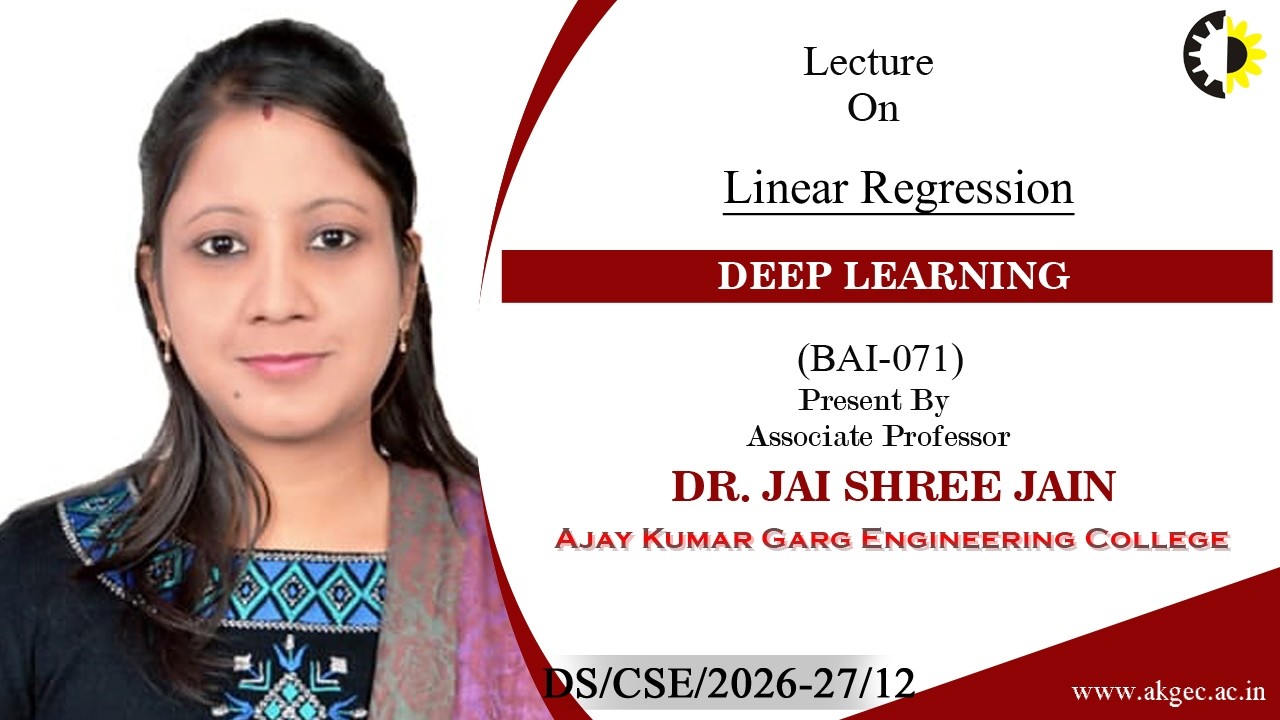
LINEAR REGRESSION | DEEP LEARNING | LECTURE 02 BY DR JAISHREE JAIN | AKGEC
Keywords
Summary
154 words
Critical Evaluation
Value of the Information & Strength of the Argument
The value lies in breaking down linear regression into digestible segments for an introductory audience. The instructor uses a concrete example (age vs. spending) to demonstrate the calculation of coefficients and the loss function, which aids comprehension. The argumentation is logically structured: from definition to equation, then to computation and evaluation. However, the explanation of the intercept formula is rushed and not fully derived, and the discussion of polynomial regression conflates it with multiple linear regression, weakening the mathematical precision. Overall, the content is useful for a first encounter, but it lacks depth and rigorous derivation.
Scientific Rigor, Source Quality, Title Accuracy
The video relies on common textbook knowledge without citing specific sources; the only external link is the college website. No research papers or authoritative references are provided, and the scientific rigor is therefore limited to the instructor’s interpretation. The title matches the content well, as it is indeed a lecture on linear regression under a deep learning course. However, the presentation contains a few inaccuracies (e.g., calling the polynomial equation ‘multiple linear regression’ when it’s polynomial regression) that slightly diminish its reliability. No comments were provided, so public reception cannot be assessed.
203 words
Title / Content Match
Title accurately reflects the content: a lecture on linear regression for deep learning, covering definitions, equations, and applications.
Quality & Reliability
6/10
The lecture presents standard linear regression concepts clearly but contains minor conceptual inaccuracies (e.g., conflating polynomial regression with multiple linear regression) and lacks any external scholarly citations.
Key Moments
Markers derived by PSI from the transcript: the creator did not define chapters.
- Introduction and definition of linear regression.
- Explanation of dependent/independent variables and supervised learning.
- Simple vs. multiple linear regression; polynomial equation.
- Loss function (mean squared error) and parameter tuning.
- Advantages and disadvantages: overfitting, noise, outliers, multicollinearity.
Cited Sources
- AKGEC Official Website — Mentioned in the video description and introduction as the institution's official site.
Contribution & Novelties
The video provides a straightforward tutorial-style overview of linear regression, suitable for beginners. It consolidates standard material without introducing new research or original perspectives. Its novelty lies in the lecture format with a worked example, integrating the least squares method and loss function. However, it does not extend beyond textbook content.
Pour aller plus loin :
- Linear regression — Foundational concept explained in depth.
- Mean squared error — Key loss function for regression.
- Overfitting — Important pitfall discussed in the video.
81 words
Radar Profile
The scores are moderate across the board, reflecting a basic tutorial that is useful but not advanced. The technical depth is limited, and reliability is average due to minor conceptual inaccuracies.