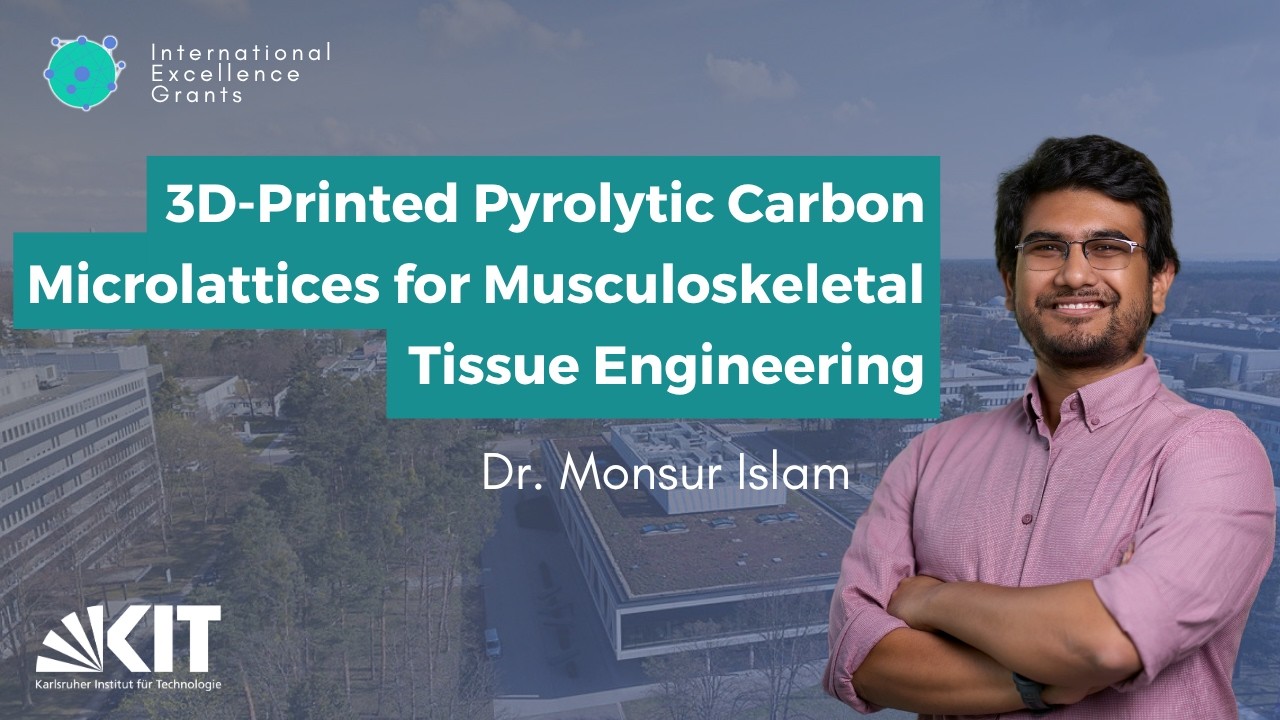
3D-Printed Pyrolytic Carbon Microlattices: A New Frontier in Tissue Engineering
Title history
- 3D-Printed Pyrolytic Carbon Microlattices: A New Frontier in Tissue Engineering — observed on 20261027-1738 UTC (YouTube)
Keywords
Summary
139 words
Critical Evaluation
Value of the Information & Strength of the Argument
The value of this research lies in the development of a versatile platform for tissue engineering with tunable mechanical properties and biocompatibility. The argumentation is strong, supported by systematic in vitro experiments, including gene expression analysis, and initial in vivo evidence. The speaker clearly explains the rationale behind each step, from material selection to fabrication, and critically assesses limitations such as the bio-inert nature of the carbon, leading to the exploration of MOF functionalization. The presentation is well-structured and provides a comprehensive view of the potential and challenges of pyrolytic carbon in biomedical applications.
Scientific Rigor, Source Quality, Title Accuracy
The scientific rigor is evidenced by the presenter’s background and the coherent presentation of data. However, the talk does not explicitly cite specific references, and the description only contains playlists rather than direct sources. The title is accurate and not exaggerated. The content appears to be based on peer-reviewed publications, as implied by the mention of collaborations and publications, but without explicit citations. Overall, the talk is rigorous in its methodology and presentation.
182 words
Title / Content Match
The title accurately reflects the content, focusing on 3D-printed pyrolytic carbon microlattices for tissue engineering.
Quality & Reliability
8/10
The video presents original research with clear experimental data, in vitro and in vivo results, and acknowledges limitations. The expertise of the presenter is well-established.
Key Moments
Markers derived by PSI from the transcript: the creator did not define chapters.
- Introduction of the speaker by Professor Jan Korvink.
- Explanation of pyrolytic carbon and its properties.
- Discussion of 3D printing process and shrinkage upon pyrolysis.
- Presentation of in vitro cell culture results and gene expression analysis.
- Use of MRI for imaging cell growth inside scaffolds.
- In vivo mouse model results and introduction to MOF functionalization.
Cited Sources
- International Excellence Talks playlist — Description link to playlist of related talks.
- Another playlist of International Excellence — Description link to a second playlist.
Contribution & Novelties
The talk introduces a novel method for fabricating pyrolytic carbon microlattices with tunable geometry and stiffness, directly applicable to musculoskeletal tissue engineering. A key novelty is the use of MRI to non-invasively monitor cell growth within opaque scaffolds, enabling longitudinal studies without destructive analysis. Additionally, the in situ growth of metal-organic frameworks on the scaffolds offers a promising route to functionalized, bioactive carbon structures.
Pour aller plus loin :
- Pyrolytic carbon — Background on the material and its biomedical applications.
- Tissue engineering — Overview of the field and scaffold design criteria.
- Metal-organic framework — Context for the functionalization strategy and potential bioactivity.
102 words
Radar Profile
The scores indicate a high level of technical detail and information density, with good information quality and moderate source reliability. The overall profile is typical of a specialized research talk, excelling in technical depth but less accessible to a general audience.