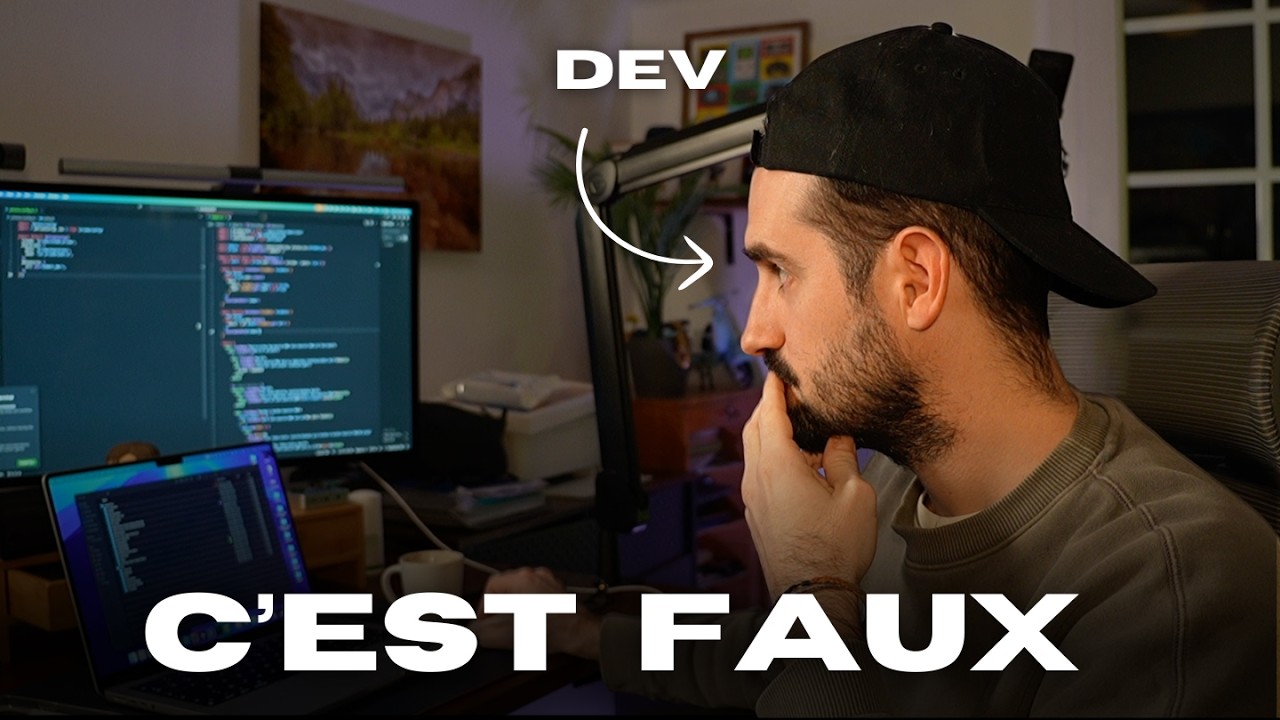
Ils veulent tous vous faire croire qu’on va travailler moins. C’est l’inverse.
They all want you to believe that we're going to work less. It's the opposite.
Title history
- Ils veulent tous vous faire croire qu’on va travailler moins. C’est l’inverse. — observed on 20261101-0144 UTC (YouTube)
Keywords
Summary
151 words
Critical Evaluation
Value of the Information & Strength of the Argument
The value lies in its honest, from-the-trenches perspective on how AI transforms the daily work of developers and knowledge workers. The argumentation is largely anecdotal, based on the narrator’s experience and observations, but it is structured and persuasive. He reinforces his points with the cited Harvard article, which is a recognized source. The reasoning is logical: if everyone becomes more efficient, the bar rises, and the same effort is expected in less time, leading to more work overall. He also highlights psychological effects, such as the loss of clear boundaries between work and rest. However, the lack of quantitative data and the over-reliance on one source weaken the scientific rigor. The argument is compelling within its scope, but not a comprehensive evidence-based analysis.
Scientific Rigor, Source Quality, Title Accuracy
The primary source cited is the Harvard Business Review article (2026) titled ‘AI Doesn’t Reduce Work—It Intensifies It.’ The narrator mentions sharing the link in the description, which is present. No other academic sources are referenced, and the video relies heavily on personal anecdotes. The title is catchy and accurately summarizes the core message, but it is somewhat sensationalist. The content engages with the article and personal experience, but the lack of empirical data, varied perspectives, or counterarguments limits its rigor. The title is justified by the content, but the evidence base is thin.
232 words
Title / Content Match
The title accurately reflects the content: the narrator argues that AI does not reduce work but intensifies it, challenging common narratives.
Quality & Reliability
6/10
The video is an opinionated personal account backed by a single Harvard Business Review article. It provides anecdotal evidence and lacks systematic data or peer-reviewed sources, but the argument is coherent and resonates with widespread experiences.
Key Moments
Markers derived by PSI from the transcript: the creator did not define chapters.
- Introduction: the narrator declares that AI does not lead to less work, contrary to claims on social media.
- Personal example: a task that used to take days now takes hours, but expectations rise accordingly.
- Explanation of how the entire team becomes faster, leading to a workflow where speed is the norm.
- Discussion of context switching and its intensification with AI; mental fatigue increases despite faster execution.
- Blurring of work and pause: prompting feels less like work, leading to fewer breaks and longer days.
- Comparison with past onboarding: mentions PlayStation experience and mentoring, now replaced by AI tools.
- Mention of the Harvard article: the narrator says they analyzed tech companies over 8 months and found mental load explodes.
- Personal claim: being 5 to 10 times more productive is expected, leading to increased pressure.
- Conclusion: the world has changed, and we must adapt; call to share experiences and engage.
- Closing remarks: thanks, reference to the pull meme, and sign-off.
Cited Sources
- AI Doesn't Reduce Work—It Intensifies It — The narrator explicitly references this Harvard Business Review article as evidence that AI intensifies work, mentioning it was shared at his workplace and recommending it to viewers.
Concurring Sources
- AI Doesn't Reduce Work—It Intensifies It — The video's main argument aligns with the claims of this article, which it cites as supporting evidence for the intensification of work due to AI.
External References
Contribution & Novelties
The video provides a first-hand account of how AI alters the daily reality of developers, emphasizing the psychological and organizational shift that is often overlooked in promotional content. It highlights that the promised reduction in work time is a myth in practice, and that the real effect is an acceleration and expansion of tasks. The original contribution is the perspective on context switching and the erosion of work-life boundaries.
Pour aller plus loin :
- Jevons paradox — An economic concept that increased efficiency can lead to increased demand for a resource, analogous to how AI-driven productivity may increase the total workload.
- Burnout — A state of chronic stress often cited in the video’s context; relevant for understanding the mental cost of intensified work.
- Harvard Business Review article — The primary source referenced, though it is from the future (2026) and may not be verifiable now; treat as indicative of the video’s claims.
152 words
Radar Profile
The radar profile shows a balanced but modest performance: moderate quantity and quality of information, low technical depth, and moderate reliability. The video is strong on personal experience but weak on objective evidence, resulting in an average profile.
💬 Très positif. Sur les 30 commentaires analysés, une écrasante majorité exprime un accord total avec le constat de l'auteur, partageant des expériences personnelles similaires de surcharge de travail et de burnout liés à l'IA.