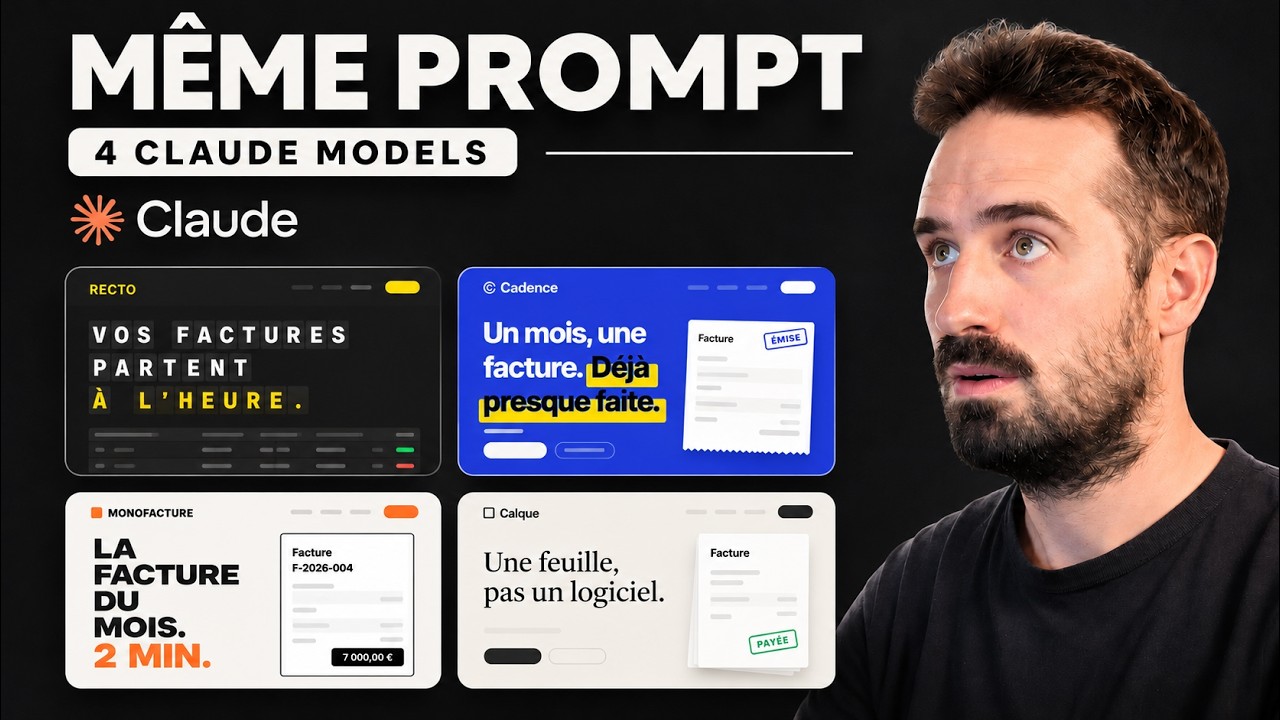
OPUS 5.5 vs Fable vs Haiku vs SONNET : qui fait la meilleure UI ?
OPUS 5.5 vs. Fable vs. Haiku vs. SONNET: Which One Makes the Best UI?
Title history
- OPUS 5.5 vs Fable vs Haiku vs SONNET : qui fait la meilleure UI ? — observed on 20261121-0039 UTC (YouTube)
Keywords
Summary
148 words
Critical Evaluation
Value of the Information & Strength of the Argument
The video’s value lies in its practical, side-by-side demonstration of current LLM capabilities for frontend UI generation, a task often assumed to require top-tier models. The argumentation is largely based on personal taste and observed behavior, with no statistical rigor or blind evaluation. The creator does test each app for functional issues using TestSprite, which adds some objective evidence—for example, Opus generated a working app with a few minor bugs (missing page refresh) that were fixed. However, the evaluation criteria are not predefined, and the sample size (one prompt) is insufficient for definitive conclusions. The reasoning is transparent and honest, acknowledging surprises (Haiku outperforming expectations) and disappointments (Sonnet and Fable), but it remains an expert opinion rather than a scientific study.
Scientific Rigor, Source Quality, Title Accuracy
The video uses only official Anthropic product references (Anthropic website, Claude Code) and mentions Vercel for deployment and TestSprite for testing, but no peer-reviewed sources or published benchmarks are cited. The title accurately reflects the content—a direct comparison of four models—which is a positive point. The description includes affiliate/sponsor links (TestSprite), and the video explicitly promotes TestSprite with a free-trial offer, which may introduce bias. There is no attempt to control variables such as model temperature or token sampling, and the evaluation is purely subjective. No comments were provided for analysis, so public reception cannot be assessed.
233 words
Title / Content Match
The title accurately describes the content: a direct comparison of OPUS 5.5, Fable, Haiku, and Sonnet on UI generation.
Quality & Reliability
6/10
The video provides a hands-on comparative test of four Anthropic models (Opus 5.5 Max, Sonnet, Fable, and Haiku) using the same prompt to generate an invoice application. The evaluation is largely subjective and anecdotal, lacking rigorous metrics or full reproducibility, but includes real user-interface demonstrations and functional testing via TestSprite. No external data or scientific methodology is cited, and the presence of a sponsor segment (TestSprite) is disclosed.
Chapters
Cited Sources
- Anthropic – Official website — Reference for the Claude model family used in the comparison.
- Claude Code – Anthropic — Mentioned as the tool used to fix the bug identified by TestSprite.
- Vercel — Platform used to deploy the invoice application for testing.
- DevArt Academy — Community resource linked in the description.
Concurring Sources
- Anthropic model comparison — Official site confirming the existence of different model tiers (Haiku, Sonnet, Fable, Opus) with varying capabilities.
External References
Contribution & Novelties
The video provides a concrete, hands-on comparison of four Claude models for a common frontend task, offering insights into their relative strengths and weaknesses. It emphasizes that smaller/cheaper models (Haiku) can produce surprisingly functional MVPs, and that Opus 5.5 in normal mode (not Max) is sufficient for high-quality UI. The use of TestSprite for automated testing adds an objective layer, revealing subtle bugs not visible in the initial design.
Pour aller plus loin :
- Anthropic Claude documentation — Official API reference and model specifications; useful for understanding differences between tiers.
- LLM evaluation benchmarks (e.g., HumanEval) — Research paper introducing a benchmark for code generation; background on objective model evaluation.
- UI/UX evaluation methodology — Nielsen Norman Group’s usability heuristics, relevant for assessing the generated interfaces beyond personal taste.
127 words
Radar Profile
The scores show high information quantity and technical level but moderate quality and low reliability, reflecting the video's hands-on yet subjective nature. The profile suggests a content that is informative and technically detailed but lacks scientific rigor.