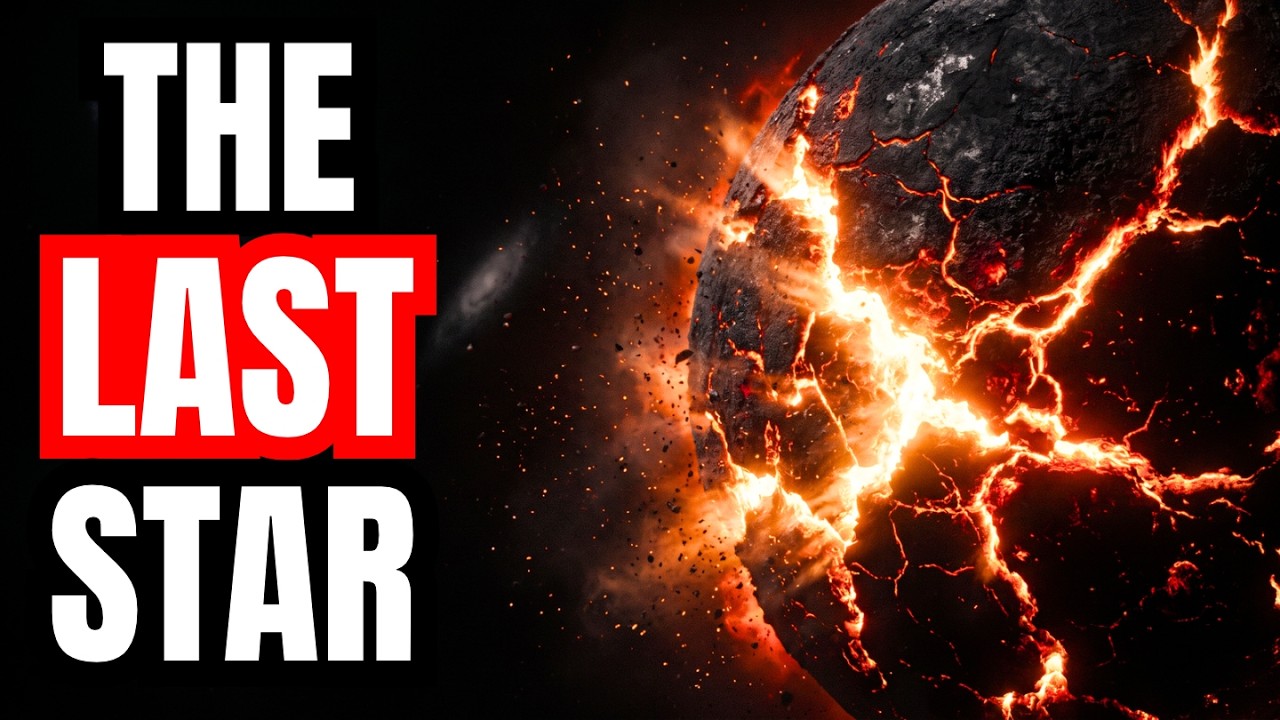
What the End of the Universe Will Actually Look Like — and When It Begins | Sleep Documentary
Title history
- What the End of the Universe Will Actually Look Like — and When It Begins | Sleep Documentary — observed on 20261107-0807 UTC (YouTube)
Keywords
Summary
165 words
Critical Evaluation
Value of the Information & Strength of the Argument
The video’s value lies in its clear, accurate, and comprehensive exposition of current cosmological understanding about the far future. It excels at presenting complex physical concepts in accessible terms without oversimplifying them, and it explicitly distinguishes between what is known with high confidence, what is probable, and what remains speculative. The argumentation is logically structured, building from the universal principle of entropy to derive the likely heat death, then systematically considering rival scenarios. It handles uncertainties honestly, such as the fate of Earth during the Sun’s red giant phase or the exact timing of proton decay, and it integrates recent observations (e.g., DESI) to show how science evolves. The presentation is methodical and internally consistent, making a compelling case for the most probable outcome while acknowledging that final certainty is impossible.
Scientific Rigor, Source Quality, Title Accuracy
The video demonstrates strong scientific rigor by grounding its claims in peer-reviewed literature and major collaborations. It explicitly references foundational papers such as Adams & Laughlin (1997) for the five eras, Hawking (1974) for black hole evaporation, Dyson (1979) for life in the far future, Caldwell et al. (2003) for the Big Rip, Schröder & Smith (2008) for the Sun’s future, Planck Collaboration (2018) for cosmological parameters, Degrassi et al. (2013) for vacuum metastability, and the recent DESI results (2024–2025) on dark energy. The presentation consistently maintains a clear separation between established physics, plausible extrapolations, and unconfirmed hypotheses. The title accurately reflects the content, which indeed describes what the end of the universe will look like and when it begins, as the video covers the timeline from the Sun’s death to the heat death and beyond.
282 words
Title / Content Match
The title accurately describes the video's content, which covers the predicted stages of the universe's end and the timeframe for its beginning.
Quality & Reliability
9/10
The video consistently distinguishes well-established physics from speculative hypotheses, accurately explaining complex concepts such as entropy, black hole evaporation, and vacuum decay, and it cites specific peer-reviewed papers and collaborations.
Chapters
- The Universe Is Already Dying
- How We Can Know the Future of the Cosmos
- The Cup of Tea That Predicts Everything (Entropy)
- The True Timeline: You Live at the Very Beginning
- The Death of the Sun
- The Last Day of Planet Earth
- The Age of Starlight Is Already Ending
- The Last Star in the Universe
- The Degenerate Era: White Dwarfs, Neutron Stars, Black Dwarfs
- Dark Energy Empties the Sky
- The Long Cold: Approaching Absolute Zero
- Does Matter Last Forever? Proton Decay
- The Black Hole Era
- The Last Black Hole Evaporates
- The Heat Death of the Universe
- When Time Itself Stops Meaning Anything
- The Rival Endings: Four Other Fates
- The Big Rip
- The Big Crunch
- The Big Bounce: A Universe Reborn?
- Vacuum Decay: The End That Could Start Tonight
- Why You Shouldn't Fear the Bubble
- Which Ending Is Actually Coming?
- The New Dark Energy Surprise (2024)
- Could Anything Survive Forever?
- Other Universes, Other Endings
- The Turn: None of It Has Happened Yet
- When the End Actually Begins: The Answer
- Born at the Beginning of Everything
- Sleep While the Stars Still Burn
Cited Sources
- Adams & Laughlin (1997), 'A Dying Universe' — Describes the five eras of cosmic future history, forming the framework for the documentary's timeline.
- Hawking (1974), 'Black hole explosions?' — Establishes black hole evaporation via Hawking radiation.
- Dyson (1979), 'Time Without End' — Discusses life and intelligence in the far future, relevant to the survival of life.
- Caldwell, Kamionkowski & Weinberg (2003), 'Phantom Energy and Cosmic Doomsday' — Proposes the Big Rip scenario for the end of the universe.
- Schröder & Smith (2008) — Detailed study of the distant future of the Sun and Earth.
- Planck Collaboration (2018) — Provides precise age and composition of the universe.
- Degrassi, Buttazzo et al. (2013) — Higgs vacuum metastability analysis.
- DESI Collaboration (2024–2025) — Evidence that dark energy may be evolving, potentially altering the predicted fate.
Concurring Sources
- Adams & Laughlin (1997) — The five-era framework aligns with the documentary's structure.
- Hawking (1974) — Black hole evaporation is a central theme in the later stages.
- DESI Collaboration (2024–2025) — Recent data on dark energy evolution is featured as a potential game-changer.
Contribution & Novelties
The documentary’s originality lies in its synthesis of multiple advanced cosmological theories into a cohesive, sleep-focused narrative that remains scientifically rigorous. It excels at explaining complex concepts such as entropy, Hawking radiation, and vacuum decay in a calm and accessible manner, while also integrating the latest 2024–2025 DESI findings about dark energy evolution. The pacing and structure are uniquely suited to its purpose, providing a thorough overview without sacrificing clarity.
Pour aller plus loin :
- Heat death of the universe — The most likely ultimate fate, directly tied to the second law of thermodynamics.
- Big Rip — The scenario where dark energy tears everything apart, one of the rival endings discussed.
- Vacuum decay — The possibility of a false vacuum collapse leading to an instantaneous bubble of destruction.
- Hawking radiation — The mechanism by which black holes eventually evaporate, crucial to the black hole era.
- Proton decay — A hypothetical process that, if occurring, would set a timescale for matter dissolution.
161 words
Radar Profile
The profile shows very high quantitative information (10) and high quality (9), with slightly lower technical depth (8) but robust reliability (9). This reflects a documentary that is thorough and accurate, yet intentionally accessible for a sleep audience.