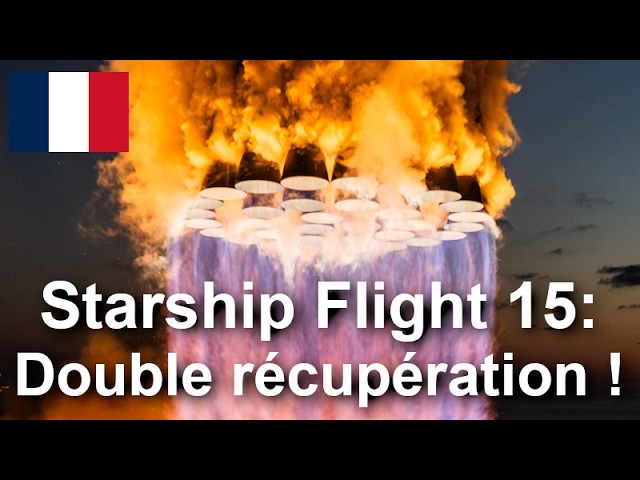
Starship Flight 15: Première récupération du V3
Starship Flight 15: First recovery of the V3
Title history
- Starship Flight 15: Première récupération du V3 — observed on 20261114-0358 UTC (YouTube)
Keywords
Summary
120 words
Critical Evaluation
Value of the Information & Strength of the Argument
The value lies in the detailed technical explanations from a propulsion engineer, covering aspects like the Raptor V3’s pneumatic systems, the choice of helium over nitrogen for pressurization, and the engineering constraints of Starship reuse. The argumentation is generally solid, relying on engineering principles and observed data, though some points are speculative and personal opinion. The host clearly distinguishes factual observations from his own hypotheses, contributing to the overall credibility.
Scientific Rigor, Source Quality, Title Accuracy
The video does not cite specific scientific studies but references the official SpaceX feed and the host’s own engineering expertise. The description includes links to a space careers site and a membership page, which are not direct sources. The title accurately reflects the content, focusing on the V3 recovery attempt. The host also mentions collaboration with another documentarian, indicating a community-based approach to sourcing historical material.
151 words
Title / Content Match
The title accurately describes the main event of the video: the first recovery attempt of the V3 booster, which is the core focus.
Quality & Reliability
7/10
The content is technical and provided by an engineer with propulsion expertise, but it includes subjective interpretations and live speculation. The reliability is moderate-high.
Key Moments
Markers derived by PSI from the transcript: the creator did not define chapters.
- Introduction and overview of the flight's objectives, including the first V3 booster and Starship recovery attempts.
- Explanation of the recovery procedure, including the use of the chopstick arms and the timeline for booster refueling.
- In-depth discussion about Raptor V3 engine reliability, including recent failures and the possibility of a Raptor V4.
- Comparison of helium and nitrogen as pressurization gases, with an explanation of cavitation and solubility issues.
- Launch moment and real-time commentary on the booster and Starship recovery attempts.
Cited Sources
- Metiers du Spatial — Mentioned as a useful resource for space-related careers and training.
- Techniques Spatiales channel membership — Support option for the channel, mentioned in the description.
Contribution & Novelties
The video provides real-time analysis of a major spaceflight event, with unique technical details about the Raptor V3’s performance and the recovery system. It also offers personal insights into documentation work and the use of AI in media production. The host’s engineering background adds depth to the coverage.
Pour aller plus loin :
- SpaceX Starship — Overview of the Starship development and its variants.
- Raptor engine — Technical details of the Raptor engine family.
- Mechazilla (catching tower) — Description of the tower and chopstick system used for recovery.
88 words
Radar Profile
The radar profile shows high scores in quantity and technical level, moderate in quality and reliability, indicating a content-rich video with substantial technical content but some subjectivity in claims.