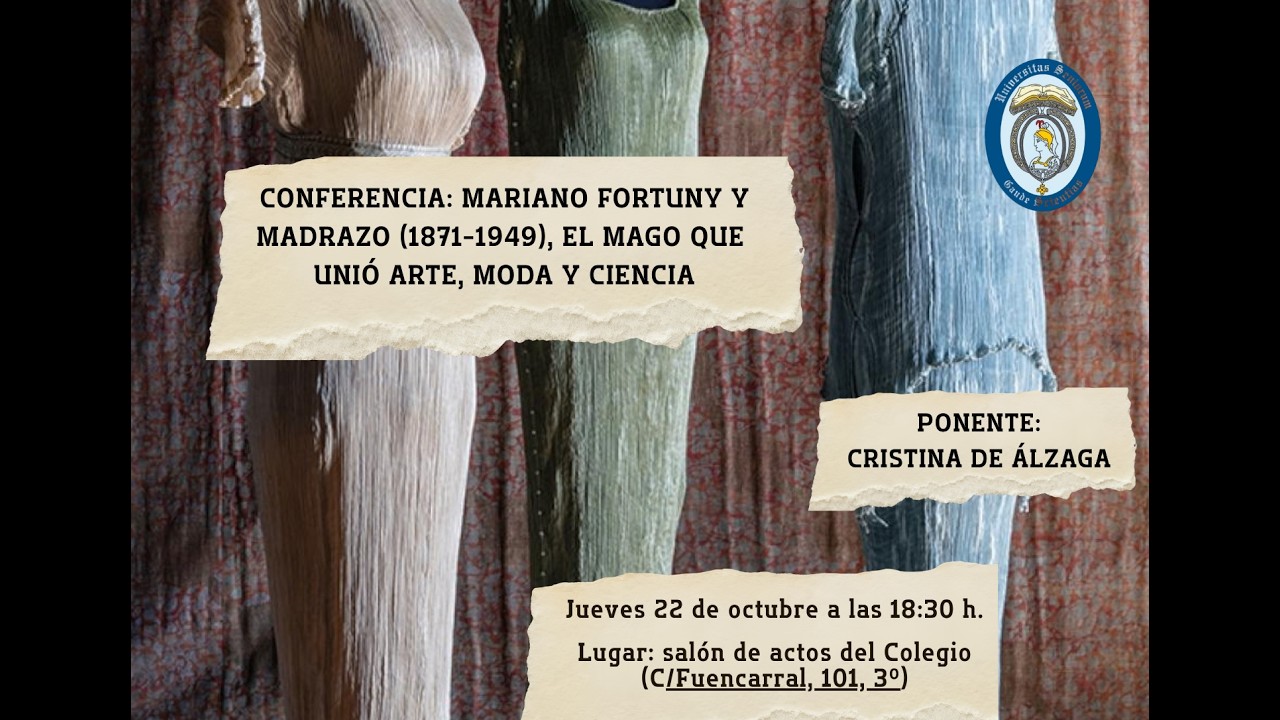
Conferencia: MARIANO FORTUNY y MADRAZO (1871-1949), el mago que unió Arte, Moda y Ciencia.
Lecture: MARIANO FORTUNY y MADRAZO (1871-1949), the magician who united Art, Fashion, and Science.
Title history
- Conferencia: MARIANO FORTUNY y MADRAZO (1871-1949), el mago que unió Arte, Moda y Ciencia. — observed on 20261026-1753 UTC (YouTube)
Keywords
Summary
173 words
Critical Evaluation
Value of the Information & Strength of the Argument
The presentation offers substantial value by situating Fortuny within the broader contexts of art, science, and fashion history. The speaker effectively argues that Fortuny’s genius lay in merging aesthetic vision with chemical expertise, as seen in his creation of new dyes and the patented lighting system. The argumentation is supported by multiple examples, including specific artworks, museum locations, and the involvement of his wife, which strengthens the narrative. However, the reliance on anecdotal evidence for certain claims, such as the inspiration behind the Delphos, and the lack of direct citations to primary sources slightly weaken the argumentative rigor. Overall, the reasoning is coherent and persuasive, demonstrating a deep familiarity with the subject.
Scientific Rigor, Source Quality, Title Accuracy
The speaker demonstrates substantial knowledge and effort to provide accurate historical details, referencing museums (Prado, Delphi Archaeological Museum) and artworks. Yet, no external sources or bibliographic references are explicitly cited, which limits verifiability. The title is well-aligned with the content, as the talk consistently addresses the intersection of art, fashion, and science in Fortuny’s career. The absence of formal citations and the occasional speculative remarks (e.g., about Henriette’s role) reduce the scientific rigor, though the overall reliability remains acceptable for a specialized lecture.
210 words
Title / Content Match
The title accurately describes the content, focusing on Fortuny's interdisciplinary work in art, fashion, and science.
Quality & Reliability
8/10
The lecture is given by an acknowledged specialist in fashion history, with detailed historical references and museum citations. However, no external sources are directly referenced, and some claims are based on anecdotal evidence.
Key Moments
Markers derived by PSI from the transcript: the creator did not define chapters.
- Introduction of Mariano Fortuny y Madrazo, his family background, and the confusion with his father.
- Early life, training in chemistry and art, and move to Venice.
- Presentation of the Fortuny dome lighting system for theaters and its patent with AEG.
- Creation of the Delphos dress, inspired by Greek chitons, and the role of Henriette Negrin.
- Exploration of their innovative textile dyeing and pleating techniques, including the secret methods.
- Legacy, museum collections, and the unreplicable nature of Fortuny's pleats and colors.
Contribution & Novelties
The lecture sheds light on the interdisciplinary nature of Fortuny’s work, emphasizing his scientific approach to art and fashion. It brings to attention the unsolved mystery of his pleating technique, which even NASA laboratories could not replicate, as well as the deliberate destruction of his formulas by his wife. This adds a layer of intrigue and underscores the uniqueness of his contributions. The narrative also highlights the collaborative role of Henriette Negrin, challenging the traditional view of the male genius.
Pour aller plus loin :
- Mariano Fortuny (designer) — Overview of his life and works.
- Delphos dress — Description of the iconic garment and its historical significance.
- Pleat — General information on pleating techniques.
- Chiton (garment) — The ancient Greek garment that inspired the Delphos.
125 words
Radar Profile
The radar profile shows high scores in information quantity and quality, indicating a content-rich presentation with substantial detail. The technical level is moderate, suggesting accessibility to a general audience while still offering specialized insights. Reliability is solid but not exceptional due to a lack of explicit citations, which slightly lowers the overall trust score.