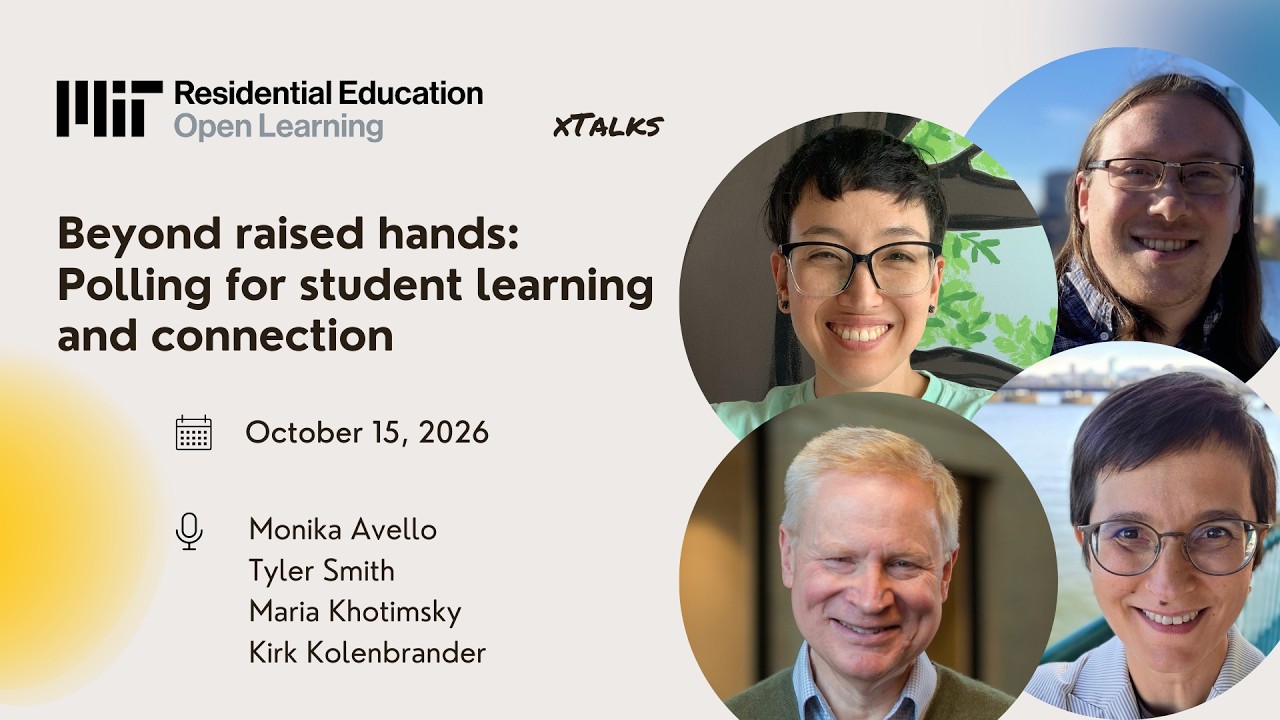
xTalk, October 15, 2026, Beyond raised hands: Polling for student learning and connection
Title history
- xTalk, October 15, 2026, Beyond raised hands: Polling for student learning and connection — observed on 20261029-1343 UTC (YouTube)
Keywords
Summary
146 words
Critical Evaluation
Value of the Information & Strength of the Argument
The value lies in the concrete, field-tested examples and the diversity of contexts (class sizes, subjects, tools). The presenters articulate clear pedagogical goals—provoking reflection, checking understanding, building community, and signaling care—and show how polling supports them. They argue convincingly that polling goes beyond participation tracking, creating ‘gotcha’ moments that correct misconceptions and spark debate. The demonstration clips from actual lectures and the live audience participation make the methods tangible. The argumentation is solid because it is built on evidence from their own practice, including data on grading policies and observed outcomes, though they acknowledge the need for further research.
Scientific Rigor, Source Quality, Title Accuracy
The scientific rigor is high: all presenters are MIT lecturers with deep subject expertise, and they ground their practices in learning science principles (e.g., formative assessment, active learning). The sources are limited to the two institutional links in the description, which are reliable and contextually relevant. The title accurately reflects the content, and the session is well-structured with clear chapters and a Q&A. The presentation style is professional, with explicit mention of tool limitations (e.g., Mentimeter’s cost for >50 participants). No evidence of bias or unsubstantiated claims.
201 words
Title / Content Match
The title 'Beyond raised hands' accurately reflects the central theme: moving from traditional hand-raising to interactive polling for deeper engagement and connection. The video delivers on this promise with a rich set of case studies.
Quality & Reliability
8/10
The content is presented by experienced MIT lecturers with concrete classroom examples, multiple polling platforms, and replicable strategies. The discussion is grounded in practical experience rather than speculation, and the presenters openly discuss their policies, data, and lessons learned.
Key Moments
Markers derived by PSI from the transcript: the creator did not define chapters.
- Introduction to xTalk and speakers by Jovi Nazareno.
- Moni Avello and Tyler Smith begin their biology polling presentation.
- Demo of a polling question about sickle cell trait to provoke reflection.
- Best practices for polling: intentional question design, think-pair-share, and time for processing.
- Maria Khotimsky begins her segment on polling in language and literature.
- Live Mentimeter word cloud demonstration on classroom community.
- Ranked choice demonstration and lessons learned.
- Kirk Kolenbrander begins on 'The Solid' Google Form.
- Discussion and Q&A with all presenters.
- End of video.
Cited Sources
- MIT Open Learning – Event page for this xTalk — Official description and resources for the event.
- MIT Open Learning – Residential Education — General resource for residential education initiatives.
Contribution & Novelties
This video offers a comprehensive, practice-oriented exploration of polling in higher education, unique in its cross-departmental perspective (biology, languages, materials science) and its blend of large-lecture and small-seminar contexts. It provides actionable strategies, including specific question types (word clouds, pin-on-image) and grading policies, along with candid lessons learned. The presentation of ‘The Solid’ as a low-stakes, personalized connection tool is a distinctive approach.
Pour aller plus loin :
- Active learning — Foundational concept for the pedagogy discussed.
- Student response system — Overview of polling systems like clickers and live polling.
- Peer instruction — A technique that benefits from polling, closely tied to the discussion-sharing examples in the video.
108 words
Radar Profile
The profile is balanced, with high scores on information quantity and quality, reflecting the dense, practical content. Technical level is moderate, as it focuses on pedagogical use rather than deep technology, and reliability is high given the MIT affiliation. This suggests a very useful resource for educators seeking proven polling strategies.