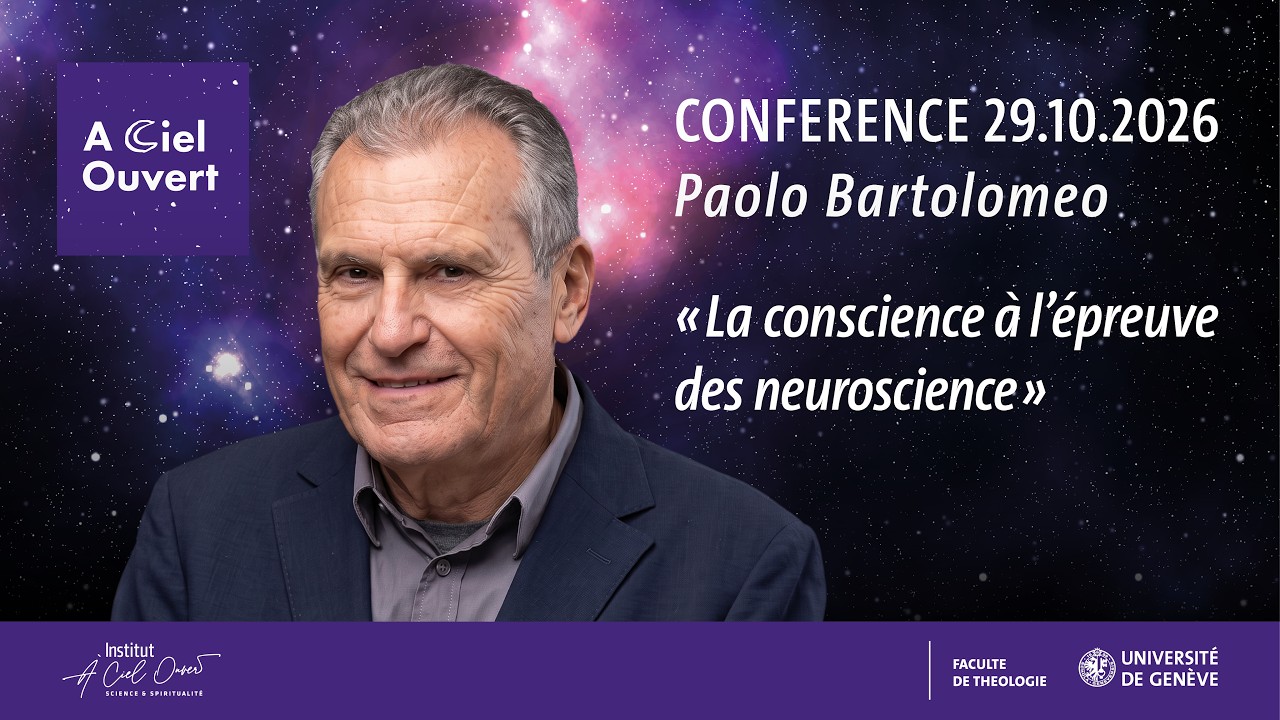
Conférence "La conscience à l'épreuve des neurosciences" - Paolo Bartolomeo
Conference "Conscience Put to the Test by Neuroscience" - Paolo Bartolomeo
Title history
- Conférence "La conscience à l'épreuve des neurosciences" - Paolo Bartolomeo — observed on 20261110-1037 UTC (YouTube)
Keywords
Summary
169 words
Critical Evaluation
Value of the Information & Strength of the Argument
The talk provides valuable insights into the clinical aspects of consciousness, illustrating that conscious experience is closely linked to attention and brain networks. The argumentation is solid, relying on well-known cases and empirical studies. However, some claims are speculative, and the speaker does not always provide direct citations, though he is an authority in the field. The demonstration of the role of the right hemisphere and white matter connectivity is particularly compelling.
Scientific Rigor, Source Quality, Title Accuracy
The talk references key scientific publications (e.g., in Nature Reviews Neuroscience and Nature) and clinical data, but no direct URLs or detailed references are given. The title matches the content well. There is no unnecessary sensationalism, and the presenter acknowledges the limits of current theories. Overall, the scientific rigor is adequate for a public lecture.
142 words
Title / Content Match
The title accurately reflects the content: the conference addresses the limits of neuroscience in explaining subjective experience, using clinical cases and theoretical discussion.
Quality & Reliability
8/10
The speaker is a renowned neuroscientist with relevant clinical experience. He presents a wide range of research, but some interpretations are personal and lack explicit citation. Overall, the information is reliable and well-informed.
Key Moments
Markers derived by PSI from the transcript: the creator did not define chapters.
- Speaker starts, outlines the challenge of consciousness for neuroscience.
- Overview of three main theories: Global Workspace, Integrated Information, and Local Recurrence.
- Introduction of spatial neglect syndrome and illustration with Federico Fellini's drawings.
- Discussion of attention and consciousness using visual illusions and line bisection tasks.
- Highlight of white matter connectivity and intracranial recordings in epilepsy patients; concluding remarks on the limits of current theories.
Contribution & Novelties
The lecture integrates clinical cases and neuroimaging to challenge existing theories of consciousness, emphasizing the importance of attention and hemispheric lateralization. It offers a nuanced view of consciousness as a graded phenomenon, moving beyond binary seen/unseen paradigms.
Pour aller plus loin :
- Global Workspace Theory — Relevant to the first theory discussed.
- Integrated Information Theory — The second theory, focuses on phi.
- Hemispatial neglect — Core condition presented in the lecture.
71 words
Radar Profile
The radar profile indicates a balanced presentation with strong factual content but moderate technical depth, suitable for a general audience with some scientific background.