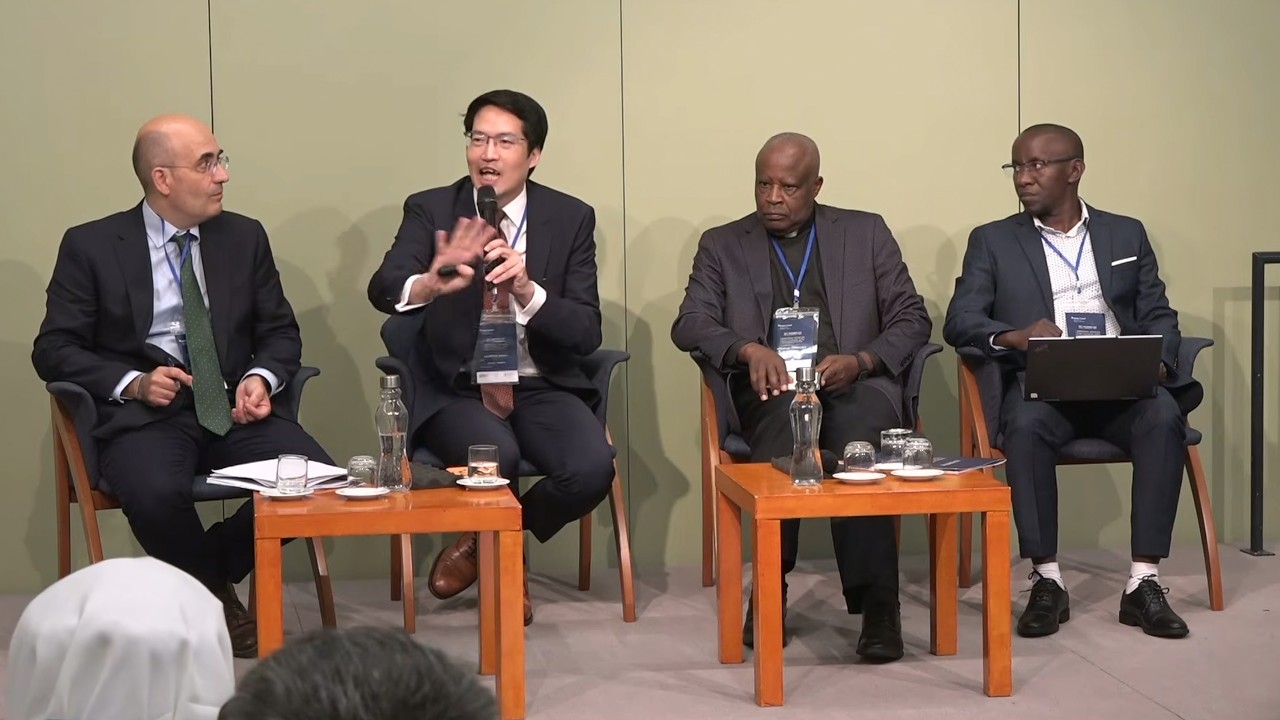
Day 1, Workshop 1 — Faith-Based Development in Practice: Operationalizing Alternative Visions
Title history
- Day 1, Workshop 1 — Faith-Based Development in Practice: Operationalizing Alternative Visions — observed on 20261120-1939 UTC (YouTube)
Keywords
Summary
259 words
Critical Evaluation
Value of the Information & Strength of the Argument
The value of the information lies in its authentic, first-hand accounts of two faith-based initiatives operating in different cultural and economic contexts. Lawrence Chong’s argument that faith can be a collaborative force in economics is compelling, especially his critique of how capital markets overlook faith-based social enterprises and his proposal for a multi-faith economy index. His personal narrative provides a concrete basis for his claims about interreligious partnerships. Vino Aram’s presentation offers a grounded example of how Hindu principles like Sarvodaya and dharma translate into large-scale child welfare work, strengthening the argument that faith-based development can be both effective and scalable. Both speakers effectively argue for integrating faith into practical action, though they lean on testimonial and anecdotal evidence rather than rigorous quantitative data. The argumentation is sincere and logically coherent but would benefit from independent evaluation or success metrics.
Scientific Rigor, Source Quality, Title Accuracy
The scientific rigor is modest; the presentation is based on personal experiences and references to established but non-peer-reviewed movements and statements. The speakers do not cite peer-reviewed literature or systematic data, relying instead on institutional references (Focolare, Religions for Peace, Vatican pronouncements) and their own organizational impact. The description provides no external links, so no additional sources are verifiable from the video. The title accurately represents the content: it is indeed a workshop on faith-based development in practice, with two practitioners operationalizing alternative visions. No comments were provided, so public reception cannot be assessed.
249 words
Title / Content Match
The title accurately reflects the workshop's focus: practitioners describing how their faith-based projects operationalize alternative visions of development. The content directly addresses the stated theme.
Quality & Reliability
6/10
The content relies on first-hand practitioner accounts and references to established movements (Focolare, Religions for Peace, Shanti Ashram) and Pope Francis's statements. While not peer-reviewed, the speakers are directly involved in the initiatives described, lending credibility. The lack of independent data and the promotional tone of some claims moderate the score.
Key Moments
Markers derived by PSI from the transcript: the creator did not define chapters.
- Moderator Fabio introduces the workshop and its focus on faith-based development.
- Lawrence Chong recounts his Singapore upbringing, the church persecution, and his transformative encounter with the Focolare movement.
- Chong discusses Pope Francis's 2017 speech on economy of communion and his own shift to faith-based investment.
- Chong outlines plans for a multi-faith economy index, G20 involvement, and a Vatican closed-door event for faith-based investors.
- Vino Aram presents Gandhi's Sarvodaya and Hindu concepts of interconnectedness and dharma as foundations for Shanti Ashram.
- Aram describes Shanti Ashram's growth from 50 children to 100,000, integrating science and spirituality in child development.
- Aram concludes with reflections on the great wealth transfer and Gandhi's message that peace begins with children.
Cited Sources
- Focolare Movement — Mentioned by Lawrence Chong as the Catholic movement that inspired his vision of faith in social action and economy of communion.
- Economy of Communion — Mentioned as a movement that encourages business practices based on communion and social impact; cited in relation to Pope Francis's 2017 speech.
- Religions for Peace — Mentioned as an international interfaith organization that connected the speakers to practical social engagement, including the Convention on the Rights of the Child.
- Convention on the Rights of the Child — Mentioned by Vino Aram as a global framework for children's rights in which faith communities were involved.
- Lancet Commission — Mentioned by Vino Aram in the context of a study on trust and faith in child health, though the specific report is not named.
Contribution & Novelties
This workshop contributes original narratives of how faith-based development can be operationalized through interreligious collaboration and innovative economic models. Lawrence Chong’s proposal for a multi-faith economy index addresses a concrete gap in assessing faith-based social enterprises, while Vino Aram’s long-term case of Shanti Ashram demonstrates the integration of spiritual values with evidence-based child welfare practice. The dialogue highlights practical measurability and scaling challenges, offering a useful starting point for practitioners seeking to bridge faith and development.
Pour aller plus loin :
- Focolare Movement — Note: Provides background on the Catholic movement that shaped both speakers’ approach to interreligious action.
- Economy of Communion — Note: Central to Lawrence Chong’s argument for reshaping economies based on communion and social justice.
- Sarvodaya — Note: Gandhi’s concept of universal welfare, foundational to Shanti Ashram’s vision.
- Religions for Peace — Note: The interfaith network that facilitated the speakers’ engagement with global initiatives.
- Convention on the Rights of the Child — Note: Key global framework referenced by Vino Aram as a milestone for faith communities.
169 words
Radar Profile
The radar profile shows high quantitative and qualitative information scores relative to the technical level, reflecting a content-rich yet accessible discussion. The fiabilit_globale is moderate, indicating a balanced credibility with limitations in independent verification. This suggests the video is a valuable expert narrative but not a high-stakes technical analysis.