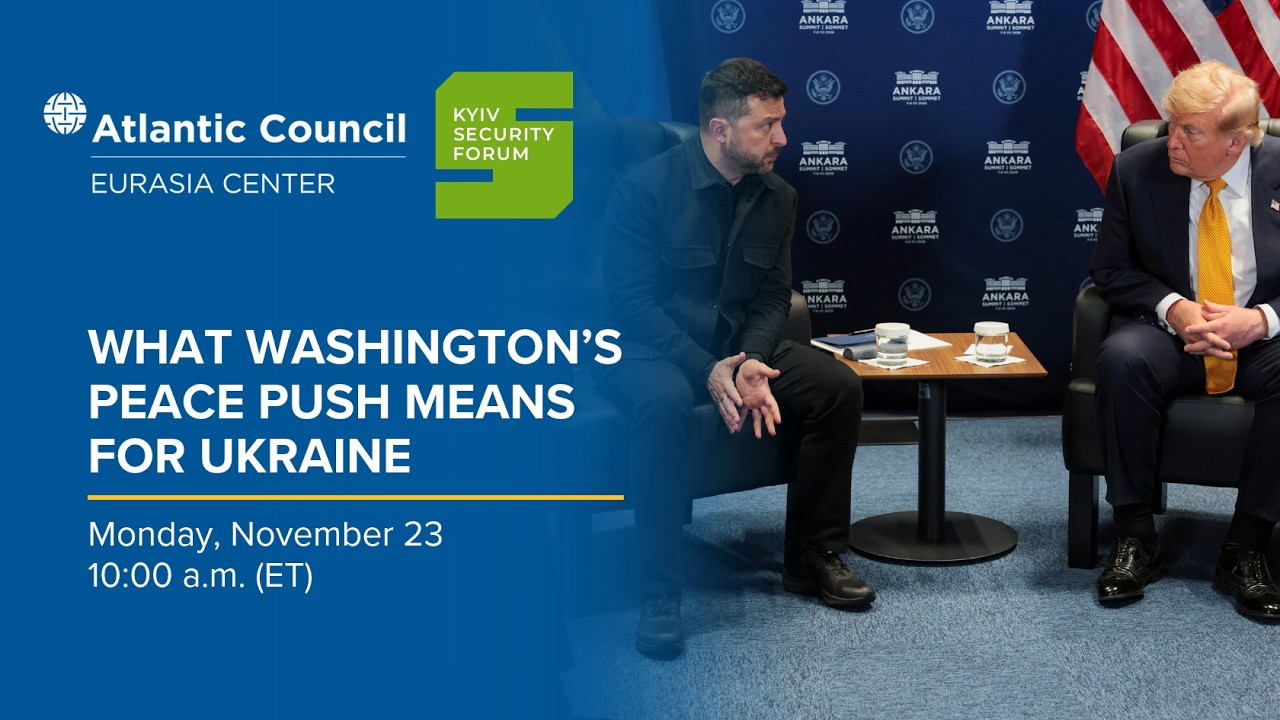
What Washington’s peace push means for Ukraine
Keywords
Summary
285 words
Critical Evaluation
Value of the Information & Strength of the Argument
The value of the information is high for understanding the policy debate as seen by Ukraine-focused Western experts. Yatsenyuk brings first-hand political experience and a clear articulation of Kyiv’s concerns, while Cooper and Lute supply operational and diplomatic detail on battlefield dynamics, air defense, satellite communications and US leverage. The panel is especially useful on the logic of pressure versus concessions, the practical meaning of security guarantees, and the ways Ukraine has sought to reduce dependence on Western capabilities. The argumentation, however, is largely rhetorical and advocacy-driven rather than demonstrative. Key claims about Russian intentions, casualty figures, territorial gains and the effects of sanctions are asserted without citation or uncertainty ranges. The panel repeatedly uses historical analogies, especially the 1938 Sudetenland comparison, to frame the stakes, which strengthens persuasion but does not substitute for evidence. Counterarguments are mostly addressed in polemical terms, and the discussion does not seriously test alternative explanations for Russian behavior or for US policy constraints. The result is a coherent and informed policy argument, but not a balanced or formally evidenced analysis.
Scientific Rigor, Source Quality, Title Accuracy
Scientific rigor is limited by the format: this is a think-tank panel, not a peer-reviewed study or structured evidence review. The speakers reference institutions, named companies, weapons systems and historical episodes, but no bibliography, data appendix or source trail is provided in the transcript. Casualty and territorial claims are presented as authoritative without attribution, and the legal argument about Russian constitutional claims is simplified for rhetorical effect. Source quality is mixed: the panelists have relevant professional backgrounds and institutional affiliations, but their statements are largely expert opinion and policy advocacy. The title is adequate for the content: the video does discuss Washington’s diplomatic push, Ukraine’s position and the risks of a territorial deal. It is somewhat broader and more conclusive in tone than the actual discussion, which remains a panel exchange rather than a definitive assessment. No comment trends are analyzed because no comment sample is provided.
338 words
Title / Content Match
The title accurately signals a discussion of US diplomacy and Ukraine, though it is broader than the panel’s opinion-heavy format. It does not overpromise a definitive answer, but it suggests more analytical closure than the open-ended discussion delivers.
Quality & Reliability
6/10
The discussion draws on a former Ukrainian prime minister and former US officials with direct policy experience, giving it substantial informed value. However, it is an advocacy-oriented panel without formal citations, and several factual claims about casualties, territorial gains, sanctions effects and battlefield developments are asserted rather than documented in the talk. The absence of a Russian or skeptical counter-perspective further limits balance, even though the panel includes some internal variation in emphasis.
Chapters
- Introduction and welcome
- Yatsenyuk on peace talks
- Risks of territorial deals
- Battlefield dynamics
- Humanitarian impact of war
- Technology and leverage
- US policy and leadership
- Political pathways to peace
- European security architecture
- Fixing air defense gaps
- Congress and oversight
- Strategic requirements for victory
- Audience Q&A and conclusion
Cited Sources
- Atlantic Council — Host institution and channel for the panel discussion.
- Center for European Policy Analysis (CEPA) — Affiliation of panelist Laura Cooper.
- Razom for Ukraine — Moderator’s cited daytime organization and source of field reports from Kyiv.
- Rosneft — Named among Russian hydrocarbon firms sanctioned by the US in October.
- Lukoil — Named among Russian hydrocarbon firms sanctioned by the US in October.
- Kyiv Security Forum — Yatsenyuk’s think-tank affiliation, mentioned in the introduction.
- People’s Front (Narodni Front) — Yatsenyuk’s party affiliation, mentioned in the introduction.
Concurring Sources
- NATO — Collective defence and Article 5 — Background on the Article 5-like guarantees discussed by the panel.
- Crimean Bridge — Contextual reference for the Kerch Strait Bridge’s military logistics role.
- Starlink — Contextual reference for satellite communications leverage and battlefield connectivity.
- MIM-104 Patriot — Contextual reference for the Patriot interceptor shortage discussed by Cooper.
Contribution & Novelties
The video’s original contribution is a compact, current-facing synthesis of the Ukraine policy debate from a distinctly Kyiv-centered and Atlanticist perspective. It combines a former Ukrainian prime minister’s political reading of Russian negotiating tactics with operational commentary from former US officials on air defense, satellite communications, sanctions and congressional oversight. Its most distinctive elements are the argument that territorial concessions would not satisfy Russian constitutional and political claims, the focus on Patriot interceptor shortages and winter infrastructure strikes, and the discussion of Starlink and Starshield as both military enablers and potential leverage points. It is less a source of new evidence than a window into how informed Western policy practitioners frame the choices facing Washington and Kyiv.
Further reading:
- Atlantic Council Eurasia Center — Institutional context for the panel and related Ukraine analysis.
- Center for European Policy Analysis — Affiliation of panelist Laura Cooper and a source of related defense-policy commentary.
- NATO Article 5 — Background for the discussion of Article 5-like security guarantees.
- Crimean Bridge — Context for the Kerch Strait Bridge’s logistical and symbolic role.
- Starlink — Context for the Starlink and Starshield leverage discussion.
187 words
Radar Profile
The profile is high on information quantity and moderate-to-high on quality and technical detail, reflecting a dense expert panel with operational and diplomatic content. Reliability is tempered by the advocacy format and lack of cited data, while the topic’s technical level is substantial but accessible to informed non-specialists.