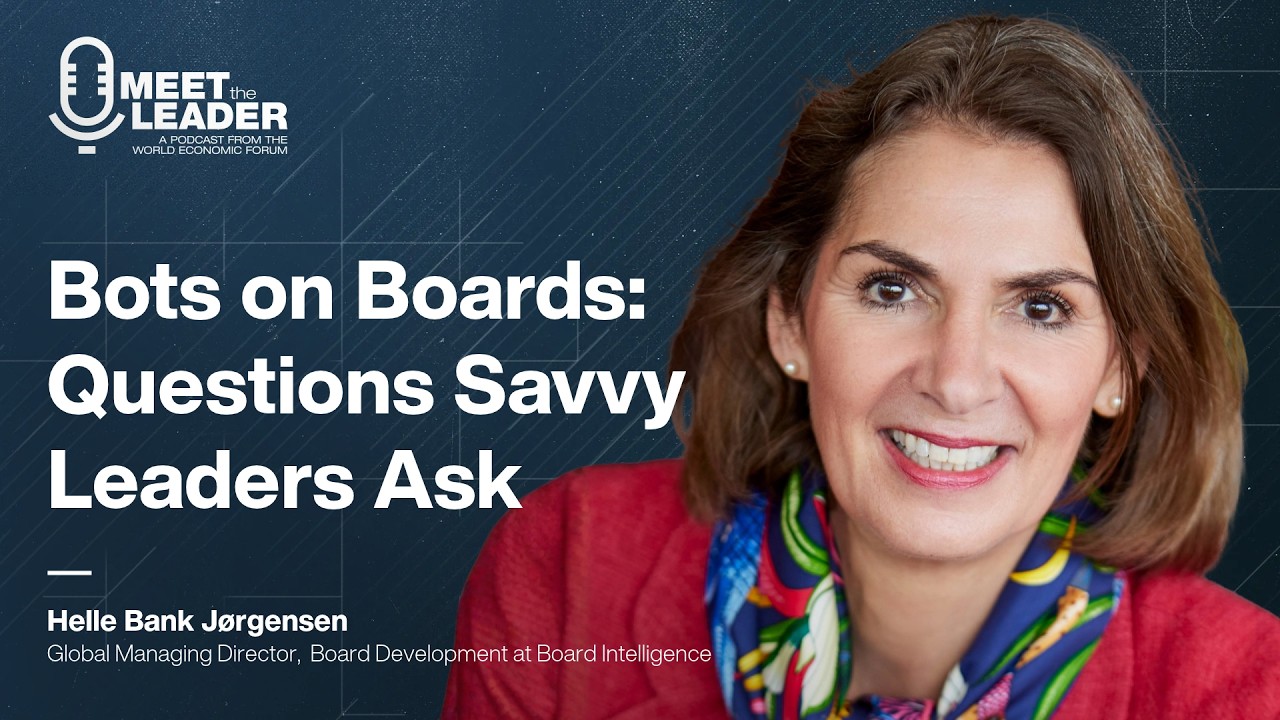
Bots in the boardroom: How AI is changing how boards make decisions
Keywords
Summary
257 words
Critical Evaluation
Value of the Information & Strength of the Argument
The informational value lies in translating an abstract debate (‘should a bot sit on a board?’) into operational questions that directors actually face: what happens to legal privilege when board material is pasted into a public model, how a chair detects that a colleague’s questions came from a chatbot rather than from reading the pack, and how minutes should record which parts of a decision were AI-assisted. The strongest contributions are concrete and testable: the description of a governance-grade agent restricted to the board pack rather than a public LLM, the insistence on an audit trail so a director can verify that a claimed inconsistency was not invented, and the point that board packs have grown to roughly 226 pages (a stated 30% rise since 2019) against about four hours of reading time. Vogel’s account of the healthcare algorithm that optimised for cost when the intended goal was better care is a well-chosen illustration of the gap between instructions and intent, and it grounds the abstract warning that a model ‘has knowledge, not context’. The reasoning is consistently hedged in the right places, notably on liability, where the speakers explicitly acknowledge that the answer is ‘TBD’ and will be settled by courts applying existing tort, contract and consumer-protection law rather than by new AI-specific statutes. The argumentation is weaker where it becomes hortatory: calls for curiosity, courage and ‘protecting independent thinking’ are sound but not operationalised, and the recommendation that directors form their own view before consulting AI is asserted rather than evidenced. Quantitative claims are delivered without attribution on screen or in the description, and the single most-cited commercial example is presented by the vendor who built the product, which the hosts do not problematise. The conversation also treats ‘debiasing’ as a benefit of AI without resolving the obvious tension that a model trained on past decisions may reproduce the very biases it is supposed to surface; Bank Jørgensen touches this when she warns that an agent can echo a director’s own biases back at them, but the thread is not developed. Net effect: a well-organised, practically useful framing of a genuinely under-discussed governance question, valuable as a map of the issues rather than as evidence for any particular conclusion.
Scientific Rigor, Source Quality, Title Accuracy
Rigour is moderate. The guests are credible and their institutional affiliations are stated up front, and the episode is careful to distinguish what AI can do in principle from what it currently does in practice, noting for instance that these tools are used for research and observation and are not voting members. The historical precedents are specific enough to be checked (Hong Kong venture firm, Kazakhstan’s National Wealth Fund, the 2023 ‘Elsa Frozen Brain’ appointment) and the Kazakhstan parliamentary response is a useful corrective to hype. Legal assertions are framed as precedent-dependent rather than settled, and the speakers openly flag uncertainty about who bears liability for AI-assisted decisions. The gaps are sourcing and disclosure rather than reasoning: the statistics on board pack length, AI adoption and formal policy coverage are quoted without naming their origin, no study, court case or regulator is cited by name during the discussion, and there is no mention of the fact that one guest leads a firm selling precisely the tool being praised, nor of the Lloyds deployment being her own product. The reference to an NYU Law Review article co-authored with Michael Chertoff is the one clear pointer to external legal analysis, and it is not developed. On title-to-content fit, the episode delivers what the title promises, with only light drift into adjacent territory such as director evaluation and the future composition of boards.
616 words
Title / Content Match
The title is accurate: the discussion is squarely about AI agents assisting corporate boards and the governance, liability and decision-quality consequences that follow. Only marginal content (e.g. board evaluation and director development) drifts slightly beyond the stated scope.
Quality & Reliability
6/10
Two recognised practitioners (Miriam Vogel of EqualAI, Helle Bank Jørgensen of Board Intelligence) bring genuine domain authority and concrete experience (the Lloyds Banking Group deployment). However, the episode is a conversational interview rather than a documented study: figures such as 226-page board packs, 82% of directors using AI and 6% having a formal policy are cited without visible sourcing, and one speaker (Bank Jørgensen) has a commercial interest in the technology she advocates. Legal claims (loss of privilege when material enters an LLM, liability unresolved until courts rule) are directionally correct and appropriately hedged but are not tied to case citations during the episode.
Chapters
- Bots on Corporate Boards: Miriam Vogel and Helle Bank Jorgensen on Meet the Leader
- Miriam Vogel on AI in the Boardroom: Asking Deeper Questions
- Helle Bank Jorgensen: Leading AI Without Becoming Its Servant
- History of AI Board Members: From Hong Kong VCs to Elsa Frozen Brain
- What Can an AI Bot on a Board Actually Do and Not Do?
- AI Hallucinations, LLM Pleaser Bias, and Board Accountability
- How Lloyds Banking Group Uses Board Intelligence's AI Agent
- Managing 226-Page Board Packs and Debiasing Director Decisions
- The Worst-Case Scenario: Abdicating Fiduciary Responsibility
- How Algorithmic Bias Harms Decision-Making Without Human Judgment
- AI Liability and Legal Risk: Why Boards Can't Sue a Bot
- How AI Changes the Board Chair's Role and Meeting Agendas
- Future Board Governance: Director Evaluation and Duty of Care
- AI Transcription in Board Meetings: Protecting the Legal Record
- Five Guardrails for Strong Enterprise AI Governance
- The Most Important AI Questions Every Board Should Ask Today
Cited Sources
- EqualAI — Organisation led by guest Miriam Vogel, focused on responsible AI governance; cited as her affiliation.
- Board Intelligence — Board technology firm of guest Helle Bank Jørgensen, and builder of the AI agent described for Lloyds Banking Group.
- Governing the Machine: How to navigate the risks of AI and unlock its true potential — Miriam Vogel — Book by Miriam Vogel, referenced for its chapters on EU, US and global rules that will govern AI use.
- The Future Boardroom: How to Transform in Turbulent Times — Helle Bank Jørgensen — Book by Helle Bank Jørgensen; chapter seven is the 'technology master or servant' argument quoted in the episode.
- Advancing Responsible AI Innovation: A Playbook (World Economic Forum) — WEF research publication listed alongside the episode as related reading on responsible AI governance.
- How AI is changing the role of directors in the boardroom (World Economic Forum) — WEF article on the 'hybrid boardroom', directly aligned with the episode's theme and listed in the description.
Concurring Sources
- Advancing Responsible AI Innovation: A Playbook (World Economic Forum) — Institutional guidance consistent with the episode's call for explicit policies, transparency and human accountability in enterprise AI use.
- Fiduciary duty (Wikipedia) — Background on the legal duty the speakers identify as the thing that must never be delegated to a machine.
- Algorithmic bias (Wikipedia) — Supports the episode's point that models trained on historical decisions can reproduce race- and class-based disparities, as in the healthcare cost example.
Dissenting Sources
- Hallucination (artificial intelligence) — Wikipedia — No substantive contradiction, but the literature documents that fabrication rates vary enormously by model and task, which nuances the episode's broad claim that AI 'is far from perfect' without quantifying reliability or benchmarking the specific agent described.
External References
Contribution & Novelties
The episode’s originality is not in arguing that AI belongs in the boardroom but in relocating the debate from membership to workflow: what a governance-grade agent does inside a 226-page board pack, how it can surface internal inconsistencies across years of documentation, and what audit machinery must exist so a director can prove a finding was not fabricated. The distinction between a constrained, private deployment and pasting confidential material into a public model is made concretely and is the most practically transferable point. The discussion of AI-transcribed minutes as a legal record — and of the ‘machine bias’ that assumes a transcript is accurate — addresses a governance problem that receives far less attention than model risk. The historical precedents (Hong Kong, Kazakhstan, ‘Elsa Frozen Brain’) usefully puncture the novelty framing, and Kazakhstan’s reclassification of an AI entity as a legal object rather than a subject is a sharp illustration of the category problem.
Further reading:
- How AI is changing the role of directors in the boardroom (World Economic Forum) — The WEF’s own written treatment of the ‘hybrid boardroom’, useful as the structured companion to this conversation.
- Advancing Responsible AI Innovation: A Playbook (World Economic Forum) — Institutional framework for the guardrails the guests describe in outline.
- Fiduciary duty — Entry point to the legal concept the speakers name as the non-delegable core of board responsibility.
- Algorithmic bias — Context for the healthcare cost example and for the unresolved tension between ‘debiasing’ claims and bias reproduction.
- Groupthink — The board pathology the guests claim AI agents can mitigate; worth reading alongside the counter-argument that a pleaser-tuned model may amplify rather than dissolve consensus.
- Artificial Intelligence Act (EU) — The regulatory backdrop to the episode’s point that existing and emerging statutes, not new AI-specific codes alone, will determine board liability.
300 words
Radar Profile
The profile is lopsided in a way that fits the format: high on informational breadth and moderate on reliability, but low on technical depth, since the discussion stays at the level of governance principles rather than model architecture or evaluation metrics. Quality tracks credibility of the speakers rather than documentary evidence, so the balance reflects a sound conceptual map resting on thin public sourcing.