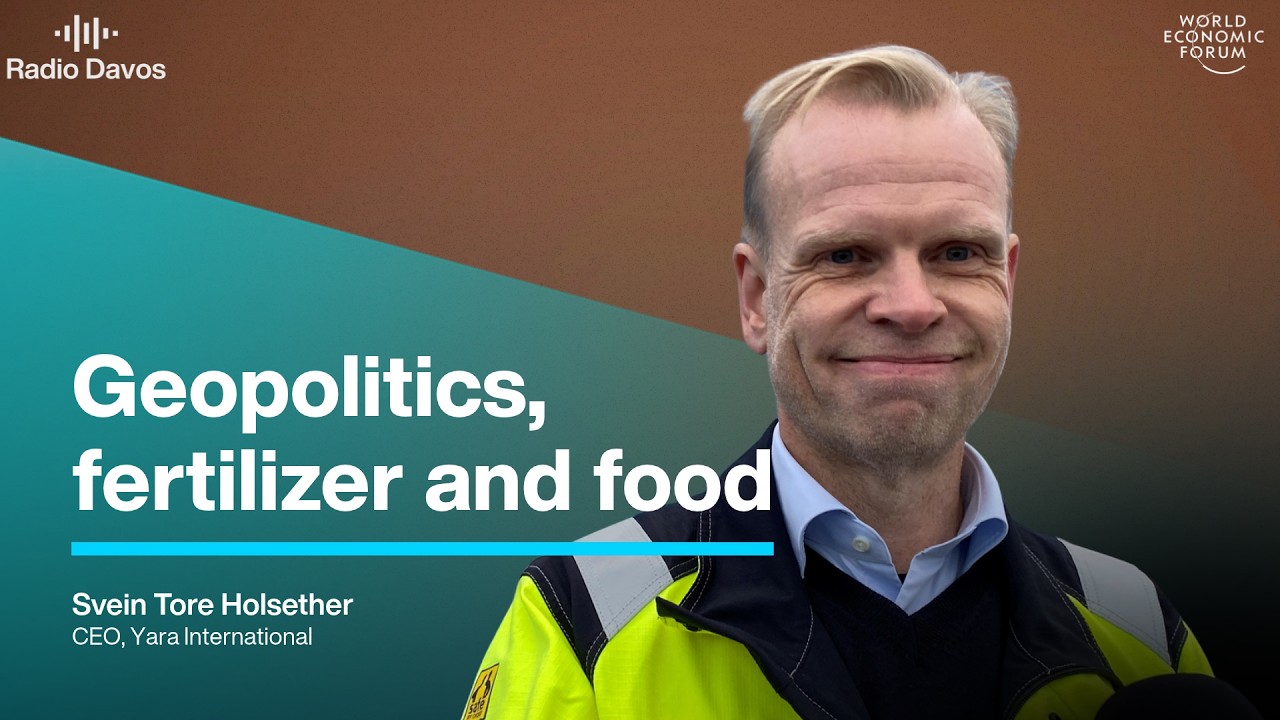
Geopolitics’ impact on farming and food, with the CEO of fertilizer giant Yara
Keywords
Summary
372 words
Critical Evaluation
Value of the Information & Strength of the Argument
The informational value lies mainly in the operational detail rather than in synthesis. The guest gives a concrete, insider account of how a large fertilizer producer absorbs shocks: shortening and diversifying raw-material supply, retrofitting plants to ramp production down when energy prices spike and up when they fall, and engineering flexibility for feedstock switching all the way down to shop-floor operators. The 30% figure for fertilizer trade through Hormuz, the roughly 50% share of food output attributable to applied nutrients, and the roughly 30% share of global emissions from food systems are the load-bearing numbers, and they give the episode a usable quantitative skeleton. The weakest material is the evidential chain behind the case studies. The Kenyan farm that survived drought and flood because of healthier soil, the Spanish biostimulant trials and the Chinese melon grower are all single anecdotes recounted from the CEO’s own travels, with no yields, no control plots, no sample sizes and no timeframe; they illustrate a mechanism rather than test it, and the confounder of generally better management versus the specific product is never separated out. The same applies to the claim that precision sensing ‘reduces consumption and levels the crop’ - plausible and consistent with the agronomic literature, but asserted rather than demonstrated. The argumentative architecture itself is disciplined: a problem (fragile system), a mechanism (energy and nutrient chokepoints), a response (flexibility plus agronomy), and a normative conclusion (farmers must be profitable before they can decarbonise). That chain holds together and the guest is careful to concede complexity, notably that productivity gains have historically come with higher emissions and that no single actor can resolve the trade-off. What is missing is counter-argument. The dependence of half of global food output on synthetic nitrogen is presented as a justification for continuity, never as a vulnerability to be reduced; nutrient runoff, nitrous oxide emissions from soils, and the energy intensity of ammonia synthesis are mentioned only obliquely, under the emissions umbrella. The framing of the ‘fourth agricultural revolution’ as an opportunity for the company is left unexamined, and competitive or regulatory constraints on consolidation in the fertilizer sector are never raised. Listeners therefore get a well-organised, internally consistent account of one actor’s strategy and worldview, of real value as primary testimony, but they should treat the causal claims about specific products and practices as hypotheses the episode does not test.
Scientific Rigor, Source Quality, Title Accuracy
No study, dataset, agency report or academic paper is named anywhere in the conversation. Every quantitative statement - the 30% share of traded nitrogen fertilizer through Hormuz, the roughly half of food produced with applied nutrients, the roughly 30% of global emissions from food systems, the 121-year company history, operations in 60 countries and sales in 140 - is delivered as background knowledge from the interviewee or the host without citation, date or uncertainty interval. The description’s links point to the Forum’s own ecosystem: the episode page itself, two sibling Radio Davos episodes (one with Jason Bordoff on the Hormuz energy shock, one with Adam Tooze on the energy transition) and podcast subscription feeds. These are legitimate context but they are in-house editorial products, not independent verification, and the two related episodes are not used inside the conversation to cross-check any figure. The interview format also removes the usual quality controls: there is no adversarial follow-up on the numbers, no external expert is brought in to contest the industry framing, and the interviewee’s commercial position is never stated as a caveat by the host. On the positive side, the guest is explicit about the limits of his own knowledge and repeatedly frames claims as observations from farm visits rather than as findings, which is honest even if it does not constitute evidence. On title and content fit, the match is good: the episode does address geopolitical chokepoints, fertilizer and food prices, and the promise of a CEO-level conversation is delivered. The only slight drift is that ‘geopolitics’ functions as a framing device, with roughly a third of the runtime devoted to leadership, AI and climate-COP advocacy that the title does not announce.
691 words
Title / Content Match
The title is accurate: the discussion does move from the Strait of Hormuz disruption through fertilizer sourcing and farming to food prices and climate. It slightly over-promises on 'geopolitics' as an analytical subject, since geopolitics is mostly the backdrop to a conversation about corporate resilience, agronomy and leadership.
Quality & Reliability
6/10
The episode is a long-form interview with Svein Tore Holsether, CEO of Yara International, conducted by a World Economic Forum editor. It offers direct access to a first-hand industry perspective and a coherent account of how successive shocks (COVID-19, the war in Ukraine, the Strait of Hormuz disruption) have reshaped fertilizer supply chains. Reliability is nonetheless limited by the format: it is a single-source corporate interview with no data tables, no named studies, no independent experts and no adversarial questioning. Quantitative claims (about 30% of traded nitrogen fertilizer transiting Hormuz, roughly half of global food output linked to applied nutrients, about 30% of global emissions from food systems) are plausible and broadly consistent with published literature but are stated without attribution or uncertainty ranges. The commercial interest of the interviewee in framing fertilizer as indispensable is not counterbalanced by dissenting views.
Chapters
- Radio Davos: How Geopolitics Impacts Fertilizer and Food
- Svein Holsether: Yara International CEO on Fertilizer and Food
- Strait of Hormuz: How Fertilizer Disruption Hits Food Prices
- Yara International: Resilience After COVID, Ukraine and Hormuz
- Energy Prices and Flexible Plants: Redesigning Fertilizer Production
- Fertilizer Raw Materials: Why Sourcing From Conflict Zones Is Hard
- Is There a Fertilizer Transition? Precision Farming and N-Sensors
- Energy Costs and Extreme Weather: The New Normal for Farming
- Food System Emissions: Why Farmer Profitability Matters
- Biostimulants and Agronomy: Helping Farmers Beat Heat Stress
- Healthy Soil: How a Kenyan Farm Survived Drought and Floods
- Farmers Under Pressure: The Human Cost of the Food Crisis
- Ukraine Farmers: Growing Food Under Attack and Mines
- What Keeps Yara's CEO Up at Night? Purpose and AI in Farming
- Fourth Agricultural Revolution: Higher Yields, Lower Emissions
- Satellite Imagery and Smartphone Agronomy for Farmers
- Crop Nutrition and Profit: A Chinese Melon Farmer's Story
- Leadership After COVID: Empowering Teams Across 60 Countries
- COP Climate Talks: Why Food Affordability Must Be a Priority
Cited Sources
- Radio Davos episode page: Strait of Hormuz, food crisis, fertilizer impact — Official episode page listed in the description, carrying the same conversation with Yara's CEO on the Hormuz disruption and food affordability.
- Radio Davos: The Hormuz shock, AI and China - the state of global energy, with Jason Bordoff — Sibling episode recommended in the description, covering the energy dimension of the same Hormuz disruption that frames this interview.
- Radio Davos: Adam Tooze on the green revolution and the history of energy — Sibling episode recommended in the description, providing the energy-transition context against which the guest contrasts a fertilizer 'transition'.
- World Economic Forum - main site — Publishing organisation of the podcast; source of the editorial framing of the episode.
- Radio Davos podcast feed — Subscription link given in the description for the programme in which the interview aired.
Concurring Sources
- Yara International - Wikipedia — Independent summary of the company's history, geographical footprint and product portfolio, consistent with the guest's description of a 121-year-old firm operating in 60 countries and selling to 140.
- Haber-Bosch process - Wikipedia — Documents the industrial nitrogen-fixation route and its energy intensity, supporting the interview's core mechanism linking energy prices to fertilizer prices and hence to food.
- Food and Agriculture Organization of the United Nations — Institutional reference on fertilizer use, food prices and food security, broadly consistent with the episode's framing of nutrient access as a determinant of food availability.
- Precision agriculture - Wikipedia — Describes sensor-based, variable-rate nutrient application and remote sensing, the techniques the guest presents as the practical content of the 'fourth agricultural revolution'.
External References
Contribution & Novelties
The episode’s distinctive contribution is not new research but the translation of a geopolitical event into an agronomic and industrial chain of consequences. Most coverage of a Strait of Hormuz closure stops at oil and gas prices; here the same chokepoint is traced through urea and nitrogen fertilizer into farm-gate economics and then into food affordability, with the useful corrective that fertilizer is a traded bulk commodity with only a handful of viable corridors. The second contribution is a candid account of what supply-chain resilience actually costs inside a heavy-industry operator: plants that must be able to throttle production against energy prices, feedstocks that can be switched without breaking product specifications, and shop-floor operators enlisted as the source of that flexibility. The third is the explicit rejection of an easy analogy: the guest argues there can be no fertilizer phase-out equivalent to an energy transition, because the substitution pathway is precision and agronomic efficiency rather than replacement, which reframes the sector’s decarbonisation debate around nitrogen-use efficiency, soil health and farmer profitability rather than around demand reduction. The material is nonetheless promotional in part, and the technology narrative around AI, satellite imagery and smartphone agronomy is presented as opportunity rather than assessed as evidence.
Pour aller plus loin (Further reading):
- Haber-Bosch process — The ammonia-synthesis route the guest alludes to when describing Yara’s founding innovation of extracting nitrogen from air; essential background for judging the energy-intensity claims made in the interview.
- Yara International — Corporate background on the interviewee’s company, its 1905 origins, its global plant network and its product lines, useful for assessing the interests behind the framing.
- Precision agriculture — Technical context for the tractor-mounted nitrogen sensors, variable-rate application and satellite-imagery recommendations discussed as the core of the ‘fourth agricultural revolution’.
- Food and Agriculture Organization of the United Nations — Institutional source for fertilizer use, food security and food price data that the episode cites only in round numbers without attribution.
- IPCC AR6 Working Group III, chapter on agriculture, forestry and other land use — Reference point for the claim that roughly 30% of global greenhouse gas emissions come from food systems; cited by name because the exact chapter address is not verifiable here.
- Erisman et al., ‘How a century of ammonia synthesis changed the world’ (Nature Geoscience, 2008) — The standard reference behind the widely repeated claim that synthetic nitrogen underpins roughly half of global food production; cited by name without URL.
404 words
Radar Profile
The profile is tilted towards accessibility and topical relevance: information density and reliability sit at a solid middle level, reflecting a fluent, figure-rich but uncited expert interview, while technical depth is the clear weak point, since no method, dataset or agronomic mechanism is developed in detail. The asymmetry describes a briefing-style conversation built for a policy and business audience rather than a technical one, strong on operational narrative and weak on verifiable evidence.