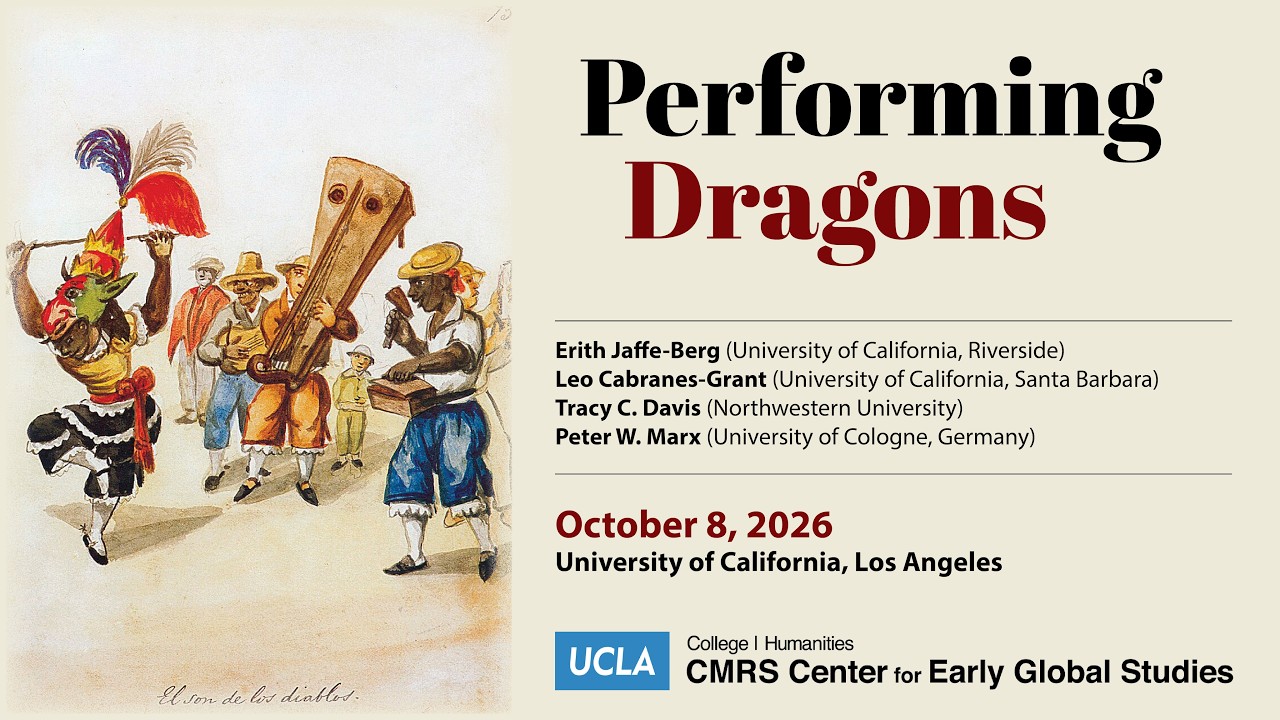
“Performing Dragons” Conference
Keywords
Summary
150 words
Critical Evaluation
Value of the Information & Strength of the Argument
The value of this content lies in its interdisciplinary approach, uniting theater history, art history, folklore, and religious studies to examine dragons as dynamic cultural phenomena. The argumentation is grounded in archival evidence, such as collections at the Newberry Library, the Getty, and various European repositories, and emphasizes the role of performance in materializing intangible beliefs. The speakers build a case for dragons as transregional and transhistorical connectors, challenging narrow cultural boundaries and highlighting processes of convergence and exchange. The collaborative method, with years of online and in-person meetings, strengthens the depth of the research presented.
Scientific Rigor, Source Quality, Title Accuracy
The sources cited include specific archives and museums (Newberry Library, Getty, Imperial War Museum, etc.) and scholarly frameworks like Warburg’s Denkraum. The description provides official links to the center’s website and the event page, which are reliable. The title accurately reflects the content, and there is no indication of sensationalism or pseudoscience. The academic pedigree of the speakers and the formal settings enhance the credibility.
176 words
Title / Content Match
The title 'Performing Dragons' precisely matches the conference's focus on dragons in performance contexts across cultures and historical periods.
Quality & Reliability
8/10
The content features presentations by established academics from major institutions, based on archival research and collaborative scholarship. The excerpt is limited to introductory remarks, but the rigor of the speakers and the associative references to primary archives and museums indicate a high level of reliability.
Key Moments
Markers derived by PSI from the transcript: the creator did not define chapters.
- Introduction by associate director: mentions Naga fireballs and convergent evolution.
- Erith Jaffe-Berg gives land acknowledgment and recounts project history.
- Leo Cabranes-Grant's remarks on carving the dragon and collaboration.
- Tracy Davis provides an overview of the Here Be Dragons project and methodology.
- Peter Marx discusses Athanasius Kircher and the concept of Denkraum.
Cited Sources
- UCLA CMRS Center for Early Global Studies — Official website of the sponsoring center
- Performing Dragons Event Page — Conference event details and abstract
Contribution & Novelties
This excerpt contributes to the understanding of dragons as performative and material agents rather than merely mythical symbols. By tracing the ‘Here Be Dragons’ project’s collaborative and archival methods, it demonstrates how dragons can illuminate global cultural interactions. The discussion of Kircher and Warburg positions dragons within spheres of knowledge and play, suggesting innovative frameworks for cultural history.
Pour aller plus loin :
- Aby Warburg — Relevant to the concept of Denkraum and cultural hybridity.
- Athanasius Kircher — Central figure in early modern knowledge systems; his work on China and dragons.
- Convergent evolution — The notion of independent cultural development of dragon myths.
103 words
Radar Profile
The radar profile shows high reliability and quality, with moderate quantitative information and technical depth. This reflects a focused academic presentation with strong credibility, though the excerpt is only a sliver of a longer conference.