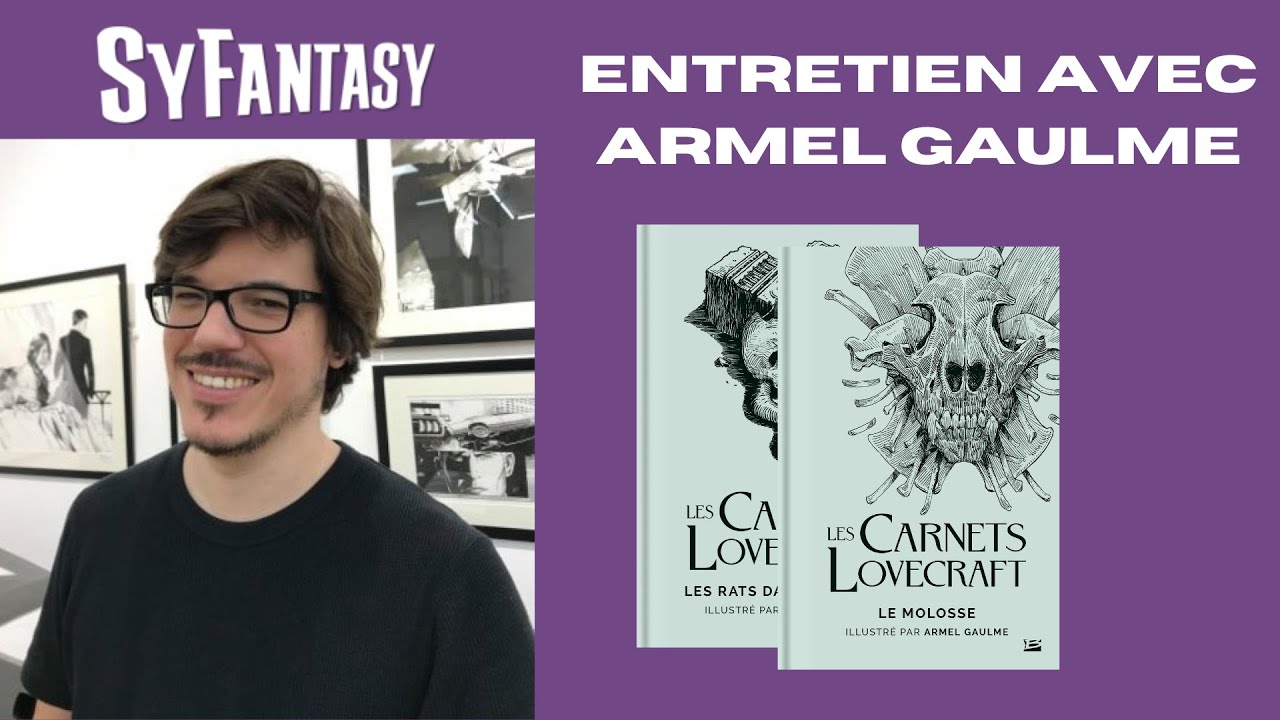
Entretien avec Armel Gaulme, l'illustrateur des Carnets de Lovecraft !
Interview with Armel Gaulme, the illustrator of Lovecraft's Notebooks!
Keywords
Summary
182 words
Critical Evaluation
Value of the Information & Strength of the Argument
The interview offers valuable personal testimony about the artistic process, especially the balance between imagination and research. Gaulme’s arguments are coherent, as he explains his choices with concrete examples (e.g., the use of period-accurate colonial architecture in ‘The Festival’). His critique of Gou Tanabe is nuanced, acknowledging the manga’s strengths while noting cultural blind spots. The discussion of illustration as a form of ‘betrayal’ is insightful, reflecting on how any visual adaptation constrains the reader’s imagination. The reasoning is consistent and well-supported by his own experiences.
Scientific Rigor, Source Quality, Title Accuracy
The interview does not claim scientific rigor but serves as a primary source on the artist’s own practice. The quality of sources is internal: he references his own notebooks, his influences (e.g., John Carpenter, Indiana Jones’ diary, scientific illustrations by David Roberts and Karl Bodmer), and other artists like François Baranger and Gou Tanabe, but without external citations. The title is perfectly aligned with the content, as the entire conversation revolves around his Lovecraft illustrations. No external data or citations are provided, so the reliability is limited to personal narrative.
191 words
Title / Content Match
The title accurately reflects the content: a focused interview with the illustrator about his Lovecraft notebooks.
Quality & Reliability
7/10
The interview provides direct, first-hand insights into the artist's creative process, influences, and personal views, which are reliable for understanding his perspective, but it is subjective and not subject to peer review.
Key Moments
Markers derived by PSI from the transcript: the creator did not define chapters.
- Armel Gaulme introduces himself and discusses his creative path, from childhood drawing to art school.
- Early career years: working in youth publishing after graduation, then moving to post-production and animation design.
- His first reading of Lovecraft: recommended by a friend, he buys 'The Nightmare' (?) and discovers atmospheric horror.
- Explanation of his graphic choice: a field-notebook style rather than cinematic, inspired by his observational drawing and a love for archival authenticity.
- Opinion on Gou Tanabe's manga: appreciates the adaptation but notes cultural differences in architecture and character design.
- The dilemma of adapting Lovecraft: the challenge of depicting the indescribable and the inherent betrayal of any illustration.
- His creative process: extensive research, collecting references, and synthesizing them into plausible invented objects without copying photos.
- His favorite Lovecraft stories and why they appeal to him.
- Future projects: hints at new directions and ongoing work.
- A Lovecraft story he would love to illustrate in the future.
- Advice to young artists: keep drawing and follow your passion.
Cited Sources
- Dj Quads on Spotify — Music credits for the background music used in the video.
- Dj Quads on SoundCloud — Music credits for the background music used in the video.
Concurring Sources
- H. P. Lovecraft — General reference on the author, consistent with the interview's discussion of his works and themes.
Contribution & Novelties
The video brings an insider’s perspective on the artistic interpretation of Lovecraft’s works, highlighting the tension between visual representation and the literary sublime. It details a unique ‘field notebook’ approach that combines observational drawing with archival research, offering a fresh alternative to typical cinematic adaptations. The discussion of Gou Tanabe’s manga provides a comparative cultural analysis, while the personal anecdotes illuminate the artist’s influences and process.
Pour aller plus loin :
- H. P. Lovecraft — Background on the author and his mythos, useful for understanding the source material.
- Gou Tanabe — Information on the manga artist discussed in the video, including his adaptations of Lovecraft.
- Cthulhu Mythos — Overview of the shared universe referenced throughout the interview, providing context for the adaptations.
122 words
Radar Profile
The radar profile shows a well-rounded interview with high scores in information quantity (8) and quality (7), moderate technical depth (6), and good reliability (7), reflecting a rich personal account rather than a technical or scientific analysis.