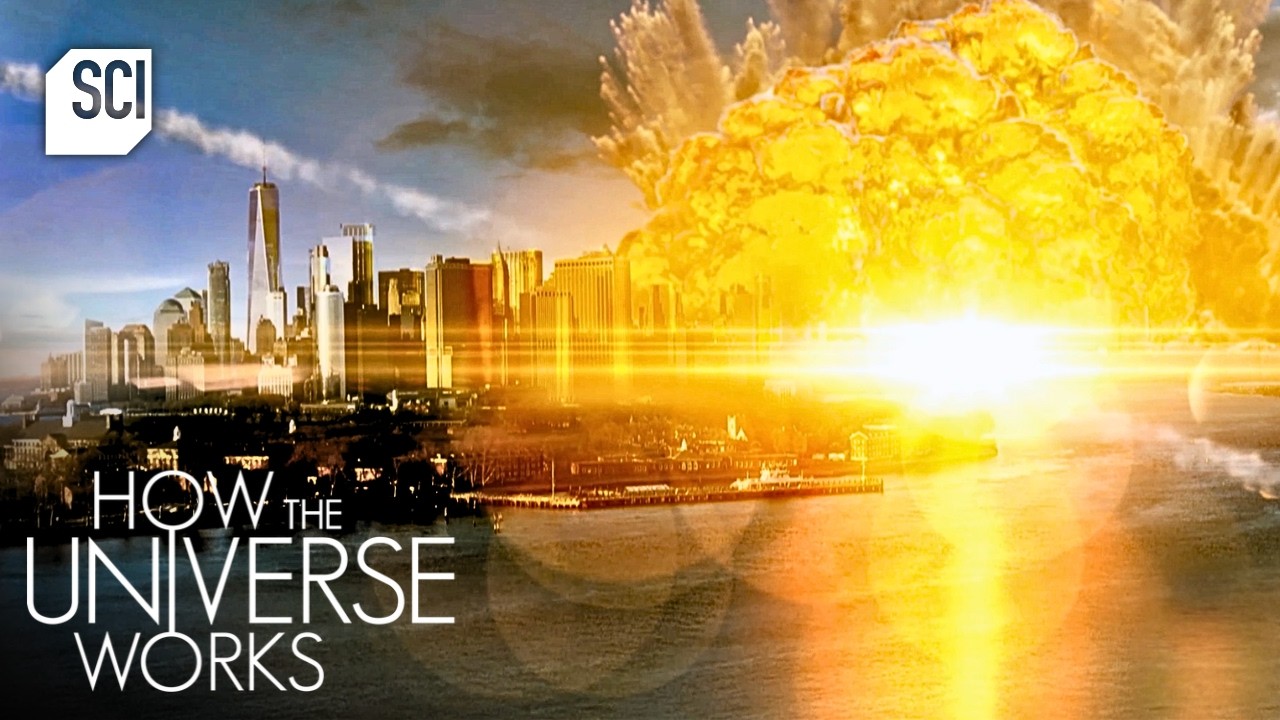
What If an Asteroid Hit New York City? ☄️ How the Universe Works | Science Channel
Keywords
Summary
146 words
Critical Evaluation
Value of the Information & Strength of the Argument
The video provides rich educational value, explaining complex astrophysical concepts with clear analogies and visualizations. The argumentation is built around expert testimony and references to real observational programs (Sloan Digital Sky Survey) and space missions (DART). The reasoning is coherent, connecting galactic evolution, stellar formation, and potential impact threats. While some simplifications are inevitable, the overall message that the universe is dynamic and life must adapt to cosmic risks is well supported. The use of multiple experts strengthens the credibility of the explanations, and the logical flow from one topic to another gives viewers a broad perspective on cosmic dangers.
Scientific Rigor, Source Quality, Title Accuracy
Scientific rigor is high: the documentary draws on reputable institutions like NASA, mentions the Sloan Digital Sky Survey, and uses recent mission results (DART). The experts are scientists who present consensus views with appropriate caution where speculation is involved (e.g., panspermia). The title, however, is clickbait-like, overemphasizing a brief scenario at the beginning, which does not reflect the episode’s actual scope, which is more about galactic life cycles and planetary climates. The quality of sources is solid, and the content is consistent with current astrophysical knowledge, though some details are omitted for brevity.
208 words
Title / Content Match
The title focuses on an asteroid striking New York, but the episode covers a broader range of cosmic threats and the life cycle of galaxies. The connection is present only in the opening segment, making the title somewhat misleading.
Quality & Reliability
8/10
The documentary relies on expert commentary, current research data (e.g., Sloan Digital Sky Survey), and real mission results (DART), though simplified for a general audience. The content aligns with established scientific understanding, with minor over-simplifications.
Key Moments
Markers derived by PSI from the transcript: the creator did not define chapters.
- Opening scenario: computer models of an asteroid impact on Manhattan.
- Discussion of the Milky Way's mass and the enigma of its death.
- Collision course with Andromeda and the future formation of Milkomeda.
- Planetary defense: the DART mission and hypervelocity impact tests at NASA Ames.
- Survival of life after a major impact; ejection of rocks between planets.
- Earth's axial precession and the greening of the Sahara.
Cited Sources
- Science Channel Video 'What If an Asteroid Hit New York City?' — Primary source of the content.
- Sloan Digital Sky Survey — Mentioned as the survey used to study galaxy evolution and discover super spirals.
- NASA DART Mission — Referenced in the segment on asteroid deflection, including the Ames vertical gun range experiments.
Concurring Sources
- Wikipedia: Galaxy formation and evolution — Aligns with the description of the Milky Way's growth through galaxy mergers.
Dissenting Sources
- No notable conflicting sources — The documentary presents consensus views; no contradictory sources were mentioned.
Contribution & Novelties
The documentary stands out for its engaging storytelling, combining multiple expert perspectives and high-quality CGI to explain both galactic-scale phenomena and planetary defense. It effectively connects diverse topics—galactic demise, asteroid threats, and climate shifts—within a single narrative about cosmic change. While not introducing new research, it synthesizes current findings for a broad audience.
Pour aller plus loin :
- Galaxy formation and evolution — Provides a deeper look at how galaxies like the Milky Way form and evolve.
- Double Asteroid Redirection Test — Details of the DART mission and its role in planetary defense.
- Axial precession — Explains Earth’s wobble and its influence on climate, as discussed in the Sahara segment.
110 words
Radar Profile
The radar profile shows high values for information quantity (9) and overall reliability (8), with somewhat lower technical depth (6). This reflects a broad, well-sourced overview rather than a deep analysis, suitable for general audiences while preserving scientific credibility.