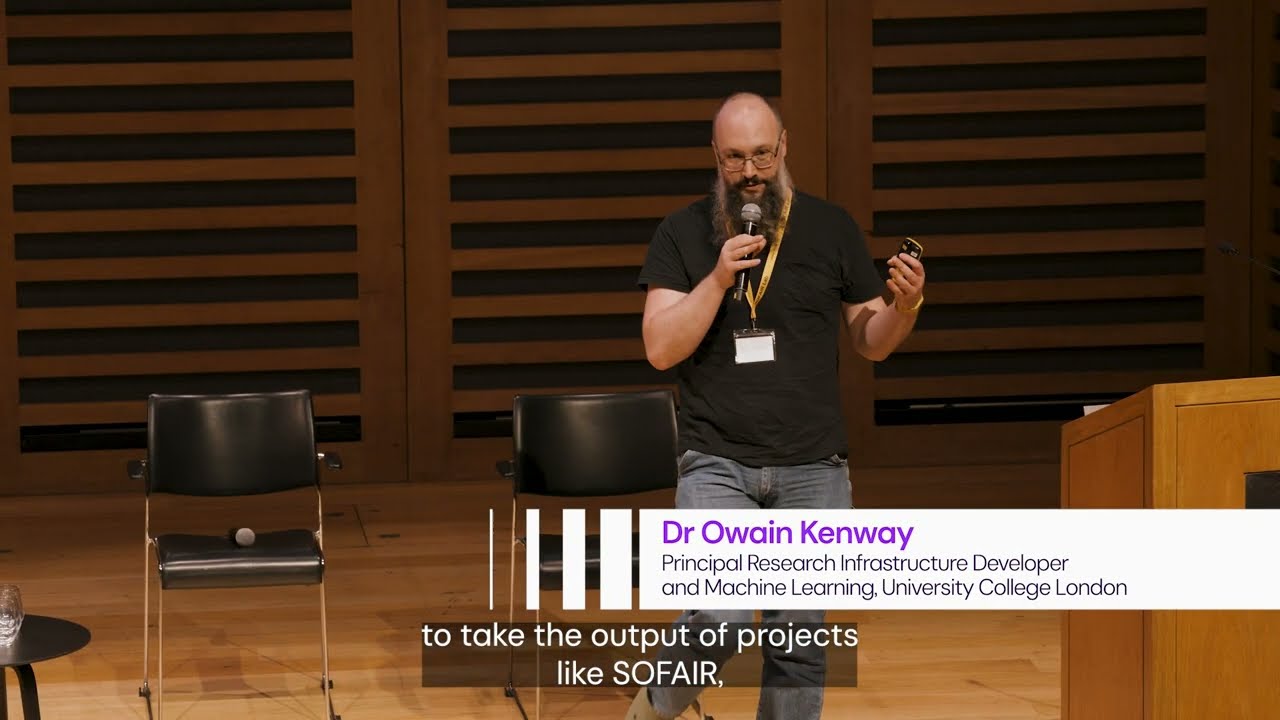
SOFAIR Launch Event. Dr OWAIN KENWAY TALK
Title history
- SOFAIR Launch Event. Dr OWAIN KENWAY TALK — observed on 20261102-1541 UTC (YouTube)
Keywords
Summary
177 words
Critical Evaluation
Value of the Information & Strength of the Argument
The talk provides valuable insight into the real-world challenges of deploying AI in a large institution, particularly around data security, cost, and accessibility. The argumentation is pragmatic, acknowledging uncertainties and dual paths. Kenway supports his points with concrete examples (e.g., HR data leaks, the Navier-Stokes incident) and a clear rationale for building in-house services rather than relying solely on external providers. However, the argumentation is largely qualitative and lacks quantitative data or detailed technical specifics, which limits its depth.
Scientific Rigor, Source Quality, Title Accuracy
The talk is a verbal presentation without cited references; no external sources are mentioned. The content is based on the speaker’s expertise and the project’s status at UCL. The title accurately matches the content, as it is a talk at the SOFAIR launch event. The lack of citations reduces rigor, but the speaker’s institutional role adds some credibility. The audience’s reception (applause) suggests positive engagement, though no comments or additional feedback are available.
167 words
Title / Content Match
The title accurately reflects the content: a talk by Dr Owain Kenway at the SOFAIR launch event, discussing building an AI service for a university.
Quality & Reliability
7/10
The speaker is an expert from UCL's Centre for Advanced Research Computing, presenting a plausible overview of the project, but the talk is early-stage, lacks concrete data, and cites no external sources.
Key Moments
Markers derived by PSI from the transcript: the creator did not define chapters.
- Introduction and rationale: UCL students/staff use external AI services, leading to data security and equity problems.
- Description of service stack: AI-enabled applications, low-code tooling, and research support.
- Discussion on inference cost for 50,000 people and pilot tests with local and commercial models.
- Tooling for non-programmers using 'Area' and example of digital education assistant.
- Challenges: data governance, cost models, skills, and the scale of the undertaking.
- Why SoFaR matters: trustworthy models and competitive risks, citing the Navier-Stokes incident.
Contribution & Novelties
The talk offers a practical blueprint for universities to deploy AI services internally, emphasizing governance, equity, and local inference. It highlights the need for dual paths (open-source and commercial) and the importance of non-technical tools for broad adoption. The approach is original in its integration of HPC principles with modern AI service deployment in an academic setting.
Pour aller plus loin :
- AI inference — Core concept in deploying models.
- Data governance — Essential for controlling data usage.
- High-performance computing — Background discipline influencing local deployment.
- AI safety — Guardrails and alignment considerations.
93 words
Radar Profile
The radar profile shows a moderate quantity of information but with reasonable quality and reliability. Technical depth is moderate, reflecting an overview rather than deep technical detail. The overall balance suggests a useful but not highly specialized talk, suitable for a general technical audience.