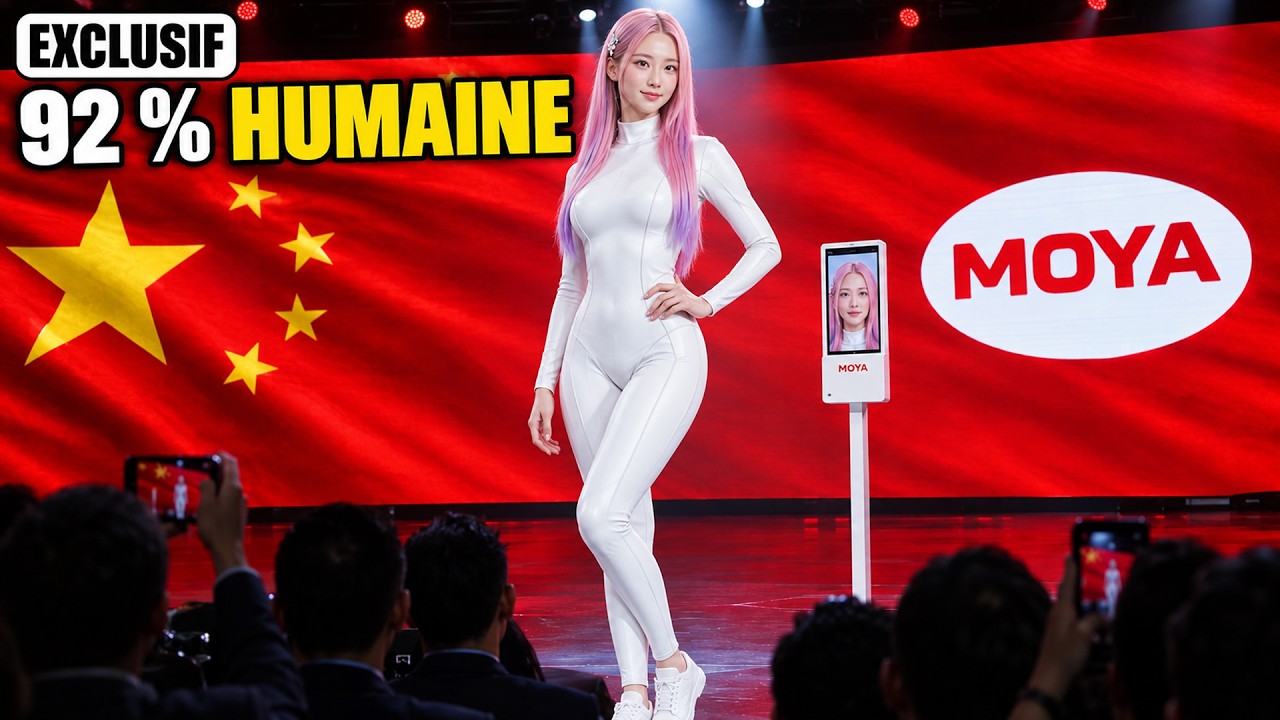
Le Robot Chinois « 92 % Humain » Qui Humilie Les Robots Occidentaux
The Chinese Robot « 92 % Human » That Humiliates Western Robots
Keywords
Summary
204 words
Critical Evaluation
Value of the Information & Strength of the Argument
The video provides substantial value by deconstructing a viral claim and placing it in context. It systematically corrects misinterpretations (e.g., the 92% gait precision, the currency error) and offers a balanced comparison of Moya vs. Ameca, avoiding hype. The argumentation is solidly built: it first presents the facts, then critically examines the evidence, and finally broadens to industry dynamics. It uses multiple named sources, acknowledges limitations (e.g., lack of technical transparency from DroidUp), and distinguishes between company assertions and independent analysis. The reasoning is coherent, and the conclusion that China’s robotics strength lies in industrial ecosystem volume rather than a single robot is well-supported by cited data on production numbers and market forecasts.
Scientific Rigor, Source Quality, Title Accuracy
The video demonstrates strong scientific rigor by citing numerous specialized outlets (e.g., Prompt Inspiration, Robot Zaps, Futurism, Online Sciences) and trade reports (Counterpoint Research, Omdia, IDC). It explicitly flags contradictions and unverified claims, such as the unclear actuator type and AI model. The title overemphasizes the ‘92% human’ phrase, which the video itself debunks, creating a slight mismatch that is, however, addressed early in the content. The source quality is good overall, though reliance on secondary sources and the lack of primary documentation from DroidUp are acknowledged. No direct interviews or original testing are presented, but the critical analysis is transparent about these limits.
232 words
Title / Content Match
The title is sensationalist and could mislead, but the content explicitly debunks and clarifies the '92% human' claim, offering a balanced analysis of the actual significance of the robot. The mismatch is acknowledged within the video.
Quality & Reliability
7/10
The video provides a rigorous critical assessment based on multiple secondary sources, but without direct access to primary technical documentation or independent testing. It clearly distinguishes verified facts from company claims and corrects misinformation, yet some technical details remain unconfirmed.
Key Moments
Markers derived by PSI from the transcript: the creator did not define chapters.
- Introduction of Moya and the '92% human' claim.
- Overview of DroidUp company and specifications of Moya.
- Comparison with Ameca, highlighting walking and facial expression capabilities.
- Clarification of the 92% figure: it refers to gait precision, not overall human likeness.
- Discussion of Moya's technical uncertainties and market positioning.
- Presentation of production volumes: China's dominance vs. US companies.
- Analysis of China's robotics ecosystem and implications for niche players like DroidUp.
- Market size context and future indicators for humanoid adoption.
- Open question to viewers about using companion robots for eldercare.
Cited Sources
- Prompt Inspiration — Cited for DroidUp's founding details and funding.
- Robot Humanoïd — Cited for Moya's presentation in Shanghai.
- Le Journal du Geek — Cited for Moya's features and company statements.
- Cri du Troll — Cited for Moya's modular head.
- South China Morning Post — Cited for Moya's target market and Unitree's shipping numbers.
- Game Blog — Reproduction of SCMP article.
- Robot Horizon — Cited for eldercare target.
- Génération NT — Cited for Moya's price and gait observations.
- Interesting Engineering — Cited for correction of currency error.
- Robot Select — Cited for Ameca's degrees of freedom and limitations.
- Wikipedia — Cited for Ameca's residency and design choices.
- Robot Zaps — Cited for Ameca's price, Moya's speed, production volume, and actuator details.
- Futurism — Cited for DroidUp's philosophy and ethical concerns.
- Online Sciences — Cited for clarification of the 92% figure.
- Harou — Cited for public demonstrations limitations.
- Stuff — Cited for Moya's facial movements.
- Daily Galaxy — Cited for actuator details and chassis uncertainty.
- Deckon Chronical — Cited for muscle materials.
- Counterpoint Research — Cited for global humanoid installations and China share.
- French Web — Cited for Counterpoint data and market forecasts.
- Visual Capitalist — Cited for AgiBot shipments and number of new humanoids.
- L'Usine Digitale — Cited for Tesla/Figure/Agility shipments and Unitree forecasts.
- Omdia — Cited for market size.
- IDC — Cited for market size.
- Stéphane Laru — Quoted about China's ecosystem advantage.
- Notebook Check — Cited for Unitree's IPO and future product plans.
- Le Journal du Web — Cited for Tesla's failed targets and Musk's statements.
Concurring Sources
- Online Sciences — Agrees with the video's clarification that the 92% figure refers to gait precision, not overall human likeness.
- Robot Zaps — Provides consistent technical details about Moya's speed and production volume, supporting the video's claims.
- Counterpoint Research — Data on China's dominant share of humanoid installations aligns with the video's argument about volume.
Dissenting Sources
- Media that repeated 'human 92%' without qualification — The video argues that many media outlets misrepresented the 92% figure, implying it meant overall human likeness, which the video corrects.
Contribution & Novelties
The video adds critical value by deconstructing a viral claim and placing it within a larger industrial perspective. It corrects misinformation (e.g., the ‘92% human’ misreading, the yen/yuan error) and systematically compares Moya to Ameca, highlighting both strengths and weaknesses. Its original contribution is the emphasis on China’s production volume as the key strategic factor, arguing that Moya is a niche product enabled by a mature ecosystem rather than a technological breakthrough. This reframes the discussion from a single robot to a systemic advantage. The video also outlines concrete indicators to watch (deliveries, independent tests, Unitree’s volumes) that could validate or challenge the current narrative.
Pour aller plus loin :
- Uncanny Valley — The phenomenon is central to comparing Moya’s realistic skin and Ameca’s deliberate design choice.
- Humanoid Robot — General context on the field and its applications.
- Unitree Robotics — Key Chinese player mentioned in the video, relevant for understanding production scale.
- Engineered Arts (Ameca) — The company behind Ameca, useful for understanding the comparison.
166 words
Radar Profile
The radar profile shows strong performance in information quantity (8) and moderate quality (7), reflecting the video's dense, well-cited content. Technical depth is moderate (6), accessible to a general audience, while overall reliability is good (7) but limited by reliance on secondary sources and lack of primary verification.