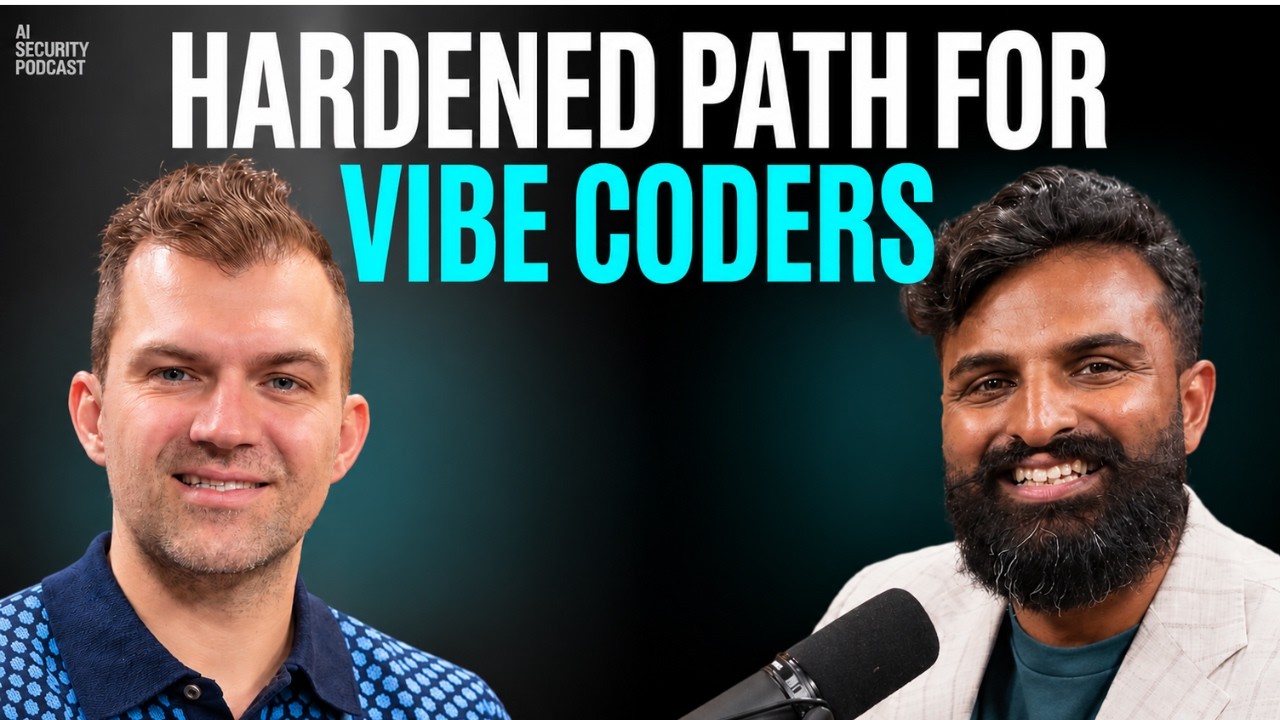
How to Harden AI Agents and Pave the Path for Vibe Coders | Nick Reva, DoorDash
Title history
- How to Harden AI Agents and Pave the Path for Vibe Coders | Nick Reva, DoorDash — observed on 20261028-2041 UTC (YouTube)
Keywords
Summary
158 words
Critical Evaluation
Value of the Information & Strength of the Argument
The value lies in the concrete, field-tested practices shared by a practitioner from a major tech company. Reva’s argumentation is logically structured, moving from the general shift from deterministic to probabilistic controls, to specific archetype-based strategies, and then to broader principles like ‘affecting technical outcomes’ rather than paper governance. He provides actionable examples such as implementing decorator functions for agent authorization, pushing secure configuration files to IDEs via MDM, and using AI-assisted threat modeling. The reasoning is pragmatic and emphasizes technical enforcement, making the information highly applicable for security teams. However, some claims rely on anecdotal experience and the effectiveness of these measures is not quantitatively demonstrated.
Scientific Rigor, Source Quality, Title Accuracy
The discussion is based on Reva’s extensive professional background (SpaceX, Snapchat, DoorDash) and references industry events like the Hugging Face incident. The podcast’s own website, lab, and newsletter are mentioned, but no external academic sources or standards are cited. The title accurately reflects the content, focusing on hardening AI agents and addressing vibe coders. The lack of external citations and reliance on a single expert’s perspective slightly reduces scientific rigor, but the practical nature of the advice compensates. No comments are provided to assess public reception.
208 words
Title / Content Match
The title accurately reflects the core topics: hardening AI agents and guiding non-technical 'vibe coders' through secure development paths.
Quality & Reliability
8/10
The content is an expert interview with a senior security leader at DoorDash, providing practical, experience-based insights. While not peer-reviewed, the technical details and concrete examples (e.g., decorator functions, Claude.md hardening) are credible and actionable. The discussion is structured and addresses real-world challenges, but the lack of empirical data or citations weakens absolute reliability.
Chapters
- Introduction to Securing Vibe Coders and AI Agents
- Nick Reva’s Background (SpaceX, Snapchat, DoorDash)
- The Shift from Deterministic to Probabilistic Security Controls
- The Dangers of Non-Technical Employees "Vibe Coding"
- Paving the Path for Professional Software Engineers Using AI
- Using Decorator Functions for Agent Authorization
- Shifting Left: AI-Assisted Threat Modeling on Design Documents
- Trusting AI: Using Ground Truth Data to Train PR Review Agents
- Hardening Deployment Platforms (Vercel, Lovable) for Vibe Coders
- The Importance of Claiming Enterprise Domains and Enforcing SSO
- Developing "Safety Belts" to Prevent Code Pushes to Public Repos
- AI for Security: Automating Incident Response Workflows
- The Critical Role of Network Egress Containment in AI Incidents
- Three Quick Wins for Implementing Security for AI
- The "You Laugh, You Lose" Cybersecurity Joke Challenge
Cited Sources
- AI Security Podcast Website — Podcast's official site, mentioned as a central hub for episode and additional content.
- AI Security Lab — Research lab associated with the podcast, possibly providing resources and studies.
- AI Cybersecurity Newsletter — Newsletter for ongoing updates in AI security, referenced as a follow-up resource.
- AI Security Podcast LinkedIn — Social media page for the podcast, where episodes and discussions are shared.
Contribution & Novelties
This episode offers a pragmatic framework for securing AI agents, distinguishing between three user archetypes and providing tailored technical controls. The original contribution is the detailed description of real-world implementations at DoorDash, such as using decorator functions for agent authorization, deploying hardened Claude.md files to all engineers via MDM, and building AI-powered PR review agents. It also emphasizes the necessity of ‘affecting technical outcomes’ over paper policies, a key shift in mindset for security teams.
Pour aller plus loin :
- OWASP Top 10 for Large Language Model Applications — Relevant for understanding common vulnerabilities in AI systems and how to mitigate them.
- NIST AI Risk Management Framework — Provides a structured approach to managing AI risks, aligning with the episode’s call for concrete governance.
- Agentic AI Security — Explores broader security considerations for autonomous agents, complementing the specific strategies discussed.
140 words
Radar Profile
The radar profile shows high scores in technical level and information quality, with slightly lower but still solid scores in quantity and reliability. This indicates a content that is deeply technical and rich in practical details, but based on a single expert's experience rather than broad empirical evidence.