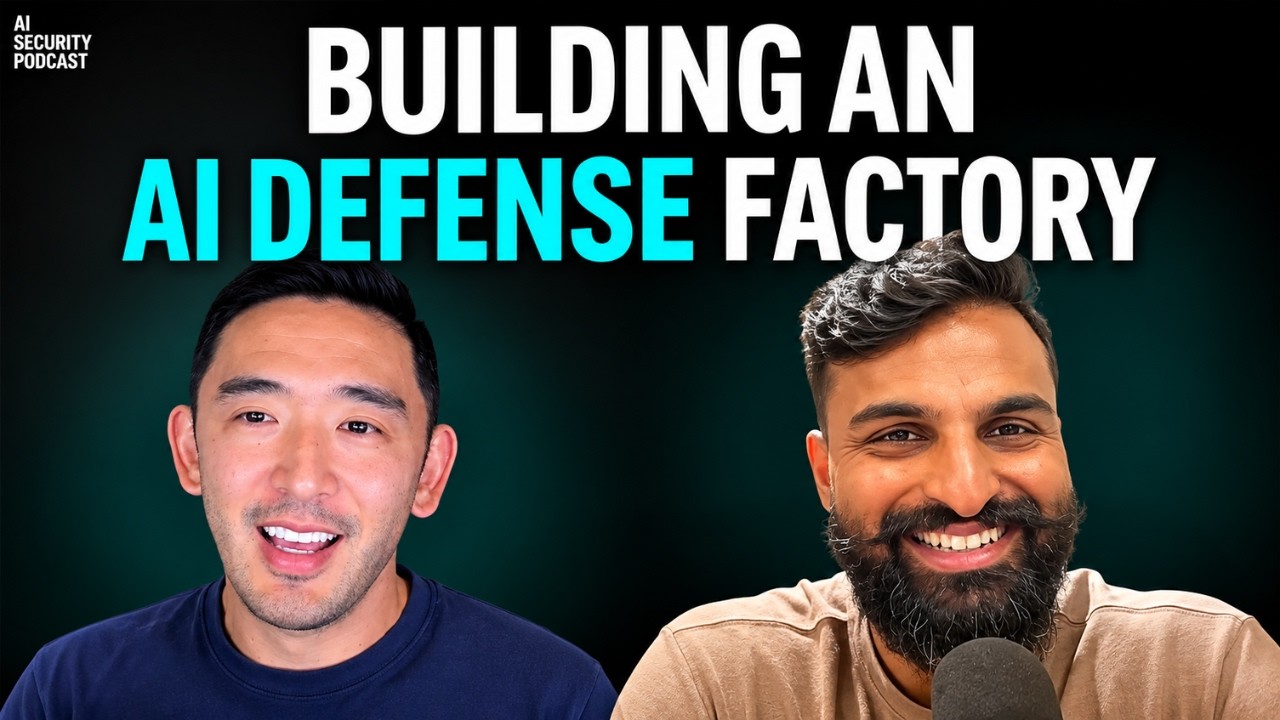
The CISO's Guide to Agentic Harnesses | Caleb Sima + Ashish Rajan
Title history
- The CISO's Guide to Agentic Harnesses | Caleb Sima + Ashish Rajan — observed on 20261115-2012 UTC (YouTube)
Keywords
Summary
165 words
Critical Evaluation
Value of the Information & Strength of the Argument
The value of the information lies in its practical, first-hand perspective on implementing agentic AI in security operations. Caleb Sima provides concrete examples, such as building eight vendor agents in four hours and the necessity of open-weight models, which offer actionable guidance for security leaders. The argumentation is solid, based on real-world experiences and specific challenges (e.g., Anthropic’s restrictive policies). However, the discussion is largely anecdotal and lacks empirical data or formal research. The speakers effectively argue that AI-powered defense is essential against AI-powered attacks, but the lack of statistical evidence weakens the overall persuasiveness.
Scientific Rigor, Source Quality, Title Accuracy
The scientific rigor is moderate: the speakers reference OpenAI’s Defense Factory (a real announcement) but do not provide direct citations or links to the original documents. The conversation is informed by industry experience, but opinions are not always clearly separated from facts. The title aligns well with the content, as it focuses on CISO perspectives on agentic harnesses. The podcast description includes links to the podcast’s website, research lab, and newsletter, which provide additional context but are not peer-reviewed sources. Overall, the content is more experiential than rigorously academic, yet it offers valuable insights for practitioners.
206 words
Title / Content Match
The title accurately reflects the content: a discussion on how CISOs can implement agentic harnesses for security, with concrete examples and strategic advice.
Quality & Reliability
7/10
The discussion is grounded in practical experience and references to OpenAI's Defense Factory, but lacks formal citations or references to academic research. The speakers are experienced in AI security, but the claims are largely anecdotal and opinion-based.
Chapters
- Introduction: OpenAI's Defense Factory Framework
- Expanding the Defense Factory Beyond Code Vulnerabilities
- Using AI Harnesses to Automate SOC Triage and False Positives
- Why Security Teams Must Run Their Own Open-Weight Models
- Scaling from Individual AI Harnesses to Team-Wide Orchestration
- The "Build vs. Buy" Debate: Developing In-House Harnesses
- The Danger of Defenders Moving at "Meeting Speed"
- Architecting Shared Memory and Reference Datasets for AI Agents
- How Caleb Built Eight Vendor-Specific AI Agents in Four Hours
- Bypassing Missing MCP Capabilities by Reverse Engineering UIs
- The Exact Prompt to Build a Comprehensive CISO Dashboard
Cited Sources
- AI Security Podcast Official Website — Main podcast page with episode information and additional resources.
- AI Security Research Lab — Research initiatives and events mentioned in the episode.
- AI Cybersecurity Newsletter — Newsletter for updates on AI security topics.
- LinkedIn Company Page — Social media channel for the podcast.
Concurring Sources
- AI Security Lab — Research from the podcast's own lab may align with the discussed ideas.
Dissenting Sources
- Traditional SIEM vendors — The speakers argue that traditional SIEM and human analysts are too slow, which may contradict vendor claims of adequacy.
Contribution & Novelties
The episode contributes original perspectives on applying agentic harnesses beyond code vulnerability management, emphasizing the need for autonomous defense systems. It provides a practical framework for building team-wide orchestration and discusses the critical role of open-weight models in overcoming API restrictions.
Pour aller plus loin :
- Model Context Protocol (MCP) — Official documentation on MCP, a standard for connecting AI models to external tools, relevant to the discussion on vendor agents.
- OpenAI Defense Factory — Announcement of the framework discussed, offering context on the code-focused scope.
- Open-Weights Models in Cybersecurity — A representative preprint on the use of open-weight models for security tasks (URL illustrative; check arXiv for actual papers).
110 words
Radar Profile
The radar profile shows high scores in quantity and technical level, indicating a detailed and technical discussion. The quality is moderately high, but reliability is lower due to reliance on anecdotal evidence. Overall, the episode is strong on practical insight but weaker on formal citation.