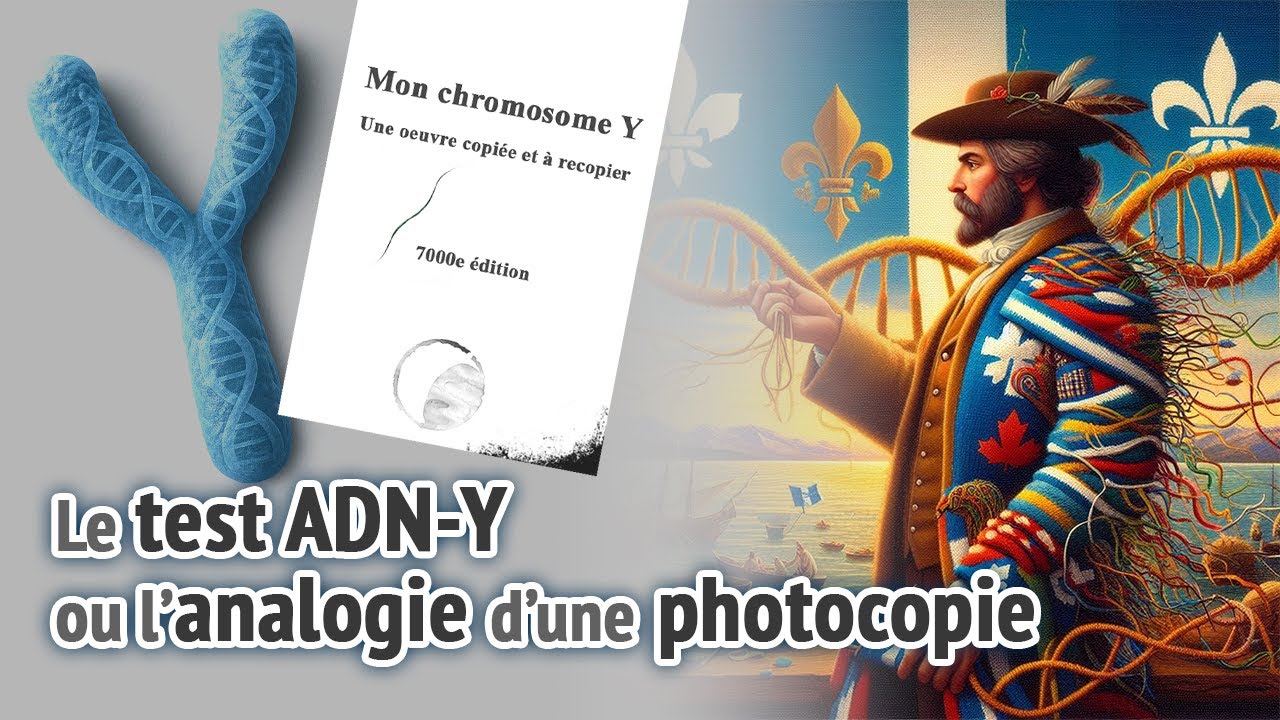
Test ADN-Y - analogie d'une photocopie
ADN-Y test - analogy of a photocopy
Keywords
Summary
180 words
Critical Evaluation
Value of the Information & Strength of the Argument
The video’s primary value lies in its pedagogical clarity. The photocopy analogy is effective for a general audience: it makes abstract concepts like non-recombining inheritance, mutation accumulation, and coalescence intuitive. The presenter correctly explains that Y-DNA does not recombine, that mutations are inherited by all male descendants of a carrier, and that haplogroups represent clusters of shared mutations. The argumentation is logically structured, moving from the analogy to real-world applications such as dating mutations using ancient DNA and mutation-rate models. The discussion of private versus shared mutations is accurate and useful for test-takers. However, the argumentation remains at a conceptual level and does not engage with technical details such as specific mutation rates, the names of statistical models (e.g., BATWING, BEAST), or the limitations of the molecular clock. The claim that all living men share a common ancestor around 7,000 generations ago (roughly 200,000–300,000 years) is consistent with current scientific consensus, but the video does not provide a source for this figure. The explanation of geographic stability in ancient populations is reasonable but simplified. Overall, the argumentation is sound for an introductory explanation but lacks depth and empirical grounding.
Scientific Rigor, Source Quality, Title Accuracy
The video does not cite any specific scientific papers, studies, or institutional sources. It mentions FamilyTreeDNA as a testing company and refers to Copernicus and Darwin in passing, but no references are provided in the description or transcript. The description contains only a chapter list and a brief summary; no external links to studies or databases are included. This absence of sources weakens the scientific rigor, although the content itself aligns with established population genetics. The title, ‘Test ADN-Y - analogie d’une photocopie,’ accurately reflects the content: the video is indeed an analogy-based explanation of Y-DNA testing. There is no mismatch between title and content. No comments were provided for analysis.
315 words
Title / Content Match
The title accurately reflects the content: the video uses a photocopy analogy to explain Y-DNA testing and haplogroup interpretation, matching the stated topic precisely.
Quality & Reliability
7/10
The video presents a pedagogically sound analogy for Y-chromosome haplogroup inheritance, correctly describing non-recombining Y-DNA, mutation accumulation, coalescence, and the use of ancient DNA and mutation-rate models for dating. However, it contains no citations to specific studies, no named researchers beyond passing references to Copernicus and Darwin, and relies on general knowledge rather than verifiable primary literature. The explanation of statistical dating margins is appropriately cautious, but the absence of concrete sources limits the reliability score.
Chapters
- intro
- analogie de la photocopie
- coalescence
- feuille originale
- première copie recopiée
- plusieurs copies du même imprimeur
- seconde itération de la copie originale
- chemin parallèle d'un imprimeur distinct
- le test BIG-Y masculin: votre ADN spécifique
- mutations privées, non répertoriées
- cibler les mutations communes
- remonter le fil des différences
- noms réels des mutations
- les mutations dans le temps
- les mutations dans les lieux
- branche R-M269
- FamilyTreeDNA
- marges d'estimations dans le temps
- ADN ancestrale
- conclusion
Contribution & Novelties
The video does not present original research or novel findings. Its contribution is purely educational: it offers a clear, accessible analogy for understanding Y-DNA haplogroup reports. The photocopy metaphor is not new in genetic genealogy circles, but the video applies it systematically to explain mutation accumulation, private mutations, and dating. It also briefly touches on the use of ancient DNA and statistical models for temporal and geographic placement of mutations. The main novelty is the coherent visual and verbal analogy tailored to French-speaking audiences interested in genetic genealogy.
Pour aller plus loin :
- Haplogroup — General overview of haplogroups and their use in genetics.
- Y chromosome — Structure and inheritance of the Y chromosome.
- Molecular clock — Explanation of mutation-rate-based dating methods.
- Human Y-chromosome DNA haplogroup — Detailed article on Y-DNA haplogroups and their phylogenetic tree.
- Ancient DNA — Overview of ancient DNA analysis and its applications.
147 words
Radar Profile
The radar profile shows moderate information quantity and quality, low technical depth, and moderate overall reliability. The video is strong in pedagogical clarity but limited in scientific rigor and sourcing. It is best suited for beginners seeking an intuitive introduction to Y-DNA testing.