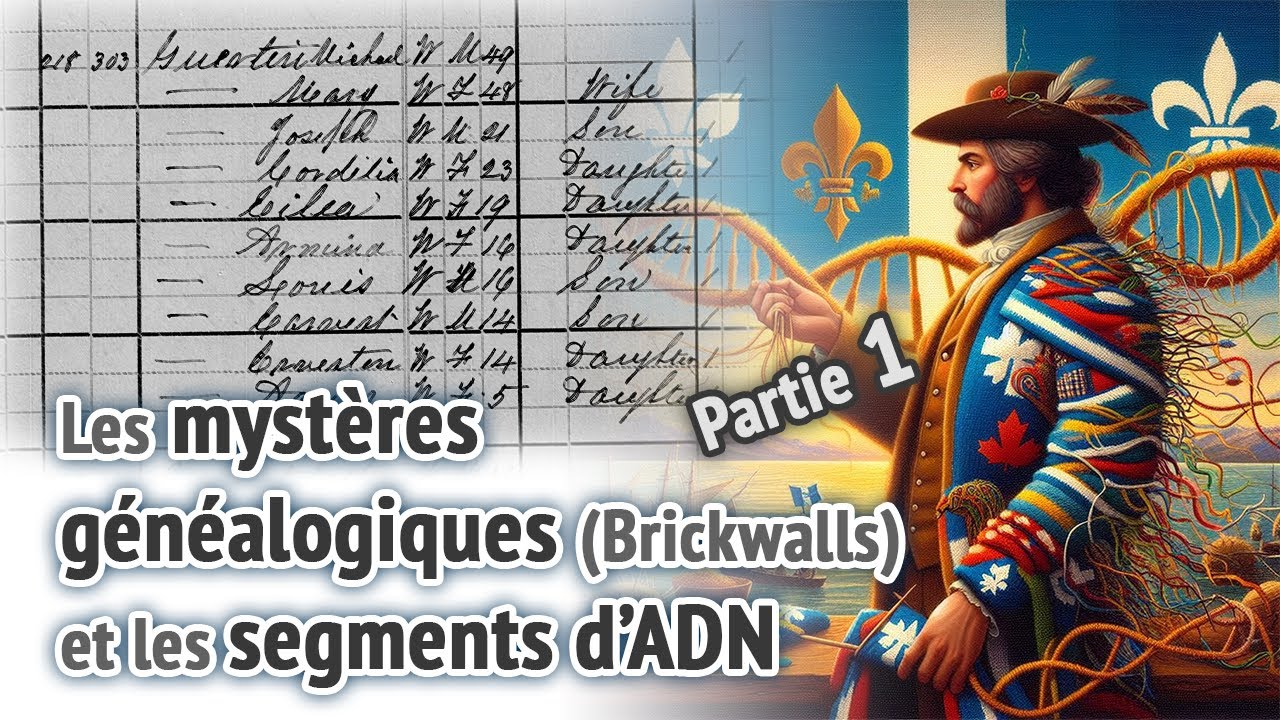
Les mystères généalogiques et les segments d'ADN - Partie 1/2
The genealogical mysteries and the ADN segments - Part 1/2
Keywords
Summary
252 words
Critical Evaluation
Value of the Information & Strength of the Argument
The informational value lies in the methodical reconstruction of a difficult genealogical case using heterogeneous sources: parish registers, civil and religious burial records, gravestones, American census returns, and correspondence with two genealogical societies. The author does not merely assert a lineage; he shows the documents, reads them aloud, and explains what each one does and does not prove. The argumentation is cumulative and largely honest about its limits. The strongest reasoning step is the arithmetic check on Euphrosine Brière’s death date (1826) against Michel’s birth (1830), which invalidates a widely repeated online attribution. The second strong step is the convergence between the gravestone-derived birth date (21 November 1830), the baptism of an illegitimate Michel (23 November 1830), and the notebook’s stated date (22 November 1830). However, this convergence is suggestive rather than conclusive: a two-day discrepancy in a period of imperfect record-keeping does not by itself establish identity, and the author acknowledges this. The weakest link is the handwritten notebook, which is treated as roughly 80% reliable without a clear demonstration of its authorship, date, or chain of custody. The argument that Michel was the brother of Jean-Baptiste and Édouard rests almost entirely on this single private document, and the author admits that no other record supports it. The hypothesis of illegitimacy is plausible and well-motivated, but it remains a hypothesis. Overall the reasoning is careful, self-aware, and avoids overclaiming, which is a genuine strength in this genre.
Scientific Rigor, Source Quality, Title Accuracy
Rigueur scientifique : the approach is that of a disciplined amateur genealogist rather than a professional historian. The author uses standard genealogical methodology (working backward from a known marriage record, cross-checking ages at death and at census, consulting Drouin and PRDH databases) and is explicit when a document is missing. He correctly flags that burial records do not name parents and that the absence of a record is not proof of absence, though he could have developed this point further. Qualité des sources : the sources are predominantly primary and archival, which is appropriate. The two genealogical societies consulted (AFGS and Héritage Sutton) are legitimate repositories, and their negative findings are reported faithfully. The private notebook is the weakest source and is used somewhat generously. Online trees on Ancestry are correctly identified as unreliable when they assign a mother who died four years before the birth. Adéquation titre/contenu : the title promises DNA segments, but this first part contains no genetic analysis at all; the creator is transparent about this being part 1 of 2, so the mismatch is mitigated but real.
435 words
Quality & Reliability
7/10
The author relies on primary archival documents (parish registers, census records, gravestones, correspondence with genealogical societies) and explicitly reports negative results (no marriage record found in Vermont or Quebec sources). He distinguishes clearly between what is documented, what is inferred, and what remains speculative. The main weakness is the reliance on a private handwritten notebook whose provenance and authorship are not fully established, and the absence of any genetic evidence in this first part, which limits verifiability of the central hypothesis.
Chapters
- intro
- mariage d'Ernestine Guertin
- email de l'AFGS (Vermont)
- email d'Héritage Sutton
- court récapitulatif du Brickwall
- baptême Ernestine Guertin et jumeau Ernest
- pierre tombale de Marie Courchenes
- pierre tombale de Michel Guertin
- Sépulture de Michel Guertin en 1892
- naissance selon l'âge au décès
- Michel Illégitime, né 1830
- Généalogie privée (carnet)
- mention que Michel est frère de deux autres Guertins
- arbre reconstitué basé sur le carnet manuscrit
- Recensement de 1880 au Massachusetts
- naissance selon l'âge au Recensement
- famille des parents d'Euphrosine Brière
- conclusion
Contribution & Novelties
The video’s original contribution is not a discovery but a transparent, documented case study of a brickwall in French-Canadian genealogy, showing the full chain of negative and positive evidence rather than only the successful steps. It demonstrates a practical workflow: establish the last documented ancestor, exhaust parish and civil records, query regional genealogical societies, use age-at-death arithmetic to bracket a birth date, then search registers for that window. It also exposes a concrete error propagated across online trees (assigning a mother who died four years before the birth), which is a useful cautionary example for anyone relying on Ancestry or similar platforms. The announced second part on DNA triangulation is where the methodological novelty would lie, but it is not present here.
Pour aller plus loin :
- Genealogical DNA test — Overview of the autosomal, Y-chromosome and mitochondrial tests used in genetic genealogy, directly relevant to the announced part 2.
- Genetic genealogy — Broader context on how DNA evidence is combined with documentary research, including triangulation.
- Drouin collection — The parish register collection referenced by the author for Quebec vital records.
- Programme de recherche en démographie historique (PRDH), Université de Montréal — The Quebec historical demography database cited by the author for family reconstitution.
- Identity-by-descent segment triangulation — The core technique announced for the second video; no single stable URL is cited here to avoid an unreliable link.
228 words
Radar Profile
The profile is balanced toward documentary richness and reliability, with a moderate technical level reflecting the genealogical rather than genetic focus of this first part. Information quantity and quality are both solid, while the technical score is held down by the absence of any DNA analysis, which is deferred to part 2. Overall reliability is good for the genre, tempered by dependence on a single private manuscript.