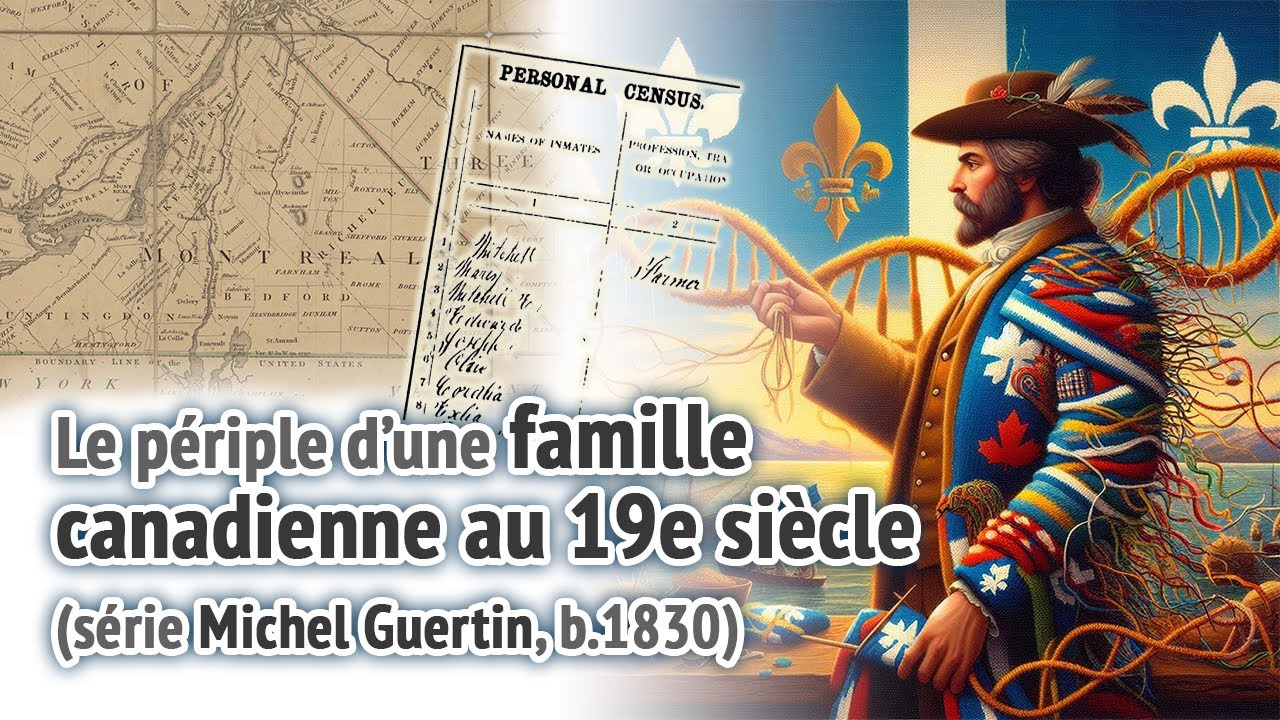
Périple d'une famille canadienne au 19e sièce
Journey of a Canadian family in the 19th century
Keywords
Summary
193 words
Critical Evaluation
Value of the Information & Strength of the Argument
The video’s value lies in its detailed chronological reconstruction of a family’s migration using period maps and census data, which provides a concrete example of 19th-century Quebec-New England migration patterns. The argumentation is built on a combination of archival documents (parish registers, censuses) and a family manuscript, with the author clearly distinguishing between established facts and hypotheses. For instance, the 1852 marriage is presented as presumed due to the lack of official records, and the ‘Wood’ surname in the 1861 census is explained through two plausible scenarios: anglicization to blend in or a census taker’s error. The reasoning is generally coherent, but some inferences, such as the exact location of the family in Sutton based on map names, remain speculative. The author acknowledges uncertainties, which strengthens the credibility of the reconstruction.
Scientific Rigor, Source Quality, Title Accuracy
The video demonstrates scientific rigor by relying on primary sources such as censuses (1825, 1861, 1880), parish registers, and period maps (1795, 1834, 1864), and by explicitly noting when evidence is lacking (e.g., the 1852 marriage). However, no direct citations or links to these sources are provided in the description, which limits independent verification. The title accurately reflects the content, as the video is indeed a journey through the family’s history using maps. Comments are not provided, so no analysis of public trends is included.
231 words
Title / Content Match
The title accurately reflects the content: a chronological journey of a 19th-century Canadian family through Quebec and New England, illustrated with period maps.
Quality & Reliability
6/10
The video is a genealogical reconstruction based on archival documents (censuses, parish registers, period maps) and a family manuscript. The author explicitly distinguishes established facts from hypotheses (e.g., the 1852 marriage is presumed from a family manuscript, not from official records). However, no archival references or direct links to the documents are provided in the description, and the reasoning relies on personal interpretation of maps and name variants, which limits verifiability.
Chapters
- intro
- Amérique du Nord actuelle
- Carte de 1795
- St-Ours, 1776
- St-Denis-sur-Richelieu, 1830
- Montgomery, VT, 1852
- Dunham, 1854
- Recensements (1825 et 1861)
- Sutton, 1861
- Truc généalogique
- Sutton, 1864
- Chemins de fer
- Easthampton, 1876
- Sutton, 1878
- Sutton, 1886 (et Bromont)
- Ware, 1883
- Brockton, 1887
- Sutton, 1889
- Sutton, 1890
- Sutton, 1892
- conclusion
Contribution & Novelties
The video’s original contribution is the application of a genealogical tip—searching censuses by first names and ages when the family name changes—to the specific case of the Guertin family, revealing their presence under the surname ‘Wood’ in the 1861 census. It also provides a visual and chronological reconstruction of the family’s migration using period maps, which is a novel approach for this channel. The bonus scoop about tracing a family with few census records adds practical value for genealogists.
Pour aller plus loin :
- Genealogy — General overview of genealogical research methods.
- Census in Canada — Historical context of Canadian censuses, including the 1861 census.
- Quebec diaspora — Background on French-Canadian migration to New England in the 19th century.
119 words
Radar Profile
The radar profile shows a strong emphasis on information quantity and reliability, with moderate technical depth. The content is rich in chronological details and archival references, but the technical level is limited to genealogical methods rather than advanced scientific analysis.