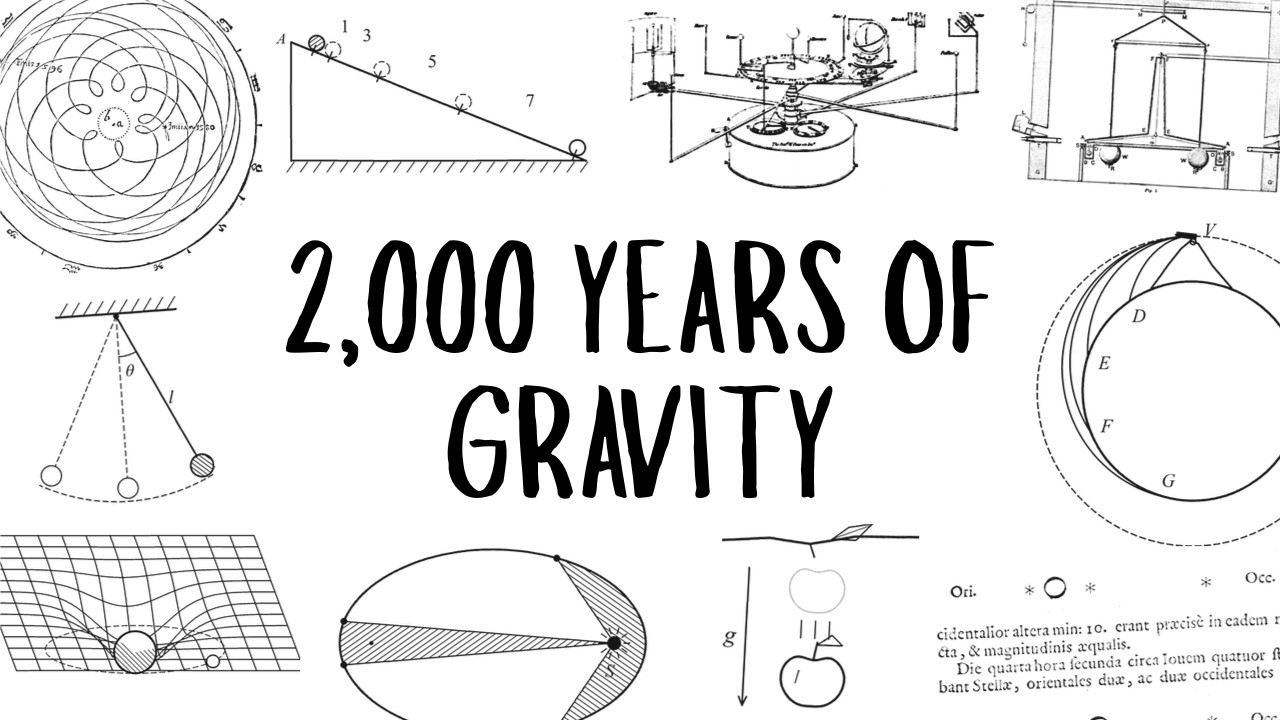
How Our Understanding of Gravity Changed Over 2,000 Years
Title history
- How Our Understanding of Gravity Changed Over 2,000 Years — observed on 20261111-2141 UTC (YouTube)
Keywords
Summary
226 words
Critical Evaluation
Value of the Information & Strength of the Argument
The information presented is of high value, offering a sophisticated synthesis that clarifies subtle conceptual distinctions often overlooked in popular science. The argumentation is solid: the video carefully supports each historical claim with reasoning based on primary sources and logical analysis, and it explicitly avoids overstating similarities between ancient ideas and modern physics. For instance, it demonstrates that while impetus theory resembles momentum, the differences in causal structure and explanatory context are essential. The video also illustrates the evolution of scientific methodology, showing how measurement, reference frames, and idealization have shaped our understanding of gravity. This makes the content not only informative but intellectually enriching.
Scientific Rigor, Source Quality, Title Accuracy
The scientific rigor is exemplary. The video engages critically with historical texts, distinguishing between what ancient authors intended and later interpretations. It cites no direct bibliographic references in the description, but it points to a publicly accessible document of visual sources, which provides a basis for verification. The title perfectly matches the content, as the video does chronicle a 2,000-year evolution. While the presentation is aimed at a general audience, it does not sacrifice precision; it consistently uses precise terminology and clarifies definitions. The absence of direct source citations is a minor weakness, but the depth of historical and scientific analysis compensates for this.
224 words
Title / Content Match
The title accurately reflects the content, which systematically traces the conceptual development of gravity from ancient natural philosophy to modern relativity.
Quality & Reliability
9/10
The video offers a historically nuanced and conceptually careful account of gravity's evolution, avoiding anachronistic interpretations and clearly distinguishing between different meanings of key terms. The reasoning is rigorous, and the presentation demonstrates a strong command of both physics and history of science.
Key Moments
Markers derived by PSI from the transcript: the creator did not define chapters.
- Introduction: the problem of defining gravity across different contexts
- Aristotle's cosmology and the natural motion of elements
- Criticisms by John Philoponus and the early impetus theory
- Avicenna and Buridan's contributions to the theory of motion
- Copernicus and the mathematical astronomy, separating calculations from physical reality
- Newton's universal gravitation and the connection of terrestrial and celestial motion
- Einstein's general relativity and the final conceptual transformation
Cited Sources
- Visual Sources (Google Document) — The video's description points to this document likely containing references for visual materials used in the presentation.
Concurring Sources
- Visual Sources (Google Document) — The video's description links to a document that presumably lists visual sources, supporting the factual basis of the presented historical narrative.
Contribution & Novelties
The original contribution of this video lies in its careful handling of conceptual change in the history of science. It avoids presenting a teleological narrative, instead showing how each theory arose from distinct questions and assumptions. The discussion of reference frames, the distinction between apparent and real motion, and the role of idealization provides a clear framework for understanding why historical theories are not merely inferior versions of modern ones.
Pour aller plus loin :
- Gravity (Wikipedia) — Provides an overview of modern gravitational theory, including Newtonian and Einsteinian perspectives.
- Aristotle’s Physics (Wikipedia) — Contextualizes Aristotle’s natural philosophy and its influence on later science.
- General Relativity (Wikipedia) — Explains Einstein’s theory, including its departure from Newtonian gravity.
- Jean Buridan (Wikipedia) — Details Buridan’s theory of impetus, a predecessor to modern inertia.
- History of Gravity (Wikipedia) — A concise historical timeline that complements the video’s narrative.
145 words
Radar Profile
The radar profile is highly consistent, with uniformly high scores across all dimensions. The strongest aspects are quantity and quality of information, reflecting the video's depth and accuracy. The technical level is slightly lower but still substantial, making it accessible without compromising rigor.