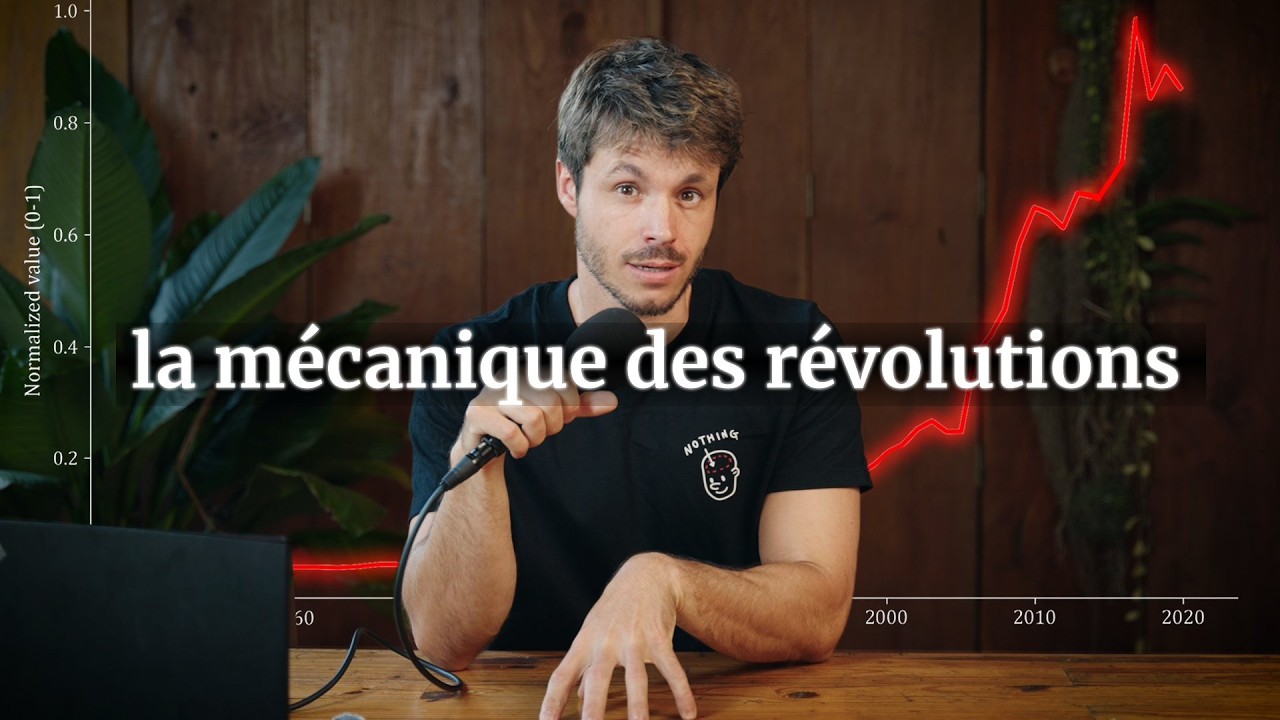
Cette révolte n'est pas politique*
This revolt is not political*
Title history
- Cette révolte n'est pas politique* — observed on 20261107-0952 UTC (YouTube)
Keywords
Summary
176 words
Critical Evaluation
Value of the Information & Strength of the Argument
The video’s value lies in its synthesis of a known but underpublicized macro-historical model and its application to a current event, offering a perspective that goes beyond partisan interpretations. The argument is built step by step: first establishing the inadequacy of ideological explanations, then exposing the SDT mechanism, and finally providing empirical illustrations from France and other countries. The reasoning is generally solid, with clear links between data points (e.g., debt-to-GDP ratio, number of grandes écoles graduates, level of food insecurity) and the model’s variables. However, the argument is one-sided: it does not seriously explore competing explanations or counter-evidence, and the selection of indicators can be seen as convenient. The speaker also openly acknowledges the model’s limitations and critiques, which adds nuance. Overall, the argumentation is persuasive but rests on a specific theoretical lens that is presented as the ‘best’ without fully comparing it to alternative frameworks.
Scientific Rigor, Source Quality, Title Accuracy
The video references a shared document in the description as the primary source compilation, but it does not cite specific publications directly within the transcript. It mentions Peter Turchin’s Nature article (2010) and a study by three French researchers, but no URLs are given. The reliance on a Google Doc as the only description link weakens immediate verifiability, though the presenter encourages viewers to consult it. The title is faithful to the content: it claims the revolt is not political in the ideological sense, and the video demonstrates that the drivers are structural, not partisan. The title is catchy and aligns well with the thesis. The absence of external peer-reviewed sources in the description is a limitation, but the video does mention the scientific literature in passing. Overall, the scientific rigor is moderate: the model is presented with clarity, yet the lack of direct citations and the selective use of data reduce its full credibility.
317 words
Title / Content Match
The title is deliberately provocative: it asserts the revolt is not 'political' in the ideological sense, and the video coherently defends this thesis by focusing on structural rather than partisan factors. The title matches the content's core argument.
Quality & Reliability
7/10
The video draws on a well-established theoretical framework (structural demographic theory) and presents quantitative indicators, but it remains an expert opinion with potential selection of data to fit the narrative. The argument is coherent but the lack of counter-examples and the broad nature of the model reduce its precision.
Key Moments
Markers derived by PSI from the transcript: the creator did not define chapters.
- Introduction: presenting the idea that the French revolt is not ideological but structural.
- Examples of similar revolts: Chile, Serbia, Nepal, Madagascar.
- Explanation of the structural demographic theory: three mechanisms (wealth pump, state fiscal crisis, elite overproduction).
- Application of the model to the French Revolution with historical data (population, elites, fiscal crisis).
- Current French indicators: inequality, public debt, elite overproduction (grandes écoles, lawyers).
- Comparison with 1990 student movement, and discussion of government response vs. historical compromises.
- Critiques of the model and conclusion on the need for elite compromise to avoid crisis.
Cited Sources
- Sources (Google Doc) — The video description points to this document as the main source list, presumably containing references for the data and studies mentioned.
Contribution & Novelties
The video’s original contribution is to popularize the structural demographic theory to a francophone audience and apply it to a very recent event (the 2026 French high school protests). It goes beyond simple news commentary by providing a macro-historical perspective, connecting short-term unrest to long-term structural trends. The video also addresses critiques of the theory, which adds depth.
Pour aller plus loin :
- Structural-demographic theory — Overview of the framework and its key components.
- Peter Turchin — Biographical and scientific context of the model’s main advocate.
- Cliodynamics — The broader interdisciplinary field that uses mathematical modeling of historical dynamics.
- Wealth pump — While not a direct match, this links to the concept of wealth concentration that fuels the ‘wealth pump’.
- Elite overproduction — Explains the exact phenomenon discussed in the video.
131 words
Radar Profile
The radar profile shows high scores in 'quantity of information' and 'reliability', with moderate 'technical level'. This indicates a video that provides substantial data and a plausible theoretical grounding, but it is not overly technical in its explanation, making it accessible to a broad audience. The 'quality of information' score is slightly lower, reflecting a certain degree of selective use of data.