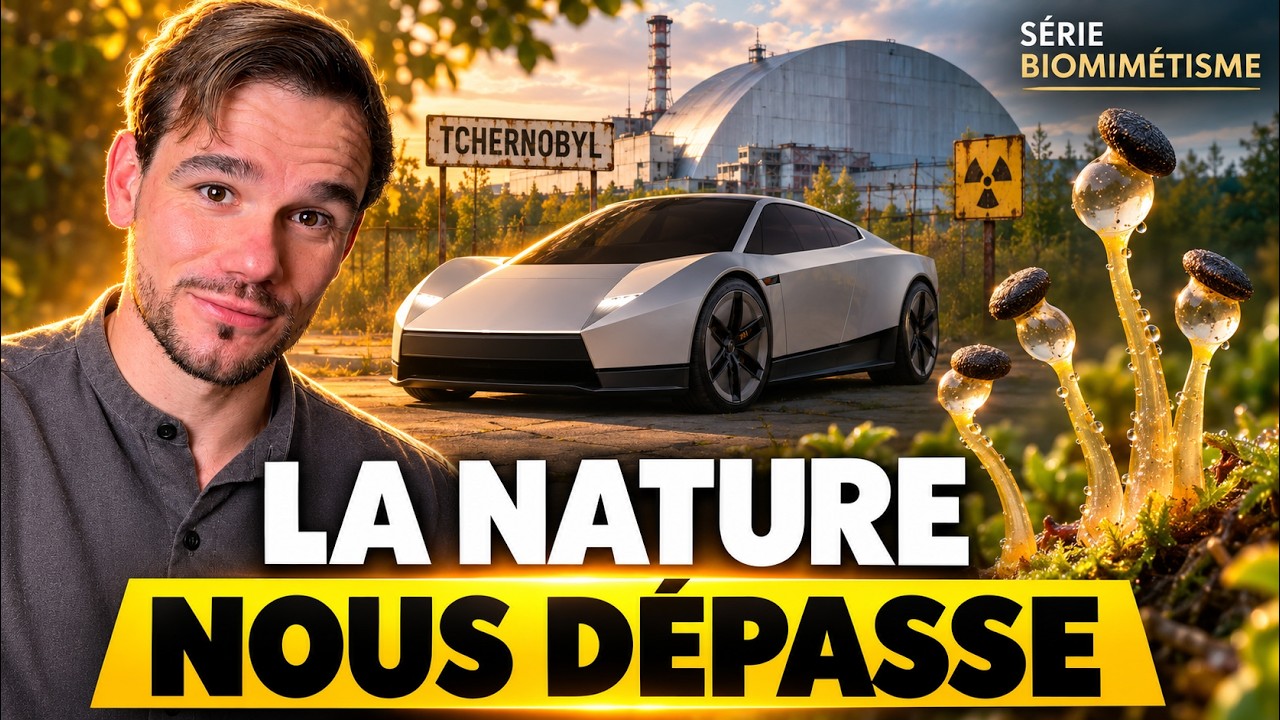
Ce champignon survit à Tchernobyl… et pourrait nous protéger sur Mars 🍄
This Mushroom Survives Chernobyl… and Could Protect Us on Mars 🍄
Title history
- Ce champignon survit à Tchernobyl… et pourrait nous protéger sur Mars 🍄 — observed on 20261110-1109 UTC (YouTube)
Keywords
Summary
128 words
Critical Evaluation
Value of the Information & Strength of the Argument
The video provides a rich amount of information, covering three diverse topics with clear explanations of underlying mechanisms. It effectively uses comparisons (e.g., acceleration scales) to make complex physics accessible. The argumentation is well-structured, moving from observation to scientific studies and then to potential applications. It also demonstrates scientific caution by explicitly separating confirmed findings from hypotheses, such as the unproven concept of radiosynthesis. The inclusion of recent studies (e.g., the 2026 mistletoe adhesive paper) adds current value. The narrative is engaging and logically flows from accelerations to radiation resistance to adhesives, reinforcing the overarching theme of biomimicry.
Scientific Rigor, Source Quality, Title Accuracy
The video shows good scientific rigor by referencing specific studies (e.g., Nicolas Money’s 2008 paper, the 2006 hydra study in Current Biology, and the 2026 Munich University paper). However, it does not provide direct linksto these sources in the description, only a general newsletter link. The distinction between demonstrated facts and hypotheses is a strength. The title overemphasizes the Chernobyl fungus and Mars, while the video covers three distinct topics; this partial mismatch is minor since the fungus segment is the most extensive. The video also clarifies that the ISS-tested strain is not from Chernobyl, which enhances credibility. Overall, the content is reliable, but the lack of explicit citations reduces the ability to verify claims independently.
229 words
Title / Content Match
The title focuses on the Chernobyl fungus and Mars, but the video also covers catapult fungi and mistletoe glue, making it broader than the title suggests.
Quality & Reliability
8/10
The video references several peer-reviewed studies and clearly distinguishes established facts from hypotheses, but it lacks direct citation links in the description.
Chapters
- Trois prouesses étonnantes du monde vivant
- Quel être vivant accélère le plus vite ?
- Les champignons qui catapultent leurs spores
- L’hydre et son harpon à l’accélération phénoménale
- Les champignons noirs de Tchernobyl
- Pourquoi certains champignons poussent vers les radiations
- La radiosynthèse : ce qui reste à démontrer
- Un champignon testé dans la Station spatiale internationale
- Un futur bouclier contre les radiations sur Mars ?
- Une précision essentielle sur les souches étudiées
- La mélanine inspire de nouveaux matériaux
- Le gui : bien plus qu’une plante de Noël
- Le secret de la colle naturelle du gui
- Une colle végétale qui adhère même au Téflon
- Résister au froid et se décoller à la chaleur
- Ce que le vivant peut encore nous apprendre
Cited Sources
- Scanderia Newsletter — The only link provided in the description, likely for further content and updates.
External References
Contribution & Novelties
The video offers a synthesis of three lesser-known biological phenomena and their potential technological applications, contributing to public awareness of biomimicry. It notably highlights the radiotropic behavior of fungi and the development of a mistletoe-based adhesive, presenting them in an accessible format. The distinction between experimental results and extrapolations adds informational value.
Pour aller plus loin :
- Biomimetics — The overarching field of nature-inspired innovation, directly relevant to all topics.
- Melanin — The pigment central to radiation resistance in fungi and potential materials.
- Mistletoe — The plant whose viscin adhesive inspired the discussed glue.
94 words
Radar Profile
The profile is well-balanced with high scores across information quantity, quality, technical level, and reliability. The video excels in providing substantial and rigorous content, with a slight edge on information quality due to careful scientific distinction.