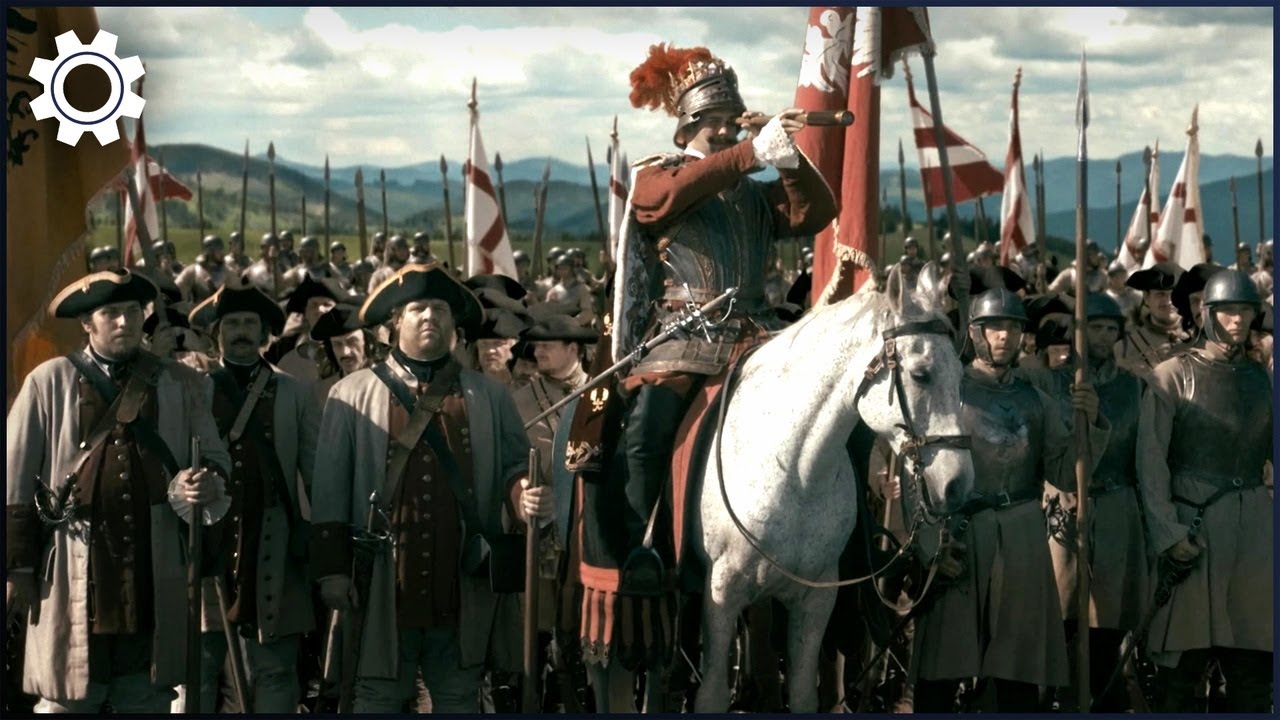
Prince Eugene Defies Louis XIV: Vienna 1683 to Zenta Gamble
Keywords
Summary
161 words
Critical Evaluation
Value of the Information & Strength of the Argument
The documentary’s informative value is substantial: it situates the Habsburg-Ottoman conflict in a rich cultural context, detailing military tactics, court dynamics, star-divination in wartime decisions, and medical knowledge transfers — such as the ant-based wound closure — that rarely make it into conventional histories. Its argumentation is built on a dual biographical thread — Eugene’s martial rise and Gül Nuş’s ascent within the harem — which effectively juxtaposes two distinct power structures and supports a more nuanced thesis than a simple good-versus-evil confrontation. Expert opinions, particularly from military historians and museum curators, anchor many claims, and the live replication of Eugene’s armor provides empirical illustration of the sort of damage a musket ball could inflict. However, the reconstruction of conversations and interior monologues is purely speculative, and the narrative at times prioritizes dramatic impact over documentary caution, weakening the argumentative coherence from a strictly scientific standpoint.
Scientific Rigor, Source Quality, Title Accuracy
The documentary displays a moderate level of scientific rigor. It relies on a mix of established historical facts (dates, battles, treaties) and interpretive storytelling. Specific institutions — the Vienna Museum of Military History and the Universal Museum Joanneum — are named as collaborators, lending credibility to the object-based segments. However, no written reference list accompanies the film, and several claims (e.g., the exact casualty figures, the intimate details of harem life) are presented as fact without citation, deriving from secondary narratives of varying reliability. The displayed title corresponds well to the content, giving an accurate preview of the episode’s geographic and thematic scope, with a slight touch of dramatic phrasing (‘Gamble’) that matches the film’s cinematic style but does not mislead about the subject matter.
286 words
Title / Content Match
The title faithfully reflects the content: the defiance of Louis XIV, the 1683 siege of Vienna, and the gamble at the Battle of Zenta are all central to the narrative, with no significant mismatch.
Quality & Reliability
7/10
The documentary combines historical narrative with expert commentary, object-based analysis (armour replica testing with the Austrian Armed Forces) and references to named institutions, but relies heavily on dramatized reenactments and reconstructed dialogues that dilute strict scientific accuracy. The inclusion of concrete demonstrations (ant-based suturing, armor ballistics) adds empirical weight, yet the absence of a bibliography or visible source list limits verifiability.
Key Moments
Markers derived by PSI from the transcript: the creator did not define chapters.
- Presentation of the two rival empires — Habsburg and Ottoman — and the main protagonists, Prince Eugene and Gül Nuş.
- Eugene's childhood in Paris: his mother Olympia Mancini, court intrigues, and his growing interest in science and astrology.
- Olympia escapes France after being accused of poisoning; Eugene later flees to the Habsburg court and offers his services to Emperor Leopold I.
- The Ottoman army sets out toward Vienna; Kara Mustafa's secret planning, the march's scale, and the brutal tactics of the Tatars.
- Siege of Vienna begins: Janissaries tunnel beneath walls, St. Stephen's Cathedral is damaged, and the city panics.
- Relief of Vienna on September 12, 1683; Eugene's baptism of fire and his reward of a regiment — the Savoy Dragoons.
- Eugene severely wounded near Belgrade; the ant-based wound-closure technique of the Ottomans is demonstrated and compared to modern medical clips.
- Mehmed IV deposed; Mustafa II, son of Gül Nuş, becomes Sultan, bringing his mother to the rank of Valide Sultan.
- Eugene prepares the decisive gamble at Zenta, ignoring the war council's counsel and betting everything on timing.
Cited Sources
- Vienna Museum of Military History — The museum housing Prince Eugene's armor, used to make a replica and infer his physical stature.
- Universal Museum Joanneum — Institution involved in the ballistics testing of the replica breastplate.
- Muhteşem Yüzyıl (The Magnificent Century) — Turkish TV series referenced by the filmmakers to illustrate modern Ottoman historical nostalgia.
Concurring Sources
- Prince Eugene of Savoy — Biographical article corroborating Eugene's career milestones and his role in the Habsburg-Ottoman conflicts.
- Battle of Vienna — Details the 1683 siege and relief, aligning with the documentary's narrative.
- Battle of Zenta — Covers the final engagement described in the video, confirming the tactical outcome.
Dissenting Sources
- Historical debate over Eugene's role at Vienna 1683 — The film asserts that Eugene actively distinguished himself at the relief of Vienna ; some historians contend that his role was marginal at that early stage and that his first meaningful command came only after the battle.
Contribution & Novelties
The film’s main novelty lies in its comparative perspective, threading the personal stories of Prince Eugene and Gül Nuş into the broader tapestry of Habsburg-Ottoman relations — a subject usually treated purely as military history. It brings to light overlooked cultural transfers, such as the ant-based surgical technique adopted from Ottoman doctors, the shared reliance on astrologers for war decisions, and the adoption of coffeehouses and hammams, complicating the image of two hermetically opposed civilizations. The armory experiment adds a tangible empirical layer rarely found in documentary history, offering a concrete sense of 17th-century combat hazards.
Pour aller plus loin :
- Prince Eugene of Savoy — An authoritative biography for extending the profile offered in the video.
- Battle of Vienna — Comprehensive details on the 1683 siege and relief operations, complementing the film’s account.
- Battle of Zenta — Background and consequences of the climactic engagement, providing a focused look at Eugene’s decisive victory.
- Harem — Contextual resource on the Ottoman harem hierarchy and the role of the Valide Sultan depicted in the film.
173 words
Radar Profile
The radar profile is relatively balanced, with information quantity scoring highest (8) and technical depth scoring lowest (6), reflecting the documentary's accessible treatment of a complex historical subject. Quality and reliability both sit at 7, indicating competent but not academic-level rigor.