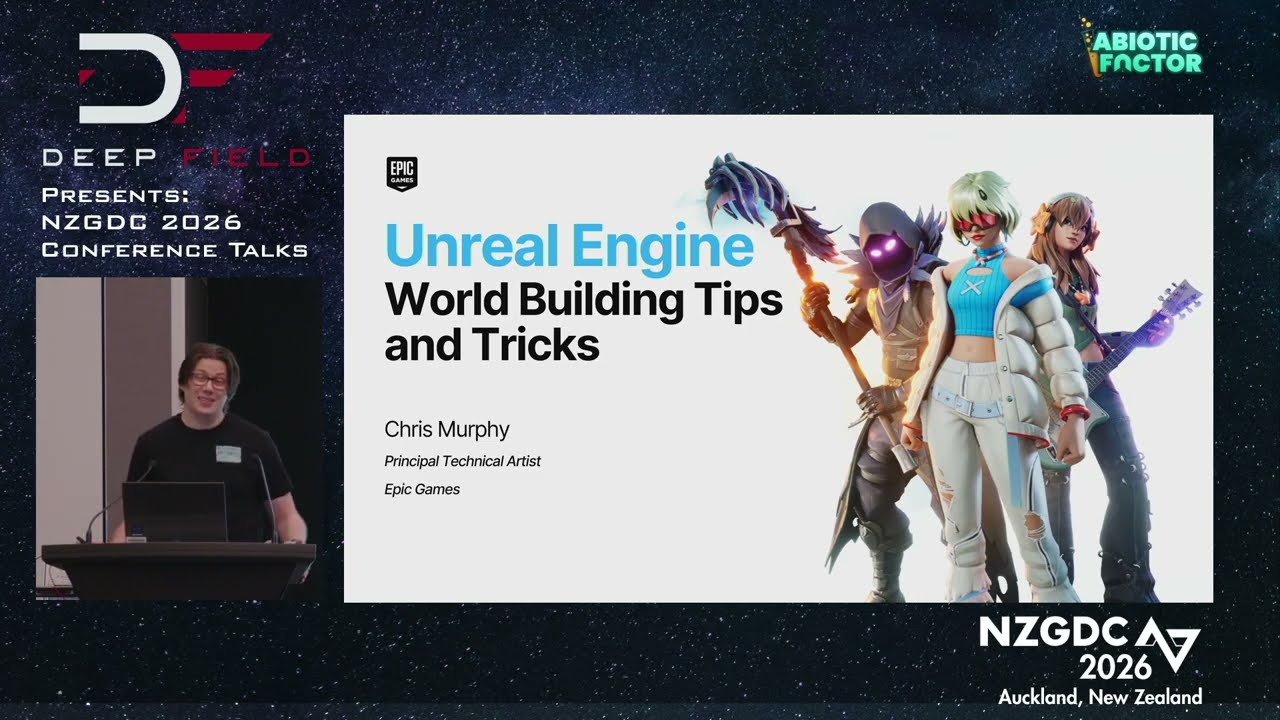
Unreal Engine: World Building Tips Every Unreal Artist Should Know | Chris Murphy | NZGDC 2026
Title history
- Unreal Engine: World Building Tips Every Unreal Artist Should Know | Chris Murphy | NZGDC 2026 — observed on 20261112-0839 UTC (YouTube)
Keywords
Summary
238 words
Critical Evaluation
Value of the Information & Strength of the Argument
The talk’s primary value lies in its practical, time-saving tips grounded in a senior technical artist’s production experience. Murphy argues for a data-oriented approach to materials (vertex data over textures) and a system-aware method for lighting debugging, which are sophisticated but presented with clear reasoning. His recommendations are substantiated by references to specific Unreal Engine features (e.g., Mesh Painting, Light Mixer) and the logic behind them (e.g., why the sun is measured in lux). The argumentation is coherent, though some tips are asserted rather than deeply justified, which is typical for a fast-paced tips session. The tone is engaging and humorous, which aids retention but doesn’t replace rigorous explanation.
Scientific Rigor, Source Quality, Title Accuracy
The presentation is not a formal scientific work but a professional tutorial; as such, no external sources are cited. However, Murphy’s position at Epic Games lends authority, and the features he discusses are verifiable within the engine. The title accurately reflects the content—it is a compilation of world building tips. The topic is directly addressed, with no major digressions. The talk’s rigor is adequate for its format, prioritizing practical relevance over academic citation, but the advice aligns with current Unreal Engine 5 capabilities and is consistent with official documentation.
213 words
Title / Content Match
The title accurately describes the content: a session dedicated to world building tips for Unreal Engine, delivered by a principal technical artist.
Quality & Reliability
9/10
Presentation by a Principal Technical Artist at Epic Games, offering practical, experience-based advice. The content aligns with current Unreal Engine features and is reliable for artists seeking to improve workflow. No formal citations, but the authority of the speaker and the specific technical details lend high credibility.
Key Moments
Markers derived by PSI from the transcript: the creator did not define chapters.
- Introduction and emphasis on Nanite being 'two clicks' to enable, urging artists to adopt it.
- Explanation of storing data in vertex level with Nanite to reduce texture memory, and introduction to Mesh Painting.
- Lighting fundamentals: using real-world values (candela, lumen, lux) and identifying system ownership for debugging.
- Coverage of Light Mixer and Environment Light Mixer tools for lighting management.
- Time of Day plugin and Color Grading tool details.
- Shortcuts and workflow tips: Ctrl+E, Ctrl+B, Alt+drag, End key, and K to keep physics state.
Cited Sources
- Unreal Engine Nanite documentation — Mentioned as a core geometry system; active in the virtualized geometry feature.
- Unreal Engine Lumen documentation — Discussed as the system handling global illumination and bounce lighting.
- Unreal Engine Megalights overview — Referenced for rendering thousands of lights; the speaker notes the need for ray tracing.
Contribution & Novelties
The session’s novelty lies in consolidating lesser-known features and shortcuts (e.g., Mesh Painting, Environment Light Mixer, local exposure) into a single practical guide. Murphy’s perspective as a Principal Technical Artist adds authority, and the emphasis on storing data in vertex attributes rather than textures is a modern optimization technique. The talk fills a gap by clarifying how to debug lighting issues by attributing them to specific systems (Lumen, VSSM, Megalights), which is not commonly covered in general tutorials.
Pour aller plus loin :
- Unreal Engine 5 Features and Documentation — Official documentation for all mentioned features.
- Nanite Virtualized Geometry — Epic Developer Community — Deep dive into Nanite’s architecture.
- Lumen Global Illumination — Epic Developer Community — Technical details and setup.
- Megalights in Unreal Engine — Epic Developer Community — Overview of this light rendering system.
- [Real-Time Rendering Fundamentals — YouTube or online course] — Since not having a stable URL, mention as a concept for understanding the principles behind the tips.
162 words
Radar Profile
The radar profile shows high scores in information quantity, quality, technical level, and global reliability, reflecting a dense, expert-led tutorial. The pattern indicates a highly practical and technically nuanced session, with moderate emphasis on novelty but strong on actionable advice.