The Art of Valheim: Good Enough | Robin Eyre, Lisa Tveit Kolfjord | NZGDC 2026
Title history
- The Art of Valheim: Good Enough | Robin Eyre, Lisa Tveit Kolfjord | NZGDC 2026 — observed on 20261112-1038 UTC (YouTube)
Keywords
Summary
159 words
Critical Evaluation
Value of the Information & Strength of the Argument
The talk offers valuable, actionable insights into a successful indie game’s art workflow. The speakers clearly articulate their reasoning behind design choices, providing concrete examples and visual demonstrations. They confidently argue that their minimalist approach, driven by resource constraints, results in a unique and appealing aesthetic. The argumentation is coherent and grounded in practical experience, though it lacks empirical evidence or comparative analysis. The value lies in the transferable principles (good enough, rule of cool) and the detailed pipeline walkthrough, which could inspire other small teams.
Scientific Rigor, Source Quality, Title Accuracy
The speakers are directly involved in the creation of Valheim, making them authoritative primary sources. They reference internal practices and tools (Blender, Krita, Unity) without citing external academic sources, which is appropriate for a professional talk. The title ‘The Art of Valheim: Good Enough’ is perfectly aligned with the content, and the practical demonstrations reinforce the credibility of their claims. The presentation includes some humorous asides but remains focused on the subject, and the absence of citations is not a weakness given the experiential nature of the content.
189 words
Title / Content Match
The title accurately reflects the content: the talk focuses on the 'good enough' philosophy and its application to Valheim's art creation.
Quality & Reliability
8/10
The talk provides a detailed, first-hand account of the art pipeline and guiding principles at Iron Gate, based on the speakers' direct experience. The content is practical, well-structured, and transparent about limitations and trade-offs. While not peer-reviewed, it is a reliable insider perspective on game art production.
Key Moments
Markers derived by PSI from the transcript: the creator did not define chapters.
- Introduction of speakers Robin and Lisa, their backgrounds and roles.
- Overview of Valheim and its art style, influenced by retro games.
- Introduction of Iron Gate studio, its small team and early history.
- Explanation of 'good enough' principle with examples from the game.
- Explanation of 'rule of cool' and its application to design choices.
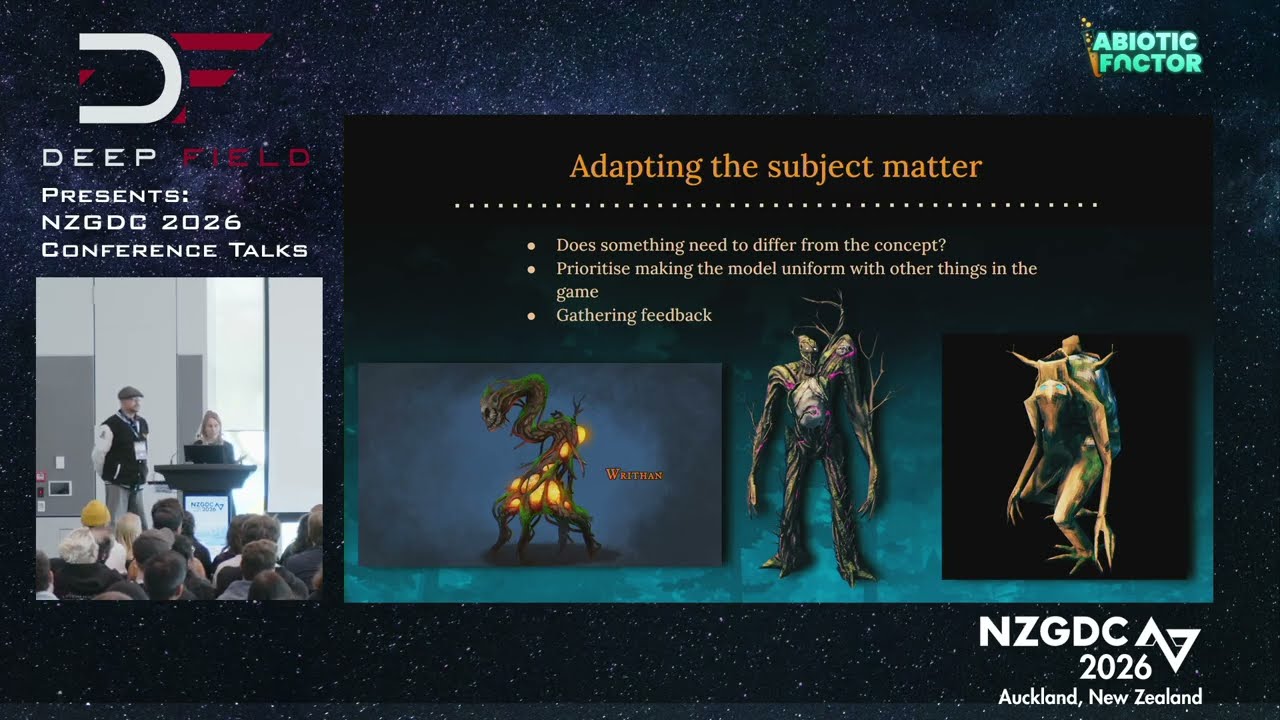
- Description of the art pipeline from concept to 3D, using the creeper creature as an example.
- Discussion of UV mapping, texture painting, and normal maps in Unity.
Concurring Sources
- Valheim - Official Website — Official game page confirming the game's setting, features, and visual style.
Contribution & Novelties
The talk provides a rare, detailed look at the artistic decision-making behind a highly successful indie game. It formalizes the ‘good enough’ and ‘rule of cool’ as practical heuristics for game development, offering a framework that balances creativity and pragmatism. The emphasis on using free open-source software (Blender, Krita) and a streamlined pipeline demonstrates how small teams can achieve distinctive results without large budgets. The presentation of the root creeper creation process is an original case study that can inspire other artists.
Pour aller plus loin :
- Low poly 3D modeling — Explanation of the aesthetic style Valheim employs.
- Valheim - Wikipedia — Overview of the game’s development, release, and reception.
- Iron Gate Studio - Wikipedia — Background on the developer and its philosophy.
124 words
Radar Profile
The radar profile shows high scores in information quantity, quality, and reliability, with a slightly lower score in technical depth, reflecting the talk's accessible yet insightful nature. The balanced profile indicates a well-rounded, practical presentation.