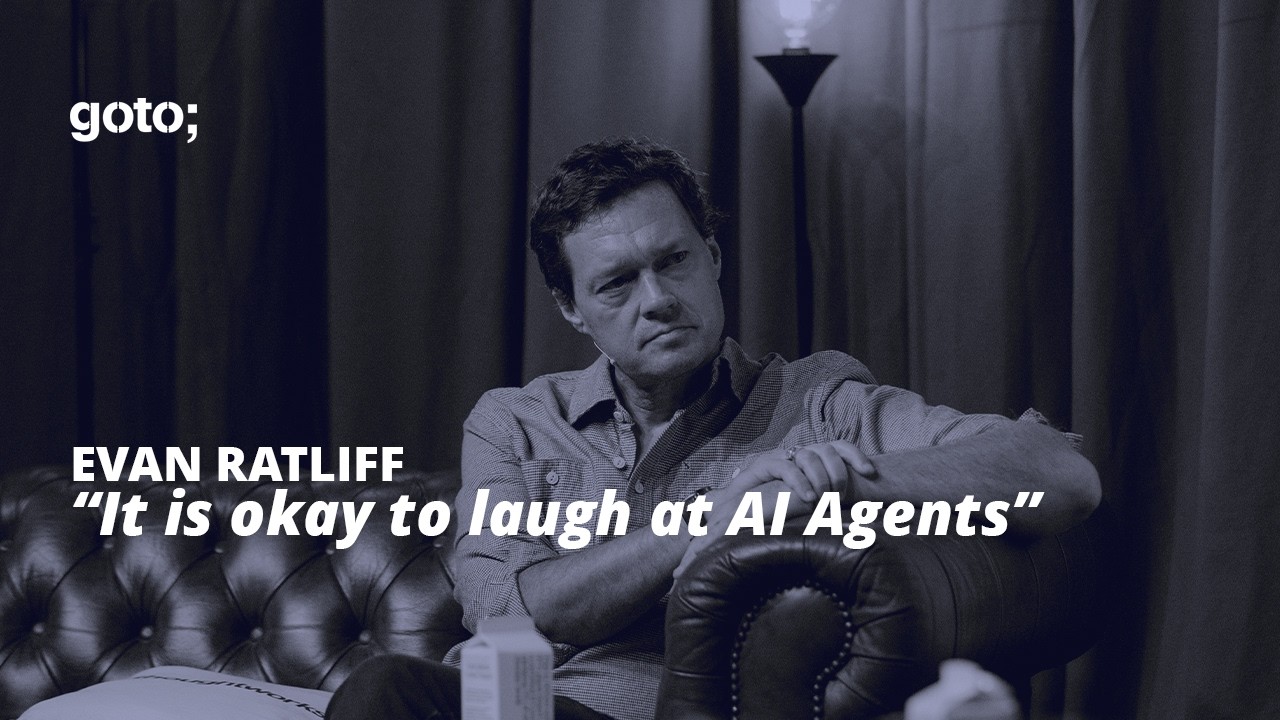
What it's like inside a company staffed almost entirely by AI • Evan Ratliff • GOTO Copenhagen 2026
Title history
- What it's like inside a company staffed almost entirely by AI • Evan Ratliff • GOTO Copenhagen 2026 — observed on 20261111-1539 UTC (YouTube)
Keywords
Summary
167 words
Critical Evaluation
Value of the Information & Strength of the Argument
The value of this talk lies in its authentic, first-hand account of an extreme use case—building a startup with AI agents—which provides insights into practical challenges that are often hidden in more controlled demonstrations. The argumentation is coherent, structured around four themes (initiative, memory, authority, connection) that emerge from direct observation. Ratliff supports his points with specific anecdotes, including audio clips of agent interactions and examples of emergent behaviors, such as the AI team organizing a hiking offsite. He also connects his experiences to broader industry trends, citing a BCG study on companies placing AI agents in org charts. However, the analysis is subjective and lacks quantitative evidence or controls, so the conclusions are suggestive rather than definitive.
Scientific Rigor, Source Quality, Title Accuracy
As a journalist, Ratliff demonstrates rigor by clearly distinguishing between his observations and interpretations. He references his own podcast ‘Shell Game’ as primary source material and mentions a Boston Consulting Group study without providing a direct citation. The title accurately reflects the content, which is about his personal experience inside an AI-staffed company. The talk includes some technical details about the tools used (Lindy, memory documents, etc.), but the emphasis is on human-AI interaction rather than underlying technology. The sources relied upon are primarily his own project, which is transparent and appropriate for an experiential account, but limits the generalizability. There is no mention of independent validation or peer review, so the overall scientific rigor is moderate.
250 words
Title / Content Match
The title accurately describes the content: a personal account of running a company staffed by AI agents.
Quality & Reliability
6/10
The talk is a first-person narrative with concrete examples, but lacks systematic data or independent verification. The speaker is a veteran journalist with 25 years of experience, which lends credibility to the account, yet the claims are anecdotal and not generalizable.
Chapters
- Intro
- About Me
- The First Experiment - Making a clone
- Doing Something A Little DIfferent - The billion dollar startup
- How I Build The Company - The AI Team
- How I Buildt The Team
- Meeting Agent Kyle
- Initiative Restraint - How to make them do their job
- Memory - Emergent behaviours
- Authority - Hire the second human working with AI
- Connection - Time to make money
- The Subject Of An Experiement
- Outro
Cited Sources
- Shell Game (podcast) — The presenter's immersive journalism project documenting AI experiments, referenced multiple times.
- Evan Ratliff on LinkedIn — Professional profile of the speaker.
- GOTO Copenhagen 2026 Session Page — Provides slides and full abstract of the talk.
External References
Contribution & Novelties
This talk contributes a unique insider perspective on managing a team of AI agents, an area often discussed theoretically but rarely demonstrated in practice. Ratliff’s immersive journalism method—placing himself at the extreme—exposes unexpected behaviors such as agents inventing fictitious progress and organizing unsanctioned offsites. These anecdotes offer practical lessons for organizations adopting AI agents. The talk also underscores the difficulty of balancing agent autonomy with control, and the persistent hallucination problem in autonomous systems.
Pour aller plus loin :
- AI agent — Provides a foundational overview of autonomous software agents and their capabilities.
- Hallucination (artificial intelligence) — Explains the phenomenon of AI generating false or nonsensical outputs, directly relevant to Ratliff’s experiences.
- Human-in-the-loop — Discusses approaches to integrating human oversight with autonomous systems, addressing the authority and restraint issues raised.
- Organizational culture — The emergence of a ’tech bro’ personality and social dynamics among AI agents parallels concepts of human organizational behavior.
152 words
Radar Profile
The profile shows moderate scores across information quantity, quality, and technical level, with a slightly lower reliability due to the anecdotal nature. This suggests a balanced presentation that is informative and engaging but not deeply technical or rigorously scientific.