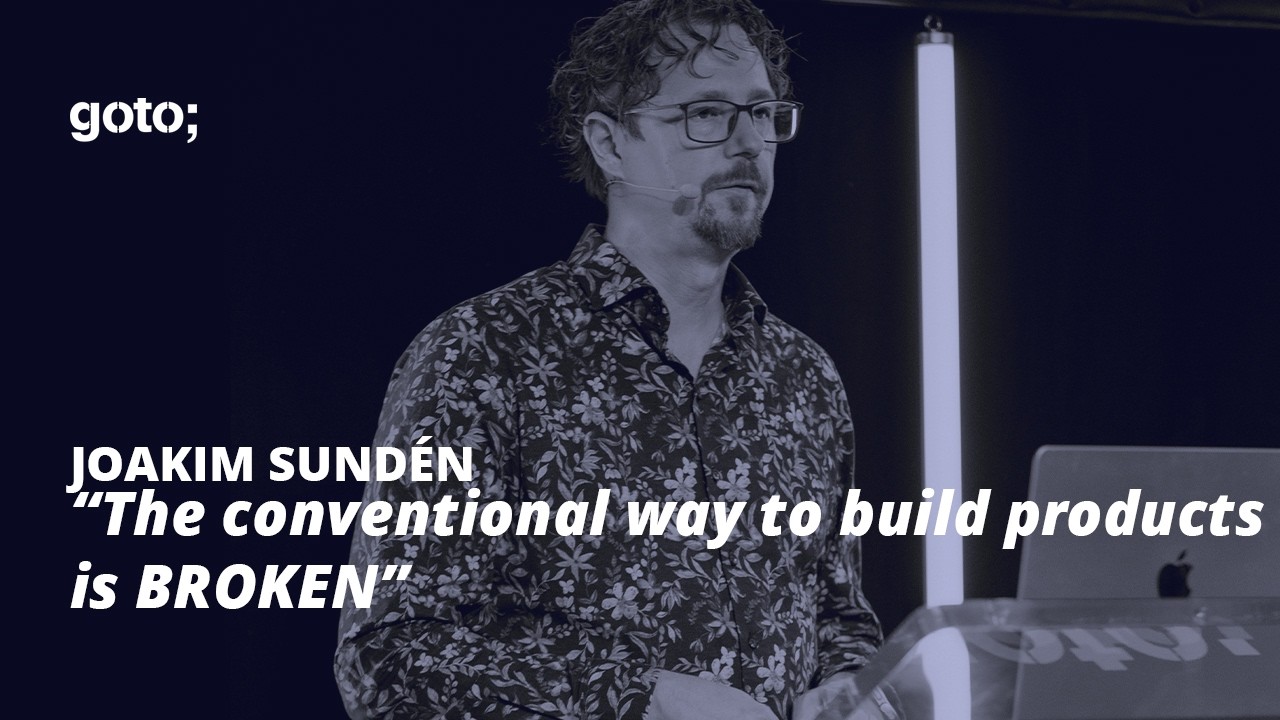
The smoothest reorg": lessons in collaborative org design • Joakim Sundén • GOTO Copenhagen 2026
Title history
- The smoothest reorg": lessons in collaborative org design • Joakim Sundén • GOTO Copenhagen 2026 — observed on 20261110-1353 UTC (YouTube)
Keywords
Summary
159 words
Critical Evaluation
Value of the Information & Strength of the Argument
The talk offers practical value by presenting a concrete case study and actionable patterns. The argumentation is persuasive, drawing on real experiences from Spotify and other organizations. The speaker effectively reframes reorgs as a collaborative discovery process rather than a top-down plan, and supports this by referencing established frameworks like Team Topologies and David Marquet’s leadership model. The reasoning is coherent, with clear cause-and-effect links between the methods used and the positive outcome (‘smoothest reorg’). However, the evidence is anecdotal — the speaker does not provide measurable success metrics or a controlled comparison with traditional reorgs, which limits the depth of the argument.
Scientific Rigor, Source Quality, Title Accuracy
The speaker demonstrates rigor by grounding his approach in well-known sources: Team Topologies by Skelton and Pais, ‘Empowered’ by Martin Cagan, and ‘Turn the Ship Around’ by David Marquet. He also cites his own experience at Spotify, which lends credibility. The title is accurate and informative. The description includes links to the speaker’s profile and conference session, but no direct links to the mentioned books or research, so the audience must search them independently. Overall, the source quality is good, though the reliance on personal experience rather than external evidence reduces scientific rigor.
211 words
Title / Content Match
The title accurately captures the core message: an experiential account of a nearly effortless reorg driven by collaborative design principles.
Quality & Reliability
8/10
Talk from a recognized conference, the speaker has deep experience at Spotify and cites established frameworks (Team Topologies, David Marquet's 'Turn the Ship Around', Martin Cagan's 'Empowered'). The content is practice-based and well-structured, though it remains an experience report rather than peer-reviewed research.
Chapters
- Intro
- The Smoothest Reorg I've ever seen - Who am i?
- What's One Word That Pops Into Your Head When You Think Of A "Re-Org"
- Done TO People And Not WITH People - Some problems
- Why Do Smart Leaders Keep Designing Organizations Top-Down?
- What If The People Closest To The Work Helped Design The Organization
- How Do You Safely Empower People?
- Change How Change Happen
- Give People A Destination
- Teach People How To Design Organizations
- Agree What You're Optimizing For
- Explore Alternatives? Strategic Context Determines Team Topology
- Make teams Explicit
- Evolve The Design And Expand The "Design Team"
- Let People Self-Select
- Will It Work? It's Not The Org Chart
- Context, Clarity, Competence and Control
- Principles That Made It Work
- Outro - Thanks for listening
Cited Sources
- Session page at GOTO Copenhagen 2026 — Official description and slides download for the talk.
- Joakim Sundén's website — Speaker's personal website with more resources.
- Joakim Sundén on LinkedIn — Professional profile and experience details.
- Joakim Sundén on X (Twitter) — Speaker's social media outreach.
- Joakim Sundén on Bluesky — Speaker's social media presence.
External References
Contribution & Novelties
This talk contributes to the field of organizational design by offering a systematic method for involving employees in reorgs. It builds on existing concepts like Team Topologies and self-selection, but introduces a structured process with stages such as ‘give people a destination’, ’teach people how to design organizations’, and ’let people self-select’. The practical emphasis on team-level APIs and using them as thinking tools is a novel adaptation. The talk also highlights the importance of treating change as product development, which is a fresh perspective in org change management.
Pour aller plus loin :
- Team Topologies book — Core reference for the team structures discussed, its principles of stream-aligned, platform, and enabling teams are central to the talk.
- Turn the Ship Around by David Marquet — The model of empowerment and the 4Cs (Context, Clarity, Competence, Control) builds on his work.
- Self-selection in organizational design — The practice of letting employees choose their teams, mentioned in the talk, has been used in various companies and is a key part of the approach.
172 words
Radar Profile
The radar profile shows strengths in quality and technical level, with moderate scores for quantity and reliability. This suggests a talk that offers solid practical guidance but lacks robust empirical backing, which is typical of expert experience reports.