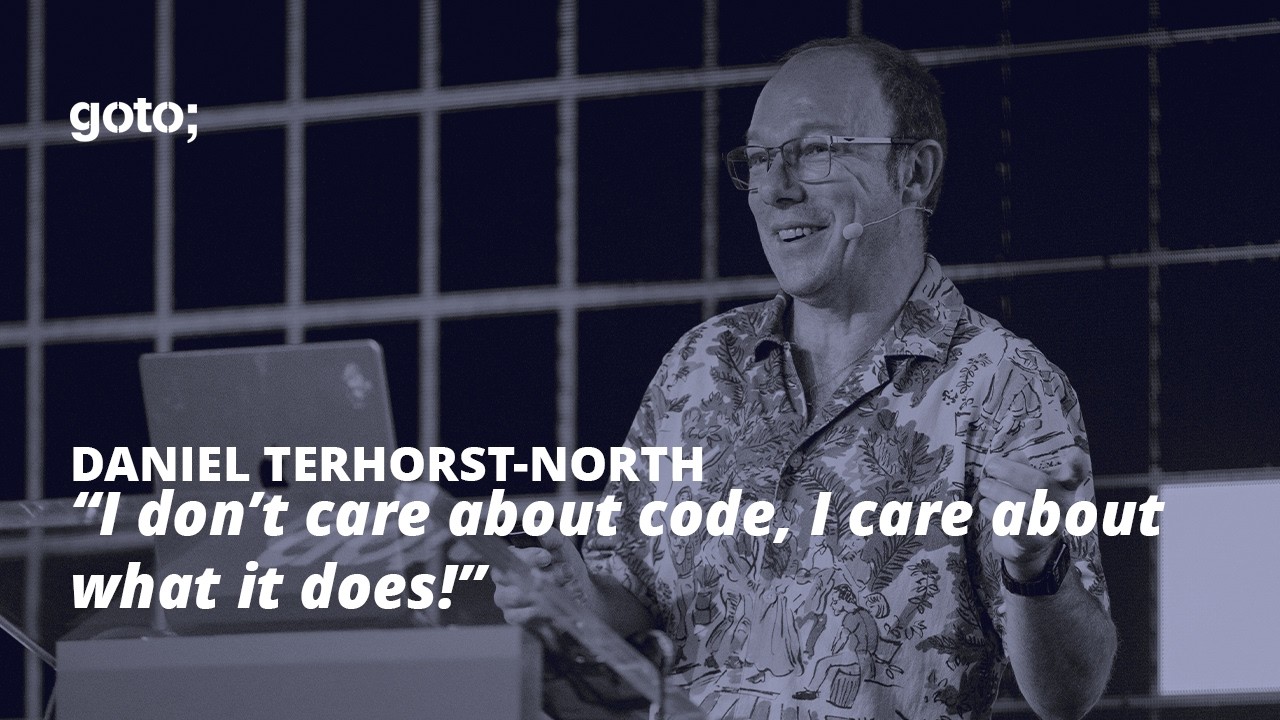
Am I holding this right? • Daniel Terhorst-North • GOTO Copenhagen 2026
Title history
- Am I holding this right? • Daniel Terhorst-North • GOTO Copenhagen 2026 — observed on 20261105-1421 UTC (YouTube)
Keywords
Summary
166 words
Critical Evaluation
Value of the Information & Strength of the Argument
The talk’s value lies in its hands-on, pragmatic perspective from an experienced software developer. Terhorst-North grounds his arguments in concrete examples (e.g., converting JQ scripts, building a presentation tool) rather than abstract theory. His argumentation is coherent and persuasive, though largely based on personal experience rather than systematic data. He acknowledges the limitations of LLMs while highlighting their utility, offering a balanced view. The use of metaphors like ‘scrapheap programming’ and ‘stochastic parrot’ effectively communicate complex ideas. However, the lack of empirical evidence or comparative analysis weakens the scientific rigor.
Scientific Rigor, Source Quality, Title Accuracy
Terhorst-North references several well-known sources, including Emily Bender’s ‘stochastic parrot’ paper, James Noble and Justin Biddle’s ‘postmodern programming,’ and Goldratt’s ‘Theory of Constraints.’ These lend credibility, but they are cited in passing without deep engagement. The talk does not provide a formal literature review or methodology. The title ‘Am I holding this right?’ is a playful but apt question that frames the talk as a self-reflection on his use of AI, which is consistent with the content. There are no comments provided to analyze.
189 words
Title / Content Match
The title is a playful rhetorical question that accurately reflects the talk's theme of evaluating one's approach to using LLMs.
Quality & Reliability
6/10
The talk is a personal, experience-based account of using LLMs, with references to known concepts but no rigorous methodology. It offers practical insights but relies heavily on anecdote.
Chapters
- Intro
- Let Us Start
- My Experience With LLMs
- My Training Materiale - Theories of constraint
- Claude I Need a Plan! - Feeding Claude my Material
- Meet The Tools - The tools i buildt
- Seing a Demo - Presenting what i made with Claude
- Notes From The Field - What have i observed
- Wrapping Up
- Things You WILL Forget Even Though I Told You
Cited Sources
- Daniel Terhorst-North's blog — Speaker's personal blog with articles on software practices and AI.
- GOTO Copenhagen 2026 session page — Detailed abstract and slides download for this talk.
- GitHub profile of tastapod — Repository of tools built and mentioned during the talk.
- LinkedIn profile of Daniel Terhorst-North — Professional profile and additional resources.
- GOTO conferences official page — Main website for GOTO events and content.
External References
Contribution & Novelties
The talk contributes a nuanced, practitioner-level framework for thinking about LLM use: ‘adjacent engineering’ (offloading side tasks) and ‘adjacent discovery’ (when side quests become products). It also challenges the ‘speed of code production’ narrative by emphasizing business impact and maintainability. The ‘scrapheap programming as a service’ metaphor is original and captures the reality that many LLM outputs are recombinations of existing code. Practical pitfalls, such as lacking self-regulation and the sunk cost fallacy, are valuable for users.
Pour aller plus loin :
- Stochastic parrot (Wikipedia) — Origin of the term in relation to LLM critique.
- Theory of constraints (Wikipedia) — Goldratt’s management paradigm referenced in the talk.
- Training from the back of the room (Wikipedia) — A teaching methodology mentioned by the speaker.
- Postmodern programming article (PDF) — The paper by Noble and Biddle that discusses code reuse and patterns.
140 words
Radar Profile
The radar profile shows a moderate quantity of information, lower technical depth, and moderate reliability, indicating a talk that is rich in practical anecdotes but not deeply technical or rigorously sourced. This aligns with a practitioner's perspective aimed at sharing experience rather than presenting formal research.