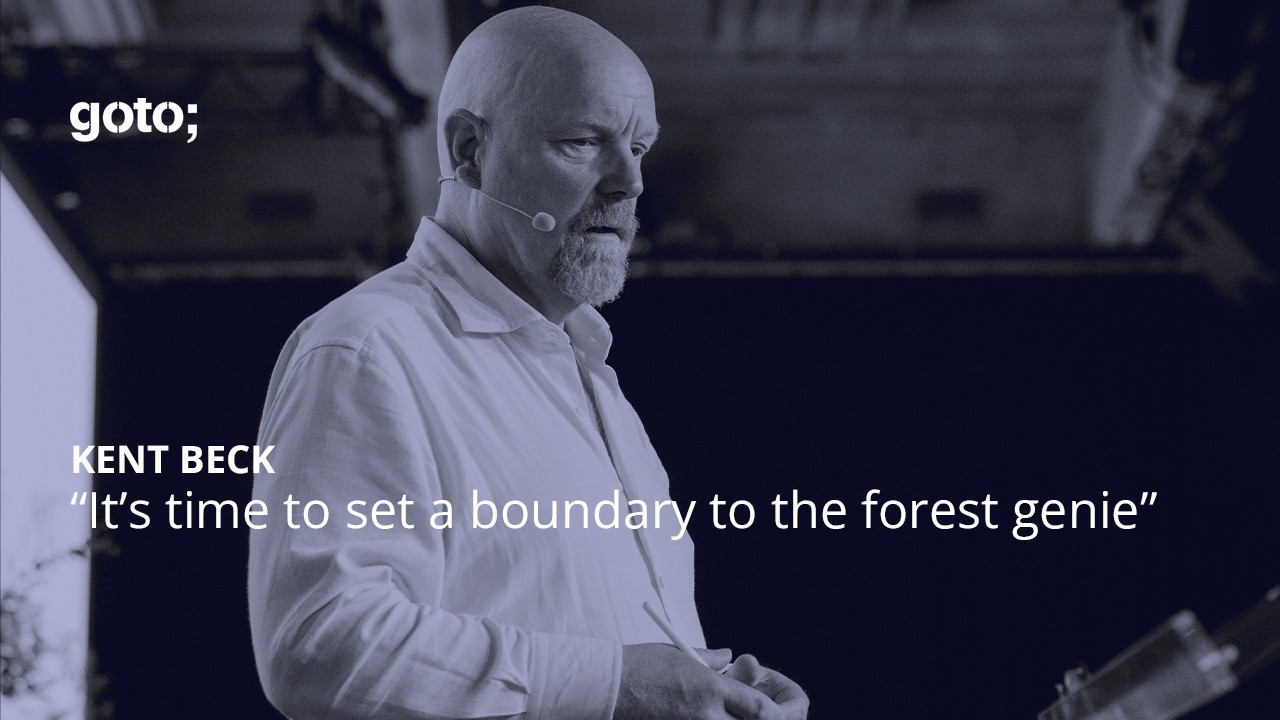
The Augmented Forest • Kent Beck• GOTO Copenhagen 2026
Title history
- The Augmented Forest • Kent Beck• GOTO Copenhagen 2026 — observed on 20261104-1139 UTC (YouTube)
Keywords
Summary
158 words
Critical Evaluation
Value of the Information & Strength of the Argument
The talk offers valuable insights into the human side of AI-assisted programming, particularly the psychological and social consequences currently underappreciated in the industry. Beck’s argument that AI amplifies existing conditions (both forest and desert) is compelling and well-illustrated with personal anecdotes. His critique of the focus on model capabilities at the expense of human needs is thoughtful, and his concept of ’tool seeds’ is an original, practical idea. However, the argumentation relies heavily on personal experience and metaphor rather than empirical data, which weakens its generalizability. Still, the reasoning is internally consistent and raises important questions about the direction of AI tool design.
Scientific Rigor, Source Quality, Title Accuracy
The talk cites no formal academic sources; instead, it references Kent Beck’s own experience and prior talks. The description provides links to his social media and GitHub, as well as the session page for slides. This is typical of an expert keynote, where authority stems from experience rather than citation. The title accurately reflects the content, emphasizing the augmentation of the forest metaphor by AI. While the talk lacks rigorous scientific backing, it is intellectually honest about its subjective nature, and the sources provided are legitimate and relevant.
206 words
Title / Content Match
The title 'The Augmented Forest' cleverly fuses the forest/desert metaphor with AI augmentation, accurately capturing the talk's core thesis about AI amplifying software development environments.
Quality & Reliability
7/10
Kent Beck is a highly respected software engineer and creator of Extreme Programming, but this talk is primarily opinion-based, drawing on personal experience and metaphorical reasoning rather than empirical evidence. The arguments are coherent and insightful, though not formally rigorous.
Chapters
Cited Sources
- GOTO Copenhagen 2026 Session Page — Slides and full abstract of the talk.
- Kent Beck's Website — Personal site with blog and resources.
- Kent Beck's GitHub — Repository with code and tools, including the call graph visualizer.
- Kent Beck on X — Social media profile.
- Kent Beck on LinkedIn — Professional profile.
- Kent Beck on Bluesky — Social media profile.
- GOTO Expert Profile: Kent Beck — Speaker bio on GOTO's site.
External References
Contribution & Novelties
The talk introduces the novel concept of ’tool seeds’—distributing prompts that generate tools rather than the tools themselves—which could change how software tools are shared and adapted. It also extends the forest/desert metaphor by framing AI as an amplifier, offering a new lens for understanding both positive and negative effects. The emphasis on human needs (competence, connection, purpose) as a missing dimension in AI tool design is a fresh and relevant contribution.
Pour aller plus loin :
- Extreme Programming — Kent Beck’s own methodology, background to many arguments.
- Technical debt — Central to the ‘features vs. futures’ discussion.
- Maslow’s hierarchy of needs — Framework for human needs referenced conceptually.
- Vibe coding — Mentioned in the talk as a contemporary practice.
- Large language model — Underlying technology of the ‘genie’.
129 words
Radar Profile
The profile shows high scores in information quantity and technical level, but lower in reliability and source rigor, reflecting a talk rich in ideas but based on personal experience rather than structured research. The balanced quality information score indicates substantive content, while the lower global reliability suggests caution in generalizing the claims.