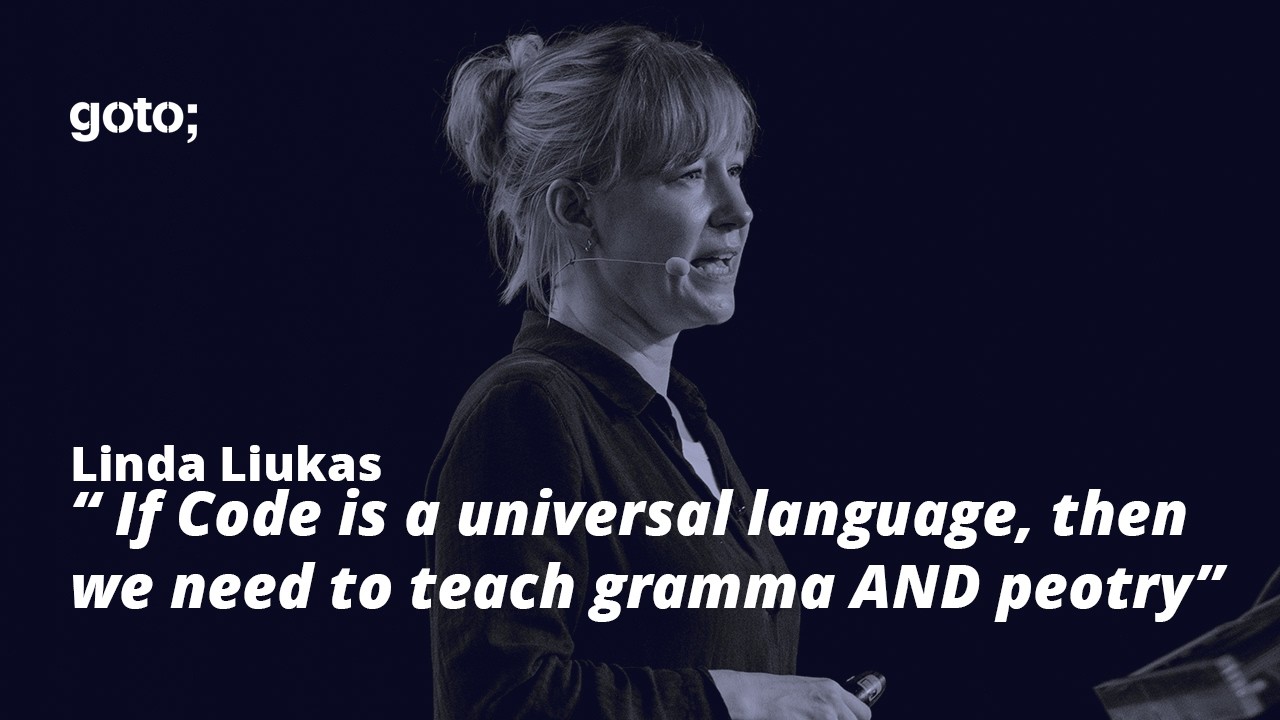
Climbing inside the machine • Linda Liukas • GOTO Copenhagen 2026
Title history
- Climbing inside the machine • Linda Liukas • GOTO Copenhagen 2026 — observed on 20261112-1855 UTC (YouTube)
Keywords
Summary
213 words
Critical Evaluation
Value of the Information & Strength of the Argument
The talk’s value lies in its concrete demonstration of how abstract computer science concepts can be translated into physical, interactive experiences. Liukas effectively argues that traditional methods of teaching code through syntax and jargon alienate many learners, and that embodied learning provides deeper understanding and retention. Her narrative is compelling, supported by personal anecdotes, examples from her books, and the detailed case study of the playground. The argumentation is sound, referencing established educational psychologists and theorists, and she makes a persuasive case for investing in playful, public spaces for learning. The presentation is engaging and flows well, though it occasionally relies on the speaker’s charisma more than empirical evidence. Overall, the argument that tangible experiences are powerful for teaching complex ideas is well-supported within the context of her projects.
Scientific Rigor, Source Quality, Title Accuracy
Liukas cites several influential figures and theories (Maria Montessori, Jean Piaget, Seymour Papert) and references cultural touchpoints like Maurice Sendak and Brett Victor’s Dynamicland. She mentions research and benchmarking of playgrounds worldwide, but no formal citations or studies are presented. The sources she does reference are credible within education and computing, but the talk is primarily based on her own experience and observations. The title is perfectly aligned with the content, as it metaphorically describes the act of physically entering a computer through the playground. The talk includes no mention of sponsors or advertisements, so there is no commercial bias. The public response (based on the absence of comment data) cannot be assessed, but the presentation is professional and well-structured.
264 words
Title / Content Match
The title 'Climbing inside the machine' directly reflects the central narrative of building a playground that allows children to physically enter a computer model, making it highly appropriate.
Quality & Reliability
7/10
The talk is based on the speaker's extensive personal experience in computer science education and a concrete large-scale project (the Helsinki playground). Claims are anecdotal and project-specific rather than peer-reviewed, but they are coherent and grounded in established educational theories (Piaget, Montessori, Papert).
Chapters
- Intro
- Who am I? And what do i do?
- What is Hello Ruby? Learning with stories
- Legacy in the field!
- Fingertip Knowledge
- Database - An anecdote of pancakes
- Making ideas tangible
- Sharing the language - making ways to understand the technical
- Returning to the playground - Constructing a playable computer
- Inspiration and research of the computer playground
- Designing the playground
- What the playground can teach you in your work
- Playground as hardware, playground as software
- What's your playground moment?
- Playgrounds as models for 21st century learning
- Children are the R&D department of humanity
- Outro
Cited Sources
- GOTO Copenhagen 2026 Session Page — Official session page with abstract and slides download
- Linda Liukas's Official Website — Author's personal website showcasing her books and projects
- Linda Liukas on X — Twitter/X profile for updates and discussions
- Linda Liukas on LinkedIn — Professional profile
- GOTO Expert Profile for Linda Liukas — GOTOpia expert page
- GOTO Conferences YouTube Channel — Channel subscription link
- GOTO Copenhagen 2027 Event Page — Upcoming event information
- GOTOpia Technology — Platform for conference content and expertise
- GOTO on LinkedIn — LinkedIn company page
- GOTO on Bluesky — Bluesky profile
Concurring Sources
- Hello Ruby Website — The speaker's educational project, which aligns with the talk's methods of teaching computing through stories.
External References
Contribution & Novelties
The talk presents a novel approach to computer science education by designing a full-scale public playground that makes computational ideas physically tangible. This goes beyond typical educational tools by embedding learning into everyday public infrastructure, fostering community engagement and long-term exposure. The project demonstrates an innovative collaboration between education, design, and municipal governance. The speaker’s emphasis on ‘fingertip knowledge’ and bodily learning offers a refreshing alternative to screen-based instruction, especially relevant in the age of AI.
Pour aller plus loin :
- Von Neumann architecture — The conceptual model that inspired the playground’s input-process-output design.
- Maria Montessori — Her educational philosophy and the characteristics of good learning materials are directly referenced in the talk.
- Seymour Papert — Pioneer of constructionist learning and LOGO, whose ideas align with the tangible learning approach.
- Brett Victor’s Dynamicland — Relevant for creating computational environments without screens, as mentioned in the talk.
- Playground design for children — General context on the evolution and importance of play spaces.
161 words
Radar Profile
The radar profile shows a moderate-to-high score in quantity of information and fiabilité, but a lower score in technical level, reflecting the talk's focus on educational and societal aspects rather than deep technical detail. The qualitative and global aspects are balanced, indicating a well-rounded presentation suited for a broad technical audience.