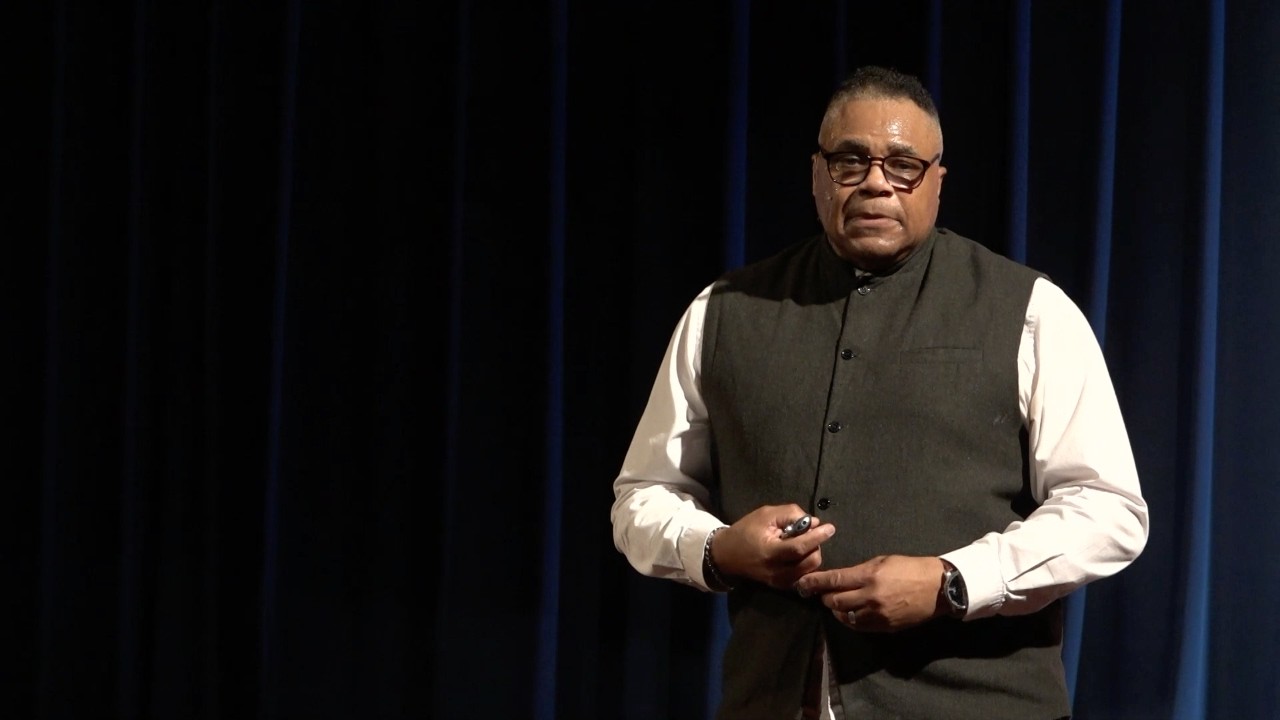
Building bridges of connection in a fragmented world | Roy Lewis | TEDxUCO
Keywords
Summary
248 words
Critical Evaluation
Value of the Information & Strength of the Argument
The informational value is low to moderate: the talk delivers almost no verifiable data, no named studies, no statistics and no conceptual framework that a listener could not have formulated alone. What it does transmit is a compact rhetorical package — a diagnosis (division is engineered), a normative claim (walls deepen disconnection, bridges reduce it), and a five-item behavioural checklist. The checklist items are individually reasonable and recognisable from established communication practice (respectful engagement, active listening, tolerance of disagreement, exposure to diverse networks, compassion and empathy), but each is asserted in a sentence or two, with no mechanism, no boundary conditions and no evidence that adopting them changes outcomes at scale. The argumentative structure rests on authority of experience rather than on inference: the Mrs. Ross anecdote is offered as proof that one person’s bridge-building changed a life, and Auschwitz is offered as proof that division is deliberate and costly. Both are emotionally powerful but logically underdetermined — a single case cannot establish a general causal claim, and the Auschwitz example is a limit case of industrialised state violence whose connection to everyday incivility is asserted rather than argued. The central causal thesis (‘it’s by design’) is stated as a conspiracy-adjacent intuition without any agent, mechanism or evidence, and is then immediately contradicted by the optimistic claim that platforms are improving connection; the two propositions sit side by side without being reconciled. The talk is also internally loose in places: an anecdote about confronting a liberal niece by showing her that her social network is homogeneous is presented as a light-hearted illustration of enlarging one’s circles, yet it actually illustrates the opposite dynamic (pointing out another person’s echo chamber). Overall the argument is coherent at the level of moral exhortation and weak at the level of demonstration; it functions as a call to attitude change, not as an analysis of polarisation.
Scientific Rigor, Source Quality, Title Accuracy
No source is cited anywhere in the talk. The only reference-like gesture — ‘research study has shown over the past decade…’ — is anonymous, without author, institution, date or metric, which makes it unverifiable and, in practice, indistinguishable from an assertion. Named references are limited to Winston Churchill (quoted loosely on truth and its ‘bodyguard of lies’), Auschwitz as a historical site, and an ‘old African proverb’ that is in fact a mangled version of a widely circulated saying about teaching someone to fish; that misattribution is a small but telling marker of sourcing carelessness. The historical figure of six million Jewish victims is accurate, and the extension to Polish citizens is correct in substance. The only external link in the video description is the generic TEDx programme page, which documents the event format but supports none of the substantive claims. The title–content fit is strong: the wall/bridge metaphor announced in the title structures the whole talk and the closing call to action, with the caveat that the ‘practical roadmap’ element is thinner than the framing implies. There are no viewer comments available for this video, so no audience trend can be described.
519 words
Title / Content Match
The title is honoured: the entire talk is organised around the metaphor of walls versus bridges and ends with an explicit call to build bridges of connection. The subtitle-level promise of a 'practical roadmap' is only partially met, since the five points are sketched in a couple of minutes without operational detail.
Quality & Reliability
3/10
The talk is built almost entirely on personal anecdote (a high-school history teacher, a family Christmas dinner, a visit to Auschwitz, a TikTok live session) and on rhetorical assertions rather than documented evidence. The single empirical gesture — 'research study has shown over the past decade we are becoming better at connecting' — is given without author, institution, date or figure. Factual references that can be checked (the six million Jewish victims of Auschwitz, the attribution of a line to Churchill) are broadly consistent with the historical record but are used illustratively rather than as evidence. The African proverb quoted is paraphrased and garbled, and its content is closer to a widely circulated Chinese/English saying than to any sourced African tradition. The five-point roadmap is a sensible but generic communication checklist with no theoretical anchoring or empirical support.
Key Moments
Markers derived by PSI from the transcript: the creator did not define chapters.
- Opening challenge: the audience is asked to 'pause' their minds and detach from personal beliefs and prior programming.
- The family Christmas dinner story, where a political remark draws 'a line in the sand', followed by the Churchill quotation on truth and its bodyguard of lies.
- Diagnosis of new mechanisms of division: accountability recast as harassment, identity redefined, ignorance 'weaponised as a virtue'; the claim that fragmentation is 'by design'.
- First story: the 11th-grade history teacher Mrs. Ross pushes him into an honours class despite his hostile, racially charged reaction; the B-plus result and her simple praise.
- Second story: the family visit to Auschwitz, including his three grandchildren, and the conclusion that separating people is deliberate and always carries severe consequences.
- The unsourced claim that social media is making people better at connecting, illustrated by a livestream conversation with strangers from Pakistan and Nigeria.
- The five-point roadmap begins: respectful engagement, active listening (including what people do not say), and comfort with disagreement.
- Enlarging circles of influence, illustrated by the anecdote about checking his niece's social media network; compassion, empathy and encouragement, with the misattributed 'African proverb'.
- Closing challenge: 'the solution is you', an invitation to identify concrete opportunities to build a bridge, and the claim that the reward outweighs the risk.
Cited Sources
- TEDx — official programme page — The only external link in the video description. It documents the TEDx event format and states that the talk was given at an independently organised local TEDx event; it supports none of the substantive claims made in the talk, and no study, report or article is cited on screen or in the description.
Concurring Sources
- Active listening — Background on the second item of the speaker's roadmap; the communication literature describes active listening as a structured practice with identifiable components, which the talk gestures at without developing.
- Nonviolent Communication — Framework by Marshall Rosenberg covering respectful engagement, empathy and needs-based dialogue — conceptually close to the roadmap's first and fifth points.
- Auschwitz concentration camp — Historical reference for the site the speaker visited and for the figure of six million Jewish victims, which is consistent with the documented record.
Dissenting Sources
- Filter bubble — Qualifies the talk's unsourced claim that platforms are making us better at connecting: the literature on filter bubbles and echo chambers documents algorithmic mechanisms that tend to narrow exposure and reinforce existing positions. The talk invokes both narratives — engineered division and improving connection — without arbitrating between them.
Radar Profile
The profile is dominated by low technical demand and modest informational density, with reliability limited by the near-total absence of cited evidence. The strong point is not measured by the radar: the talk is coherent, well-structured rhetorically and clearly committed to a prosocial message. The gap between the appeal of the delivery and the thinness of the support is what the scores capture.