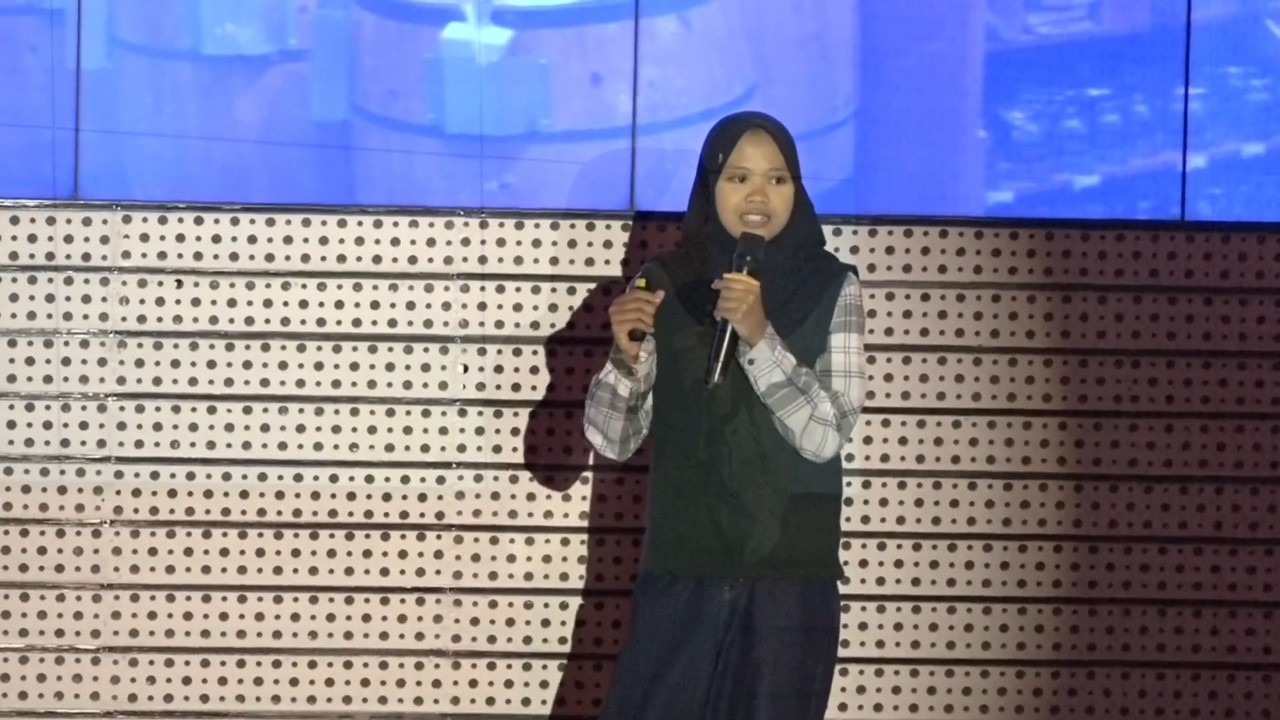
The Blind Brushstroke of Society | Aeshnina Aqilani | TEDxITS
Keywords
Summary
308 words
Critical Evaluation
Value of the Information & Strength of the Argument
The informational value lies mainly in the concrete, transferable practical content: a clear waste-separation principle, a substitution table pairing each single-use item with a reusable alternative, and a four-step civic engagement model (analysis, initiation, participation, collaboration). The quantitative content is thin — a handful of orders of magnitude on usage time (five minutes, two seconds), the five-millimetre microplastic threshold, the two-percent contamination cap on imported waste — and none is contextualised by volumes, tonnages, recycling rates or dates. The argumentation is narrative and moral rather than demonstrative: it proceeds through personal experience (the landfill hill, the childhood river, the letters and their media echo), through an analogy between the banana leaf and plastic, and through a closing appeal about borrowing the Earth from future generations. This makes the case vivid and memorable, and the upstream-versus-downstream framing (prevention before clean-up) is a genuinely sound structuring idea. Its weaknesses are methodological: the central empirical claim that recycling is economically futile is asserted rather than evidenced, and the claim that recycling plants in the US, Germany, Australia and the Netherlands have collapsed is stated without dates, capacity figures or sources. The causal chain from her letters to EU policy change is presented as personal causation while the actual policy sequence is left unspecified. No counter-arguments, trade-offs or feasibility constraints on reusable systems are examined, and the mechanism by which microplastics would impede blood distribution is stated in a simplified, physiologically loose form. The four-C framework is a rhetorical organising device rather than a validated behavioural model. Overall the argumentation is coherent, well-paced and emotionally effective, but it persuades through testimony and values rather than through demonstrated evidence, and several load-bearing empirical assertions would need verification before being relied upon.
Scientific Rigor, Source Quality, Title Accuracy
Scientific rigour is limited. The talk cites no study, report, institution or dataset by name; its factual claims — plastic waste exports to developing countries, the economics of recycling, the presence of microplastics in human placentas and breast milk, the EU decision to stop shipping plastic waste and the Indonesian two-percent contamination limit — are delivered as established fact without attribution, dates or measurable scope. Several of these correspond to real and well-documented developments in the scientific and policy literature, but the audience has no way to distinguish them from the speaker’s own framing, and at least two are compressed to the point of imprecision: the description of recycling infrastructure having ‘collapsed’ in four named countries, and the timing of the EU measure. The only link supplied with the talk is the generic TEDx programme page, which documents the event format but points to no reference material, so the source quality is essentially that of a first-person advocacy testimony. The title-content relationship holds: the ‘blind brushstroke’ image is introduced in the premise and returned to in the conclusion, and the body of the talk does deliver the announced theme of convenience-driven choices with long-term consequences, even if the intermediate sections read as a standard plastic-pollution appeal rather than a sustained development of the metaphor.
515 words
Title / Content Match
The 'blind brushstroke' metaphor is developed in the opening and closing and maps reasonably well onto the talk's core claim that careless convenience-driven choices paint a long-lasting future; the fit is metaphorical rather than literal, and the rest of the talk is a fairly conventional plastic-pollution appeal.
Quality & Reliability
5/10
The talk mixes broadly accurate environmental facts (pervasive microplastic contamination of ecosystems and human tissue, limited effectiveness of plastic recycling, the global waste trade) with a personal advocacy narrative. No figures, studies or reports are cited; several statements are compressed or imprecise (the claim that recycling plants in the US, Germany, Australia and the Netherlands have 'collapsed', the timing and scope of EU restrictions on plastic waste exports, the mechanism by which microplastics would 'block blood distribution'). The content is sincere, largely consistent with the scientific literature on plastic pollution, but presented without verifiable sourcing, so it functions as testimony rather than as evidence-based communication.
Key Moments
Markers derived by PSI from the transcript: the creator did not define chapters.
- Opening provocation: paying for objects designed to become waste — bottled water, sachets, styrofoam — used for minutes or seconds.
- Account of the Ngipik landfill in Gresik: the 'hill' she climbed was a mound of daily waste that shook when trucks passed, with organic and inorganic refuse mixed together.
- Childhood memory of swimming in clean rivers and observing river biota, contrasted with the later realisation that rivers, coasts, seas and drinking water are heavily polluted.
- Argument that plastic recycling is costly and ineffective, with the claim that recycling plants in the US, Germany, Australia and the Netherlands have failed, pushing waste exports toward developing countries.
- Microplastic and nanoplastic contamination across ecosystems, rain and clouds, and human blood vessels, brain, heart, lungs, breast milk and placenta; adsorption of pollutants such as pesticides and heavy metals.
- Behaviour-change argument linking feeling, thinking and action, followed by a substitution list: tumblers, woven baskets, stainless or bamboo straws, tiffin carriers, refill shops, cloth nappies.
- Story of the letters: to the Gresik regent as a fourth-grader and to Donald Trump in 2019 on imported waste, which triggered national and international media coverage.
- Claim that her advocacy helped move the EU to stop shipping plastic waste to developing countries, and mention of Indonesian rules capping contamination in imported waste at two percent.
- Presentation of the four Cs — analysis, initiation, participation, collaboration — grounded in personal identity and a childhood habit of diary writing.
- Closing appeal: 'we are borrowing the Earth from the next generation', with a preference for prevention at the source over downstream clean-up.
Cited Sources
- TEDx — independently organized TED events (programme page) — The only link provided in the video description; documents the TEDx format and the independently organised local event behind this talk, but offers no scientific reference material.
- Letter to then-US President Donald Trump on imported plastic waste (2019) — Cited by the speaker as a personal written intervention that drew national and international media coverage; no document or link is supplied with the video.
- European Union measures on plastic waste shipments to developing countries — Invoked by the speaker as a policy outcome of her advocacy, without naming the legal instrument, its date or its scope.
- Indonesian regulation limiting contamination in imported waste to 2% — Mentioned as a national regulatory achievement; no reference number or issuing authority is given in the talk.
Concurring Sources
- Microplastics — Documents the widespread environmental distribution of microplastics and their detection in human tissues including blood and placenta, supporting the talk's central contamination claims.
- Plastic pollution — Corroborates the persistence of single-use plastics, their accumulation in rivers and oceans, and the limits of recycling as a mitigation route.
- Basel Convention — Provides the regulatory background for the transboundary plastic waste trade and the export restrictions the speaker associates with her advocacy.
- Waste hierarchy — Supports the talk's structuring principle that prevention at the source outranks clean-up and treatment downstream.
Dissenting Sources
- Plastic recycling — The documented picture is more nuanced than the talk's blanket claim: mechanical recycling is economically fragile and rates are low, but the sector has not uniformly 'collapsed' across the four countries named, and chemical recycling and capacity shifts complicate the assertion.
- EU waste shipment rules — timing and scope of the plastic waste export restriction — The speaker presents the EU measure as already in force and as a direct result of her letters; the actual legal instrument has staggered application dates and a scope defined by destination-country status rather than a simple halt to shipments to developing countries, so the causal and chronological framing is imprecise.
- Physiological effect of microplastics on blood circulation — The claim that accumulated microplastics 'block the distribution of blood to organs' compresses preliminary and largely in vitro or animal observations into an established human effect; the literature supports presence and potential inflammatory or endothelial effects, not a demonstrated obstruction mechanism.
Contribution & Novelties
The original contribution is less a new finding than a first-person account that connects three normally separate registers: a field observation at a specific landfill, a critique of the global plastic waste trade from the perspective of a receiving country, and a personal model of civic action built from childhood letter-writing. The substitution table (bottle/tumbler, bag/basket, straw/stainless or bamboo, styrofoam/tiffin carrier, sachet/refill shop, disposable nappy/cloth) and the four-C sequence give the talk a practical, replicable structure that distinguishes it from generic awareness messaging. The framing of prevention upstream versus clean-up downstream, and the emphasis on identity and personal inclination as the durable foundation of commitment, are the elements most worth retaining.
Further reading (Pour aller plus loin) :
- Microplastics — Overview of sources, environmental distribution and the human-exposure findings the speaker refers to (blood, placenta, breast milk).
- Plastic pollution — Context for the single-use plastic life cycle, leakage into rivers and oceans, and policy responses.
- Basel Convention — The treaty framework governing transboundary movements of waste, including the plastic waste amendments central to the export issue raised in the talk.
- Waste hierarchy — The prevention-before-treatment ladder that underwrites the speaker’s ‘upstream rather than downstream’ argument.
- Extended producer responsibility — The policy instrument most often proposed as an alternative to relying on household sorting and recycling alone.
- Circular economy and behaviour-change models for waste separation — conceptual complements to the four-C framework, cited by name because no stable reference address is certain.
241 words
Radar Profile
The profile is that of a persuasive advocacy talk: strong on practical applicability and accessibility, deliberately low on technical depth, with information quantity and reliability sitting in the middle because many assertions are delivered without sources. The gap between rhetorical force and evidentiary backing is the dominant feature of the radar.