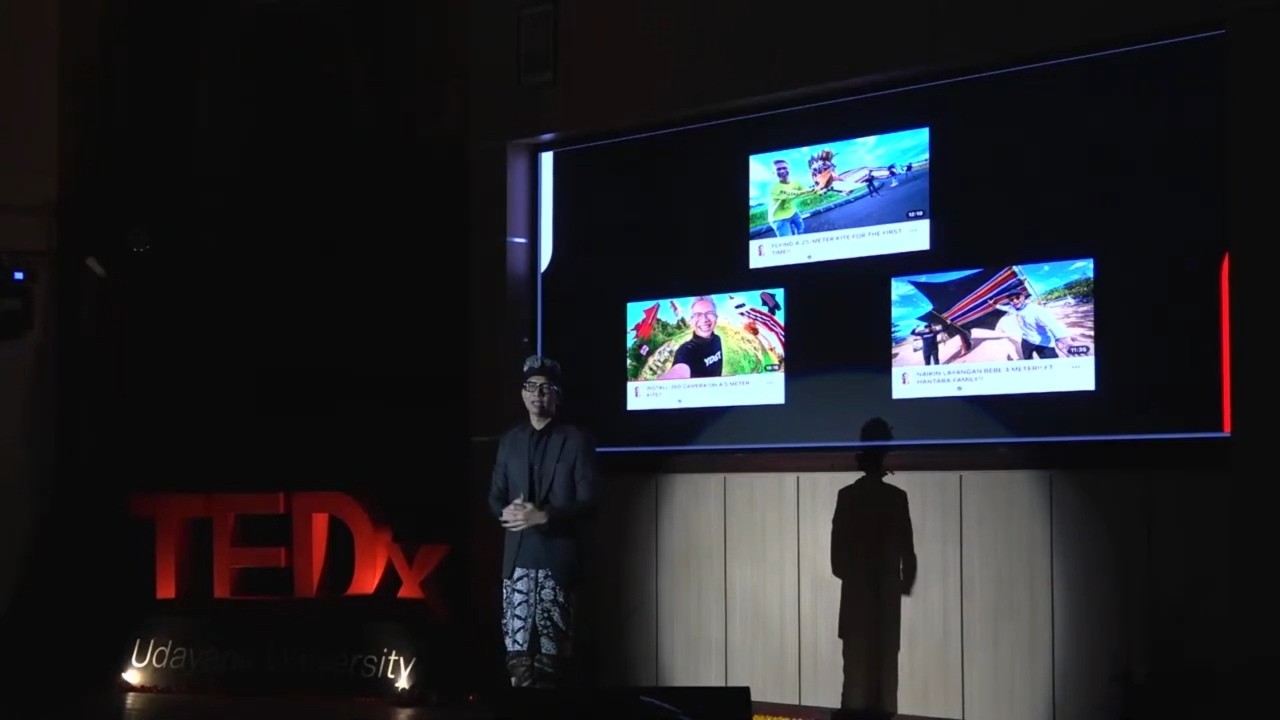
Beyond Preservation : Making The Tradition Matter Today | Yudist Ardhana | TEDxUdayana University
Title history
- Beyond Preservation : Making The Tradition Matter Today | Yudist Ardhana | TEDxUdayana University (PSI archive)
- Beyond Preservation : Making The Tradition Matter Today | Yudist Ardhana | TEDxUdayana University — observed on 20261114-0309 UTC (YouTube)
Keywords
Summary
210 words
Critical Evaluation
Value of the Information & Strength of the Argument
The talk’s value lies in its concrete, field-based perspective: the speaker demonstrates through real examples how digital content can re-engage younger audiences with traditional culture. The argument is structured as a clear progression—from the problem (traditions practiced without understanding), through the diagnosis (physical forms change, values must be preserved), to the solution (storytelling and digital media). The use of view-count metrics (6 million, 5.8 million, 19 million) gives tangible weight to his claims. The reasoning is coherent and practical but remains essentially a personal success story; there is no comparative analysis with other preservation approaches, no empirical data on audience attitudes, and no discussion of potential limitations or negative side-effects of the content-creation approach. The argumentation is persuasive at the level of personal testimony but lacks the structured evidence that would make it a fully rigorous position.
Scientific Rigor, Source Quality, Title Accuracy
The talk has no explicit external scientific sources; it is an expert-opinion talk based on the speaker’s professional experience. The only link provided in the description is the generic TEDx page, which does not offer verifiable references for the claims made. The speaker makes factual assertions about his videos’ view counts and about Balinese traditions (Trunyan burial practice, ogoh-ogoh, Bali Aga heritage) without citations, although these are broadly consistent with common knowledge about Balinese culture. The title accurately captures the theme of the talk, and the content stays aligned with that theme throughout, avoiding digressions. Overall scientific rigor is modest: the talk is well-structured and honest about its anecdotal basis, but it does not attempt to ground its arguments in academic literature or systematic observation.
277 words
Title / Content Match
The title accurately reflects the core message: the talk argues that tradition should be kept relevant and meaningful today, not merely preserved as a static heritage object.
Quality & Reliability
5/10
The speaker provides a personal, experience-based testimony as a Balinese content creator with over a decade of digital practice. The arguments are coherent and illustrated with specific view-count metrics, but they rest entirely on anecdotal evidence and subjective impressions, with no academic references, statistical data, or external verification.
Key Moments
Markers derived by PSI from the transcript: the creator did not define chapters.
- Opening question: why do we do certain things? The common answer 'it's always been that way' and the challenge it poses.
- Growing up in Bali, daily exposure to dance, ceremonial dress, and rituals; accustomisation leading to taking culture for granted.
- Tourists travel thousands of kilometres to see Balinese culture, while locals complain about congestion and are drawn to foreign cultures like Korean or Japanese.
- The true essence of tradition lies in values, meaning, philosophy, norms, and ethics—not in physical forms which can and do evolve.
- Example of the Trunyan village video: a unique Bali Aga burial tradition with a fragrant tree, reaching 6 million views through curiosity-driven content.
- Traditional performance video (dragon/big puppet performances) attracting 5.8 million views, introducing young Balinese to their own traditions.
- Ten years of regular ogoh-ogoh content: process of creation, museum coverage, and parade documentation; view counts in the millions.
- An Instagram ogoh-ogoh video reaches 19 million viewers worldwide, with comments from Libya, Europe, and America—showing global reach.
- Storytelling as the key: every cultural content piece carries a narrative that conveys values, and simple actions by everyone can keep traditions relevant.
Cited Sources
- TEDx Program — Official Page — The only link provided in the video description; refers to the TEDx conference format under which this talk was independently organised.
Contribution & Novelties
The talk offers a practitioner’s perspective on cultural transmission through digital content, arguing that curiosity-driven storytelling on social media can engage younger generations with traditional values more effectively than formal preservation efforts. The speaker demonstrates with concrete view-count metrics that digital media can serve as a modern vehicle for cultural documentation and value transmission, and emphasises the distinction between preserving physical forms (which evolve) and preserving core values (which must remain stable).
Pour aller plus loin :
- Ogoh-ogoh — The Balinese giant puppet tradition that the speaker has documented for over a decade, central to his examples.
- Bali Aga — The indigenous Balinese people of Trunyan village, whose unique burial customs are featured in his most-viewed video.
- Intangible cultural heritage — UNESCO’s framework for safeguarding living cultural expressions, directly relevant to the speaker’s argument about transmitting values rather than static forms.
141 words
Radar Profile
The score profile shows a moderate quantity of information with slightly lower technical depth, reflecting a talk grounded in personal professional experience rather than academic theory. Quality and reliability scores are balanced and average, consistent with an opinion-led TEDx presentation whose strengths are illustrative examples rather than systematic evidence.