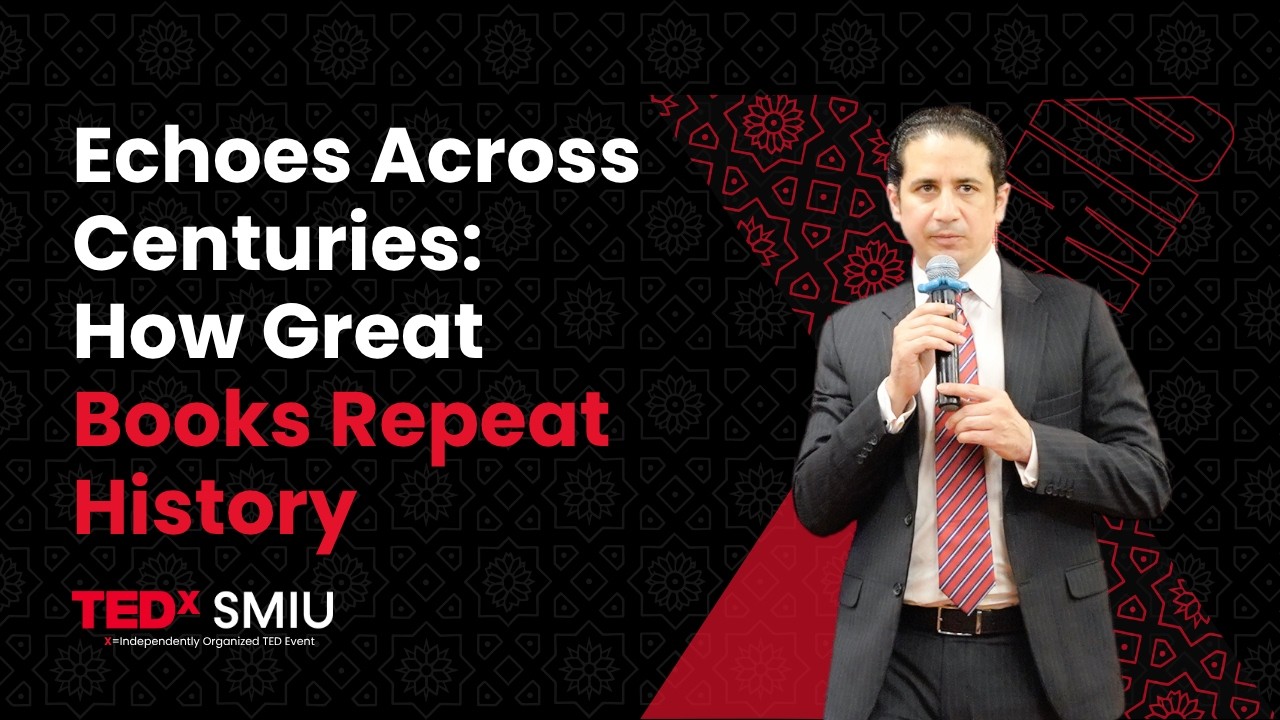
Echoes Across Centuries: How Great Books Repeat History | Sibtain Naqvi | TEDxSMIU
Title history
- Echoes Across Centuries: How Great Books Repeat History | Sibtain Naqvi | TEDxSMIU — observed on 20261027-0220 UTC (YouTube)
Keywords
Summary
131 words
Critical Evaluation
Value of the Information & Strength of the Argument
The talk’s value lies in its accessible application of literary classics to contemporary challenges. The speaker effectively connects abstract themes from novels to concrete examples like AI, social media echo chambers, and elite capture, making the relevance of old works tangible. His argument is structured as a narrative journey, using each book to illustrate a distinct facet of social repetition. The strength of the argumentation comes from the diversity of sources—from Victorian novels to dystopian fiction—which collectively support his thesis that human conflicts remain consistent across centuries. However, the reasoning is largely anecdotal and introspective, lacking systematic evidence or engagement with scholarly criticism. The appeal is more emotional and intuitive than rigorously analytical.
Scientific Rigor, Source Quality, Title Accuracy
The talk references canonical works with high name recognition, but does not provide citations or contextual scholarly analysis. The sources cited are the books themselves, which are widely accepted as classics, but the speaker does not engage with literary criticism or historical scholarship. The only external source is the TEDx platform link. The title accurately reflects the content, which focuses on how great books reveal historical echoes. The talk’s rigor is limited by its personal perspective; however, it stays true to its claim of using literature as a lens for contemporary reflection. No misrepresentation of the works is evident, though interpretations are subjective.
231 words
Title / Content Match
The title accurately represents the talk's core message about literature reflecting historical cycles.
Quality & Reliability
7/10
The talk draws on well-known literary classics to illustrate recurring social patterns, but relies on personal interpretation without rigorous academic citation.
Key Moments
Markers derived by PSI from the transcript: the creator did not define chapters.
- Introduction to the theme of timeless literature and recurring history
- Difference between prescriptive self-help books and experiential reading of classics
- North and South: industrial inequality paralleled to AI and modern labor
- The Time Machine: class division and permanent societal fragmentation
- A Tale of Two Cities: polarization and the dangers of unchecked inequality
- 1984 and surveillance: modern data collection and echo chambers
- Conclusion: literature as a tool for recognizing and avoiding historical mistakes
Cited Sources
- TEDx Talks — General TEDx platform information; the talk was delivered at a TEDx event.
Contribution & Novelties
The talk offers a fresh angle on using literature as a diagnostic tool for contemporary societal issues, bridging the gap between classic fiction and modern anxieties. It suggests that reading old works actively can cultivate historical awareness and moral vigilance.
Pour aller plus loin :
- Literary criticism — Provides a framework for analyzing literature beyond plot, useful for understanding the talk’s interpretive approach.
- Historiography — Examines how history is written and understood, relevant to the talk’s claim about history repeating through literature.
- Great Books movement — Supports the idea that classic texts are foundational for education and cultural literacy, aligning with the talk’s emphasis on canonical works.
107 words
Radar Profile
The profile shows high quality and quantity of information but moderate technical depth and reliability, indicating a well-articulated but non-academic synthesis.