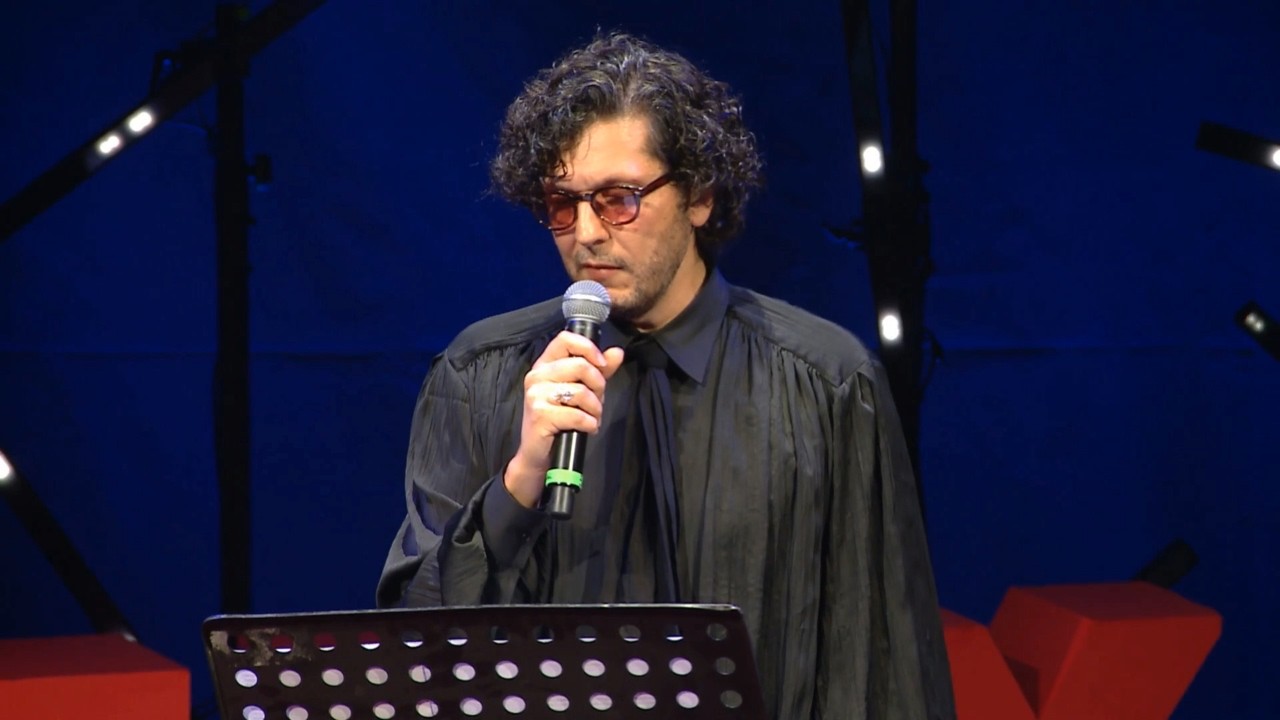
Tutti i confini che ho dovuto attraversare per diventare me stesso | Ermal Meta | TEDxTaranto
All the boundaries I had to cross to become myself | Ermal Meta | TEDxTaranto
Keywords
Summary
294 words
Critical Evaluation
Value of the Information & Strength of the Argument
The informational value here is experiential rather than factual. What the talk delivers is a dense sequence of concrete particulars: a named illness and a medical prognosis, a specific decision taken on a football pitch, a migration at thirteen, a named method for learning a language (translating Venditti, transcribing the Costanzo Show), a named band and its dissolution, a described technical object (a malfunctioning audio interface) and the precise use made of it, a diagnosis of panic attacks and an explicit course of therapy, and the writing of a first novel. These particulars are what give the narrative its texture and make the boundary metaphor feel earned rather than decorative. The argumentative construction is chronological and cumulative: each episode is framed as a frontier encountered, resisted, then crossed or postponed, and the sequence builds inductively towards a general proposition stated at the end — that a boundary is not a measure of how far one may go but a device for discovering what one is willing to become. That proposition is asserted rather than demonstrated, and the talk wisely stops short of extending it into advice or prescription. The main structural weakness is retrospective reconstruction: the narration is coherent because it has been ordered after the fact, and no episode is confronted with a competing interpretation, a counter-example, or a case where crossing a boundary proved harmful. The one nuance offered — that some boundaries should not be crossed immediately, and that he was not ready — is stated but not developed, although it is arguably the most interesting claim in the talk. Its strength lies elsewhere: in the willingness to report failure without cosmetic repair (a band described as ’the most famous unknown band in Italy’, songs for which nobody queued, two years of rejection), which lends credibility to the successes recounted later.
Scientific Rigor, Source Quality, Title Accuracy
In terms of scientific rigour, the talk makes no scientific claim and therefore cannot be faulted for the absence of a bibliography; it is a testimony, and it presents itself as one. That said, it offers no verifiable anchoring of any kind: no dates, no documents, no external referents beyond the names of people and a band, and nothing that a reader could independently check. The single externally checkable factual element — the reference to the balloon flight of Wetzel and Strelisk towards the lights of the West at the end of the 1970s — is accurately characterised, which suggests the speaker’s other historical and biographical references are similarly reliable, but this is inference, not verification. The vocabulary of causality used throughout (’the mind had transferred itself to the body’, ‘I understood my mistake’) belongs to personal interpretation and should be read as such, not as aetiological claim. As for the relationship between title and content, it is exemplary: the title promises a catalogue of crossed borders leading to selfhood, and the talk is precisely that catalogue, announced in the opening seconds and closed by the corresponding thesis.
507 words
Title / Content Match
Excellent fit: the title announces a journey through successive borders towards selfhood, and the talk delivers exactly that, enumerating them in chronological order (breath, skin, language, migration, shyness, love, career, depression, fatherhood). No discrepancy whatsoever.
Quality & Reliability
5/10
First-person autobiographical testimony, internally coherent and rich in concrete particulars (places, names, dates, mechanisms), but by nature unverifiable and unsourced: no data, no citation, no external reference framework. The account contains no scientific claim that would require sourcing, and the one checkable external fact (the 1979 balloon escape over the Berlin Wall) is described accurately. Reliability is therefore that of an honest but non-auditable personal narrative, not that of a documented study.
Key Moments
Markers derived by PSI from the transcript: the creator did not define chapters.
- Opening: the first border is light at birth; the mind, unlike the body, has no frontiers.
- Childhood respiratory illness and the doctors' prognosis; the decision on the football pitch to tear down that boundary, and the forbidden sweat.
- The frontier made of documents, passports and police: leaving Albania at thirteen, and recognising the televised promise of abundance as a trap.
- The language border: thinking in one idiom and speaking in another, overcome by translating Venditti's songs and transcribing the Costanzo Show.
- Graduation, university and the fear of disappointing the boy he left on the Albanian shore; the decision to become an artist.
- The Moleskine notebook and the defective audio interface: learning to record and shape sound alone in his bedroom.
- La Fame di Camilla ends and depression follows; the discovery that he never smiled in a single band photograph.
- Success, then panic attacks and therapy; the fourth album and the slow emergence of a first novel.
- Fatherhood, the one boundary he had sworn never to cross; closing thesis on what a border actually reveals.
Cited Sources
- TEDx — the independently organised TED event format — Referenced in the video description as the framework under which this talk was given.
- Antonello Venditti (artist page) — The singer whose lyrics Meta translated as a teenager to break down the language barrier; 'Ricordati di me' is quoted in the talk.
- Maurizio Costanzo (artist page) — Meta transcribed episodes of his television show to learn Italian; both men later became his friends.
- Ermal Meta (biography, including the band La Fame di Camilla) — Covers the biographical trajectory narrated in the talk and the band whose dissolution preceded his depression.
- Berlin Wall (balloon escape episodes, 1979) — The talk compares crossing into writing a novel with the balloon flight of Wetzel and Strelisk over the Wall.
Concurring Sources
- Ermal Meta (biography) — Corroborates the verifiable biographical elements of the narrative: birth in Fier, arrival in Bari at thirteen, the band La Fame di Camilla, the solo career and the published novels.
- Sanremo Music Festival 2018 — Corroborates the win with Fabrizio Moro mentioned in the video description, though not developed in the talk itself.
Contribution & Novelties
The talk does not introduce new knowledge and does not claim to; its contribution is the application of a single metaphor — the border — to a heterogeneous set of experiences usually treated separately: chronic childhood illness, emigration, second-language acquisition, adolescent shyness, artistic failure, clinical depression, panic disorder, and parenthood. The interesting move is the reversal operated at the end, where the border stops being a limit to be pushed back and becomes an instrument of self-revelation, together with the intermediate admission that some borders should not be crossed immediately because one is not ready. A second, less developed idea is the reclassification of seriousness: years spent making music solemnly, and failing to smile in any photograph, followed by the recognition that it was happiness, not music, that deserved to be taken seriously. Listeners looking for conceptual handles on migration and mental health will find concrete material here (the translation-and-transcription method of language acquisition, the sequence of success followed by panic attacks, the therapeutic work described as being allowed to stay at the bottom); those looking for evidence, data or a testable model will not.
Further reading:
- Third culture kid — Frame for the identity position of someone who migrates in early adolescence and belongs fully to neither the country of birth nor the country of arrival.
- Panic disorder — Clinical context for the attacks described after success, and for the therapeutic route he mentions.
- Music therapy — Useful counterpoint to the informal, self-directed use of songwriting and recording described in the talk; the video makes no clinical claim of this kind.
- Berlin Wall — Background on the 1979 balloon escape used as the talk’s image for crossing into the unknown.
- Second-language acquisition through song lyrics and subtitling — the method he describes (translating Venditti, transcribing a talk show) is a recognised informal learning strategy; no single canonical reference is cited here.
312 words
Radar Profile
The profile is strongly asymmetric: high on narrative density and human interest, very low on technical content, and middling on verifiable reliability because the whole account rests on a single unverifiable first-person perspective. Information quantity and quality sit at the mid-range — plentiful concrete detail, no external corroboration. This is a testimony-shaped profile, not a documentary or a popularisation profile.