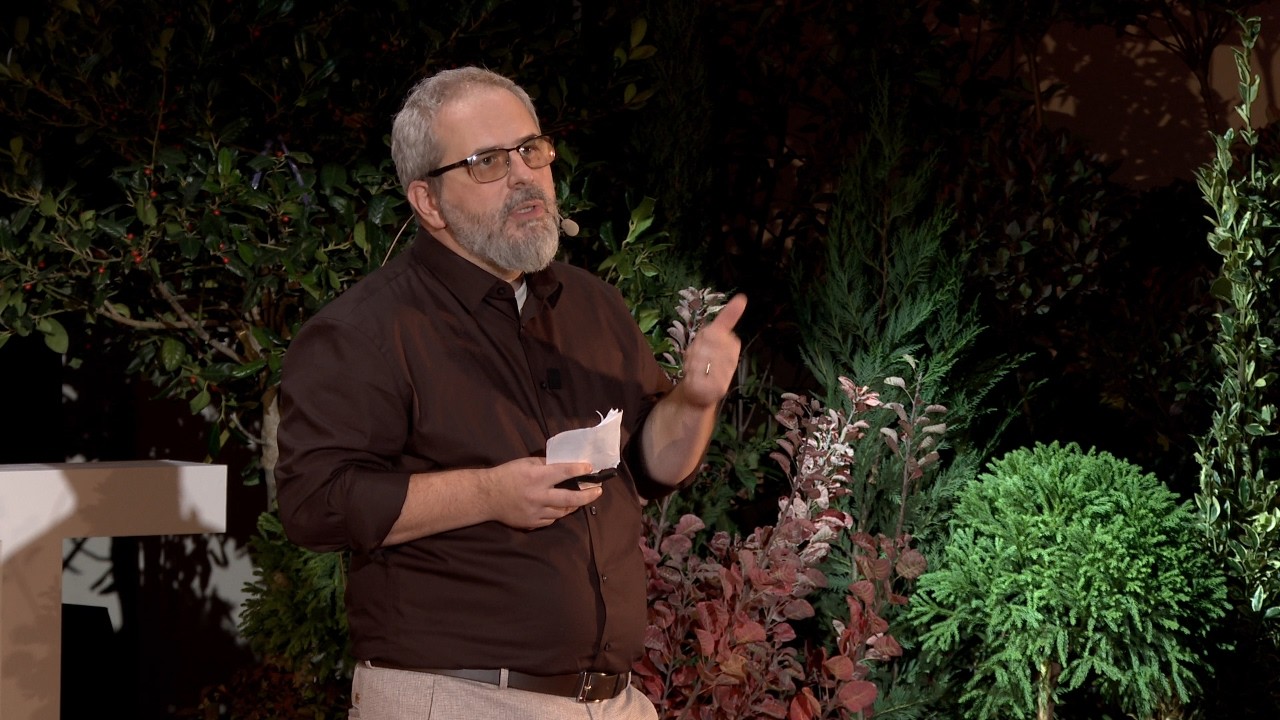
How to Decide When Science Is Still Deciding | Răzvan Vlasin | TEDxUSVT
Keywords
Summary
282 words
Critical Evaluation
Value of the Information & Strength of the Argument
The informational value of the talk lies less in what it asserts than in what it makes observable. The opening staging is genuinely functional: by breaking the audience’s expectation and then immediately decoding what just happened in their heads, the speaker converts an abstract claim about prediction error into a shared first-hand datum. That is a legitimate pedagogical device and it gives the rest of the talk a concrete anchor. The conceptual inventory is compact and mostly serviceable — model versus new information, millisecond-scale surprise, appraisal along threat and coping dimensions, model updating versus model preservation versus distorted updating, and the distinction between a plan (fragile) and a direction (robust). The compass metaphor in the final third is the strongest single contribution: it reframes the problem from ‘predict better’ to ‘hold a stable purpose while the route is rewritten’, which is a defensible and practically usable heuristic, and the fuel-price example, deliberately banal, makes it memorable. The argumentation, however, is associative rather than demonstrative. Each claim is introduced by assertion and illustrated by anecdote; none is tested against a counter-example, none is qualified by magnitude or by boundary conditions. The three degraded responses are presented as an exhaustive menu without justification, and the political example is used to psychologise a complex social phenomenon in a single stroke. The speaker himself concedes that permanent adaptation is unrealistic and that sometimes ignoring or self-deception is necessary, which is an honest move, but he then declines to say how one should choose — the very question the title and the closing promise to answer. The invitation to ’try to understand your reaction and that of those around you’ is a reflective exercise, not a decision procedure. The result is a talk with real rhetorical craft and moderate conceptual value, whose argumentative load is carried by metaphor and staging rather than by evidence.
Scientific Rigor, Source Quality, Title Accuracy
No source is cited anywhere in the talk: no author, no study, no institution, no dataset, no date. The only external material offered is a link to the TEDx programme page in the description. The framework for how the brain handles reality — ignoring, distorting, generalising — is explicitly attributed to NLP, which is presented on stage as an authority without any indication of its contested scientific status. The bandwidth comparison (about two million bits of incoming information per second against 50 to 130 bits of conscious processing) is delivered as a hard number with no measurement context, no definition of what is being counted and no reference; the figure circulates widely in popular and self-help literature but is not traceable here to a controlled study. The claim that humans are born with only two fears, falling and loud noise, is stated flatly and is at odds with the developmental literature, which describes fear as emerging progressively with motor experience and learning rather than as a fixed two-item innate list. The flat-earth digression is used illustratively and is broadly consistent with accounts of belief-reinforcement loops, but the dopamine explanation is offered as mechanism without evidence. Registration is consistent: the talk presents itself as a personal reflection on uncertainty, not as a research report, and the speaker explicitly frames his examples as simplifications — this honesty mitigates somewhat, but does not remove, the absence of verifiable support. On title–content fit, the announced subject of deciding while science is still deciding is essentially absent; the delivered subject is individual emotional and cognitive response to uncertainty, and the word science barely appears. Presence of an advertising sequence: none identified in the transcript.
603 words
Title / Content Match
The title announces a method for deciding while scientific evidence is still unsettled, but the talk never discusses scientific controversy, evidence grading or how to act on incomplete data; apart from a passing mention of disinformation bubbles, it addresses how individuals react emotionally to uncertainty. The mismatch is substantial, though the compass metaphor offers a loose bridge.
Quality & Reliability
3/10
The talk is a well-paced stage demonstration built on a small set of psychological claims, but the scientific scaffolding is thin and partly borrowed from non-academic sources. The three-way model of reality processing (ignore, distort, generalise) is attributed on stage to NLP, a framework with no established empirical standing. The figures quoted — roughly two million bits of sensory input per second against 50–130 bits of conscious processing per second — are repeated without any cited measurement or study, and are closer to popular self-help literature than to peer-reviewed psychophysics. The assertion that humans are born with exactly two innate fears is stated categorically and would not survive contact with developmental research on fear acquisition. No author, paper, institution or dataset is named at any point, and no counter-argument or effect size is offered. What remains solid is the general architecture: prediction error, appraisal of threat versus coping resources, and the role of personal purpose in stress resilience are all recognisable and defensible ideas, even if here they are delivered as rhetorical narrative rather than evidenced argument. Verdict: stimulating as a public-speaking performance and as a reflective tool, weak as a source of factual claims.
Key Moments
Markers derived by PSI from the transcript: the creator did not define chapters.
- Opening disruption: the speaker abandons his announced topic, announces three surprises and triggers a sudden loud noise, deliberately creating surprise and confusion in the room.
- Claim that humans are born with only two innate fears — falling and loud noise — and that all others are acquired during life.
- The prediction error model: each listener's internal model collides with the unexpected information, producing surprise ('wait') then confusion ('what').
- The bandwidth argument: roughly two million bits of information per second reaching the brain against 50 to 130 bits of conscious processing, used to justify compression, deletion and generalisation.
- Appraisal stage: is this a threat, and can I cope with it? Coping leads to learning, adaptation and an updated model; the loop then closes.
- Degraded responses one and two: procrastination and deliberate ignoring, illustrated by a generalisation about why accomplished people avoid entering politics.
- Degraded response three: a distorted model update, illustrated by flat-earth beliefs and the dopamine-driven loop of fast, low-energy, irrational closure.
- The central metaphor: the hiker's map is the plan, the fog is uncertainty and the compass is direction, meaning purpose.
- Purpose and resilience: people with a personal, internal sense of purpose resist stress better during uncertainty, illustrated by the fuel-price and holiday-to-Greece example.
- Closing challenge to observe one's own reactions to uncertainty, and the final twist that the third surprise does not exist.
Cited Sources
- TEDx — independently organised TED events (programme page linked in the description) — The only external link provided with the video; it documents the TEDx format and does not point to any of the scientific claims made on stage. No study, author or dataset is named during the talk.
Concurring Sources
- Predictive coding (Wikipedia) — Supports the core mechanism the speaker describes: the brain constantly generates predictions and surprise arises when incoming signals violate them.
- Cognitive appraisal (Wikipedia) — Corresponds to the talk's two-question evaluation — threat versus coping resources — as a determinant of emotional response and subsequent behaviour.
- Cognitive bias (Wikipedia) — Provides the mainstream research framing for the distortions the speaker attributes to NLP, and offers a more solid vocabulary for the same phenomena.
- Modern flat Earth beliefs (Wikipedia) — Documents the belief system used in the talk as an illustration of distorted model updating and self-reinforcing explanations.
Dissenting Sources
- Neuro-linguistic programming (Wikipedia) — The speaker explicitly grounds his ignore/distort/generalise model in NLP, but the framework is widely characterised in the scientific literature as lacking empirical support; presenting it on stage as an explanatory authority overstates its standing.
- Visual cliff (Wikipedia) — Classic experiments on infants' avoidance of apparent drop-offs indicate that fear of heights emerges with locomotor experience rather than being fully present at birth, which complicates the claim that humans are born with exactly two innate fears.
- Bandwidth figures of roughly two million bits per second versus 50–130 bits of conscious processing — These numbers are quoted as established fact but trace to popular and self-help literature rather than to a verifiable measurement; without a definition of what is being counted, they should be treated as illustrative rather than quantitative.
Radar Profile
The profile is dominated by accessibility and delivery rather than by informational density or technical depth: quantity and quality of information sit at mid-to-low levels while technical level is clearly the weakest axis, reflecting a talk built on metaphors and anecdotes rather than on methods or data. Overall reliability tracks the low technical level, since the few quantitative claims made are the least supported. The shape is that of a persuasive stage performance with a genuine conceptual core, not of an evidence-based briefing.