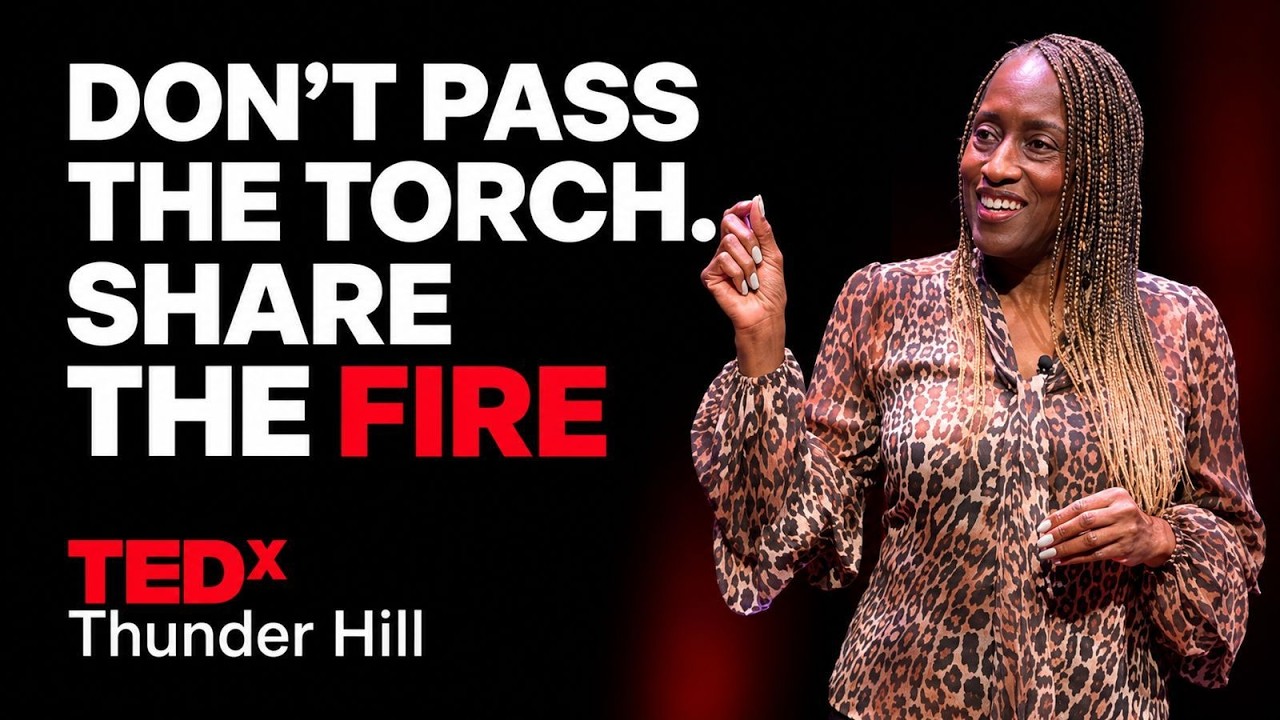
Don't Pass the Torch. Share the Fire! | Valari Jackson | TEDxThunder Hill
Title history
- Don't Pass the Torch. Share the Fire! | Valari Jackson | TEDxThunder Hill — observed on 20261114-0313 UTC (YouTube)
Keywords
Summary
195 words
Critical Evaluation
Value of the Information & Strength of the Argument
The talk’s value lies in its accessible framing of wisdom as a renewable resource and its actionable, intergenerational call to action. Jackson effectively combines personal storytelling with simple neuroscience concepts to make a compelling case for proactive knowledge sharing. However, the argumentation is largely anecdotal; she references specific studies (like the founder age data) without providing detailed methodology or citations, which weakens the scientific depth. The emotional resonance carries the message, but the evidence base is thin, relying on a few broad claims to support a broad societal critique.
Scientific Rigor, Source Quality, Title Accuracy
Jackson mentions research from the US Census Bureau and MIT and discusses fluid versus crystallized intelligence, but she never provides specific sources, links, or study names, limiting verifiability. The talk has a TEDx format, which encourages personal insight over rigorous academic review. The title ‘Don’t Pass the Torch. Share the Fire!’ accurately reflects the central thesis—that simple transmission isn’t enough; active, generous sharing is necessary. The content is consistent with the title, and the speaker’s experience as a coach and engineer lends credibility, though not formal academic authority.
192 words
Title / Content Match
The title aptly captures the central message of actively sharing wisdom rather than merely transferring it.
Quality & Reliability
5/10
The talk references general research (e.g., founder age study by US Census Bureau and MIT, fluid vs crystallized intelligence) but provides no specific citations or details. Claims are anecdotal and inspirational, with limited verifiable evidence.
Key Moments
Markers derived by PSI from the transcript: the creator did not define chapters.
- Introduction with childhood story about hugging Floyd and mother's Sudoku book
- Introduces the problem: society discounts wisdom while spending billions on digital data
- Cites US Census Bureau and MIT study on founder ages, and explains fluid vs crystallized intelligence
- Shares her mother's letter, offering personal guidance and wisdom
- Calls for intergenerational pact: younger ask elders, elders proactively share wisdom
- Concludes with 'wisdom is our most valuable renewable resource' and 'write in ink'
Cited Sources
- TEDx Talks — Video hosted on TEDx platform; general link from description
Contribution & Novelties
The talk’s original contribution is framing wisdom as a ‘renewable resource’ and proposing a simple two-sided pact for intergenerational sharing. It integrates neuroscience concepts (fluid vs crystallized intelligence) with practical advice for bridging generational gaps, making the argument accessible to a broad audience.
Pour aller plus loin :
- Fluid and crystallized intelligence — Directly relevant to the cognitive science discussed; explains the two types of intelligence and their developmental trajectories.
- Wisdom — Explores philosophical and psychological perspectives on wisdom, its definition, and associated qualities.
- Intergenerational learning — Relates to the proposed exchange between generations; discusses how knowledge and skills can be shared across age groups.
105 words
Radar Profile
The radar profile shows moderate to low scores across information quantity, quality, technical level, and reliability, indicating an accessible, inspiring talk that prioritizes emotional engagement over rigorous scientific depth. The technical level is notably low, consistent with its aim to reach a general audience, while the moderate reliability reflects the lack of specific sourced evidence.