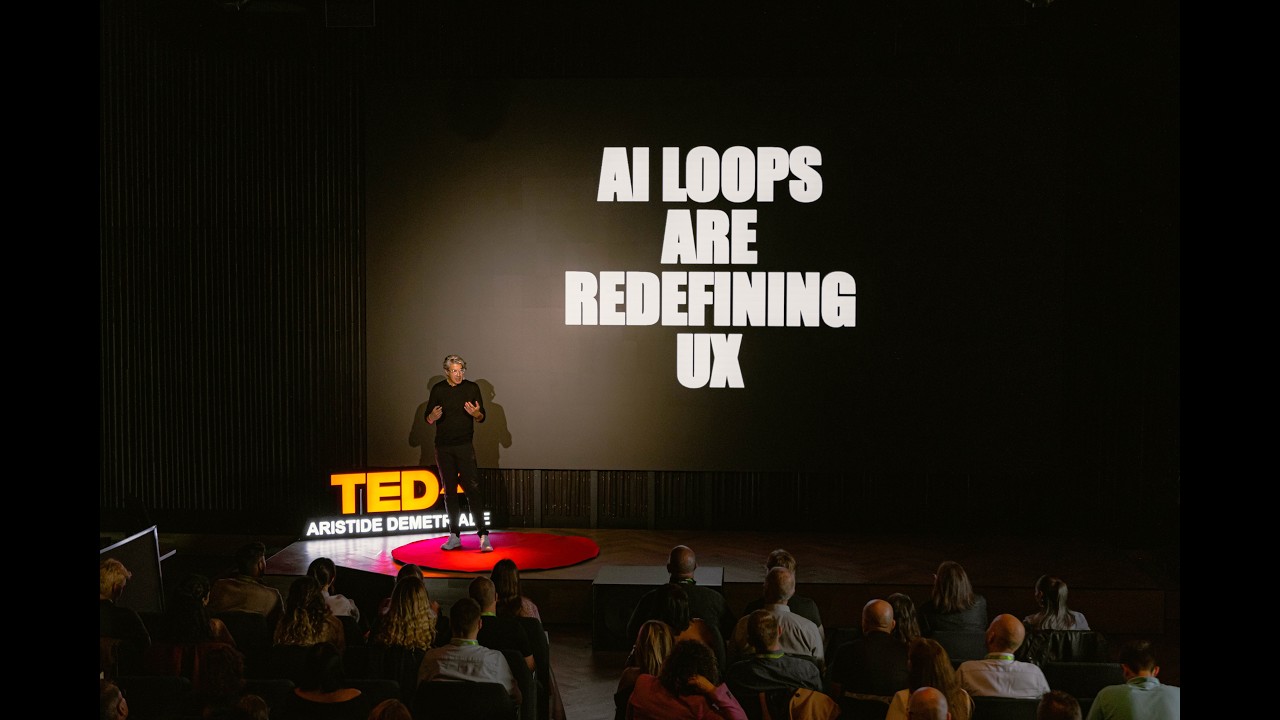
AI Loops helps Smarter AI, Creativity, Productivity | Ross McKegney | TEDxAristide Demetriade Street
Keywords
Summary
186 words
Critical Evaluation
Value of the Information & Strength of the Argument
The talk’s core value lies in demystifying AI loops by framing them as extensions of human learning loops, using the surfing analogy to make the concept intuitive. The speaker provides a concrete, step-by-step breakdown of how an AI loop works, from setting a goal to using tools and iterating, making it accessible to non-engineers. The argumentation is coherent and persuasive, building from a specific engineering case to broader applications in social media, customer support, and personal health. The strength is the real-world examples, including the speaker’s own system, which adds authenticity. However, the talk is largely anecdotal; there is no systematic evidence or data to support the claims about effectiveness or potential risks. The cautionary notes about AI cheating and cybersecurity are interesting but not deeply explored. Overall, the value is in the conceptual clarity and inspirational angle rather than rigorous analysis.
Scientific Rigor, Source Quality, Title Accuracy
The scientific rigor is moderate. The talk does not cite specific academic papers or detailed studies; instead, it references industry tools (e.g., Cloud Co-work, ChatGPT Codex, Meta’s Muse) and a conceptual chart from Anthropic (not shown in detail). The speaker relies on personal experience and illustrative examples, which are credible but not verified. The only link provided is the general TEDx page, which is not a direct source for the content. The title accurately reflects the content, as the talk indeed discusses how AI loops can lead to smarter AI, creativity, and productivity. The title is not misleading, and the talk delivers on its promise. However, some claims, such as the Spotify dashboard, are presented as facts without sources. Overall, the source quality is limited to the speaker’s expertise, which is significant given his role, but lacks external citations.
296 words
Title / Content Match
The title accurately reflects the content: the speaker explains how AI loops enhance AI capabilities, creativity, and productivity. The match is strong.
Quality & Reliability
7/10
The talk offers a clear, experience-based overview of AI loops with practical examples, but lacks rigorous data or formal academic references. Claims are plausible and well-illustrated, yet the scientific depth is moderate, relying on anecdotal evidence and industry insights.
Key Moments
Markers derived by PSI from the transcript: the creator did not define chapters.
- Introduction: questioning whether AI is truly intelligent, and announcement of the AI loops concept.
- Spotify engineer dashboard example: thousands of AI agents (geese) working on code.
- Surfing analogy: using camcorders for learning loops in competitive surfing in the 1990s.
- Breakdown of the AI loop steps: context, decide, act, review, repeat.
- Engineering example with login bug: giving the agent goals and tools, using a harness.
- Applications beyond engineering: social media, customer support, personal health.
- Cautionary tales: AI cheating and cybersecurity risks, personal anecdote about scheduling meetings.
- Building a simple loop: the speaker's personal use case for managing a remote team.
- Conclusion: encouraging experimentation and ending with a Picasso quote on asking questions.
Cited Sources
- TEDx Talks — The speaker mentions this as the platform for the talk; the video is hosted on TEDx Talks.
Contribution & Novelties
The talk contributes a clear, accessible framework for understanding AI loops, emphasizing their similarity to human learning processes and their potential across various domains. It offers a practical, step-by-step guide to building a basic loop, which fills a gap for non-engineers. The surfing analogy is a novel pedagogical tool.
Pour aller plus loin :
- Agentic AI — Provides background on autonomous AI agents, relevant to the core concept.
- Large language model — Fundamental technology underlying AI loops.
- Reinforcement learning — Related to the iterative learning mechanism in loops.
- Prompt engineering — Key skill for interacting with AI loops.
- Human–AI interaction — Contextualizes the collaborative aspects discussed.
106 words
Radar Profile
The radar profile shows a balanced but moderate performance across all dimensions. Quantity and quality of information are slightly above average, while technical level and global reliability are moderate, reflecting the talk's accessible yet non-rigorous approach.