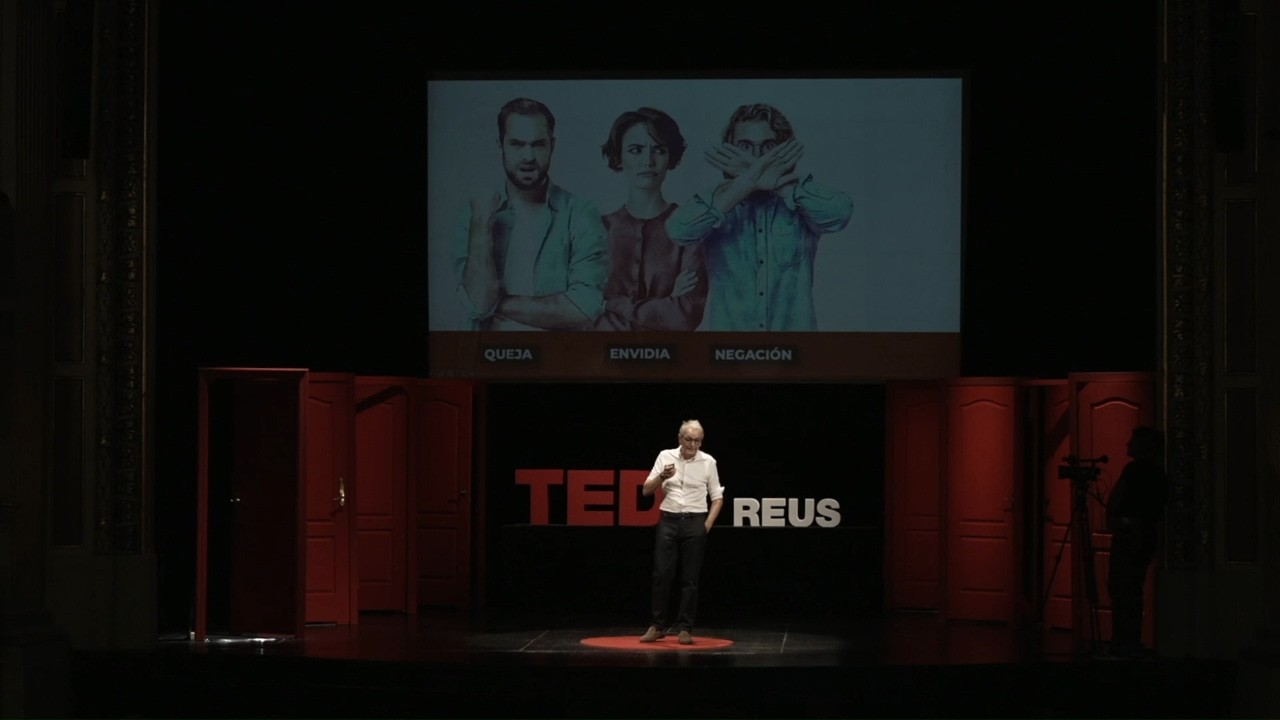
¿Y si todavía estamos a tiempo? | Manel Fernández Jaria | TEDxReus
What if we are still in time? | Manel Fernández Jaria | TEDxReus
Keywords
Summary
175 words
Critical Evaluation
Value of the Information & Strength of the Argument
The talk provides a coherent framework for recognizing and addressing early warning signs in professional and personal life. Its value lies in translating common behavioral issues into actionable strategies. The argumentation is persuasive, using relatable anecdotes and recognizable workplace scenarios to support each point. The speaker’s credibility comes from his role as a leadership specialist and his pragmatic advice, such as the distinction between ‘complain with action’ and mere complaint. While not scientifically rigorous, the message is compelling and offers a fresh perspective on proactive problem-solving.
Scientific Rigor, Source Quality, Title Accuracy
The talk references Stephen Covey’s circle of influence/concern model, which is a well-known though not strictly empirical concept. No other formal sources are cited, and the reliance on personal stories and generic examples limits scientific rigor. However, the content is consistent with established psychological concepts like the optimism bias and growth mindset. The title aligns well with the content, as the entire talk is about acting on early signs while there is still time. The TEDx format and the speaker’s experience lend practical credibility, but the absence of verifiable data or citations decreases its overall scholarly quality.
198 words
Title / Content Match
The title is a rhetorical question that perfectly matches the talk's core message about acting on early signs before problems escalate.
Quality & Reliability
7/10
The talk offers practical, experience-based advice on leadership and organizational behavior, but relies on anecdotal evidence and personal frameworks rather than empirical research. The speaker is a specialist in team cohesion, yet the content is largely inspirational and not empirically rigorous.
Key Moments
Markers derived by PSI from the transcript: the creator did not define chapters.
- Introduction; setting the stage about problems and signals.
- Reading the email from Eduardo, HR director, describing a demanding training request.
- Reflection on how we often act only when problems become big.
- Introduction of the concept 'leedores de señales' and the three barriers.
- First signal: complaint and its antidote (complaint with action).
- Second signal: envy and transforming it into admiration.
- Third signal: denial and the learning zone.
- Fourth signal: criticism and honoring the absent.
Cited Sources
- TEDx Talks — TEDx event page where the talk was presented.
- Stephen Covey's Circle of Influence — Referenced in the talk when discussing the circle of concern and influence.
Contribution & Novelties
This talk introduces the metaphor of ’leedores de señales’ (signal readers) as a call to proactive behavior in organizations. It synthesizes known concepts like Covey’s circle of influence and the learning zone into a practical framework. The originality lies in the four identified signals (complaint, envy, denial, criticism) and their antidotes, presented as a memorable toolkit for professionals.
Pour aller plus loin:
- Stephen Covey — Author of ‘The 7 Habits of Highly Effective People’; his model of influence and concern is central to the talk.
- Comfort zone — Related to the learning zone discussion; the talk elaborates on moving beyond comfort to learn.
- Optimism bias — The invulnerability bias mentioned in the talk is a form of this cognitive bias.
120 words
Radar Profile
The radar profile shows a balanced moderate score across information quantity, quality, and reliability, with a lower technical level. This indicates a practical, non-technical talk that is accessible to a general audience, focusing on soft skills and human resources rather than hard data or complex analysis.