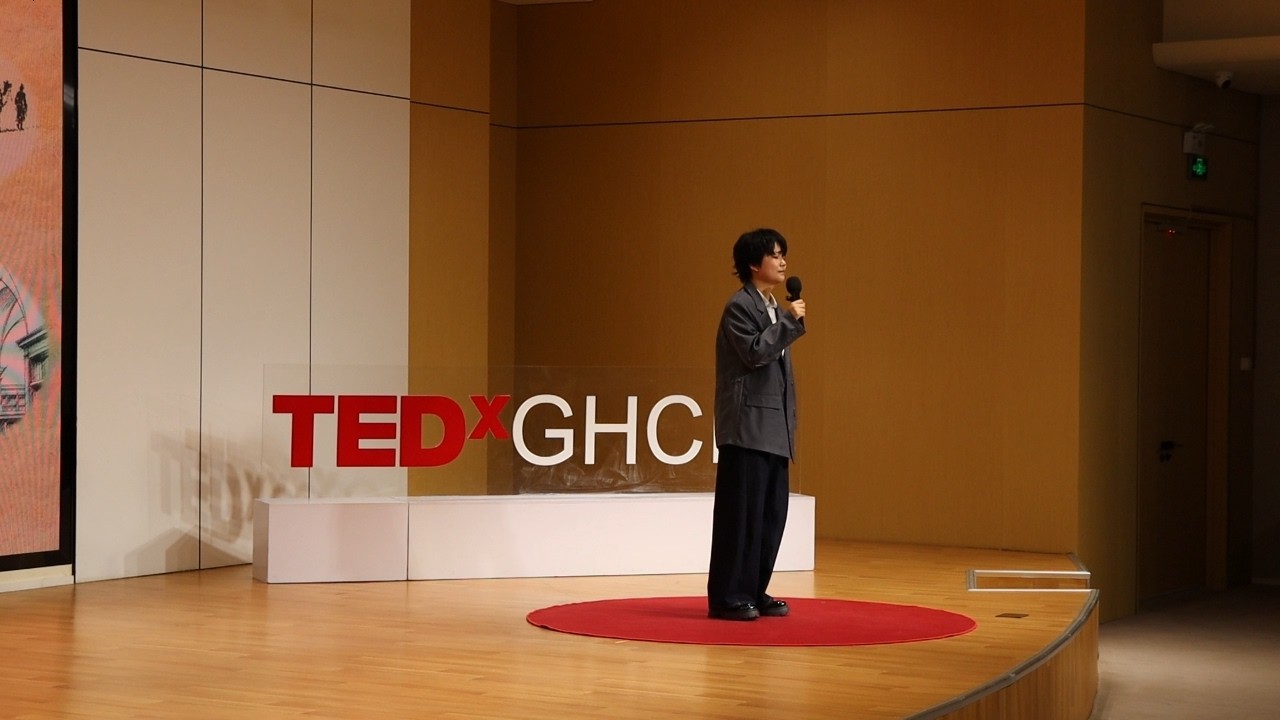
历史的动脉:于冲突的深谷间奔流 | Xinyue Zhang | TEDxGHCIS Youth
The Artery of History: Flowing Through the Deep Valleys of Conflict | Xinyue Zhang | TEDxGHCIS Youth
Title history
- 历史的动脉:于冲突的深谷间奔流 | Xinyue Zhang | TEDxGHCIS Youth — observed on 20261110-1822 UTC (YouTube)
Keywords
Summary
158 words
Critical Evaluation
Value of the Information & Strength of the Argument
The talk offers a compelling and optimistic reinterpretation of conflict as a creative force. It weaves together diverse historical examples from East and West, showing a pattern where breakdowns lead to breakthroughs. The argument is structured around a clear thesis and a layered model, which lends it intellectual coherence. However, the reasoning relies on analogies and selected examples without engaging with contrary evidence or alternative interpretations. The claim that all conflicts ultimately benefit civilization is presented as a universal truth, which is debatable. The speaker’s rhetorical style is engaging and inspirational, but the logical rigor is moderate, as it tends to simplify complex historical processes for narrative effect.
Scientific Rigor, Source Quality, Title Accuracy
The talk does not cite specific academic sources, but it references well-known historical events and thinkers. The only link in the description is the generic TEDx page, which does not provide further references. The title accurately encapsulates the central metaphor of history as an artery whose vitality is shaped by conflict. However, the content occasionally drifts into motivational language, but it remains anchored in historical narrative. The speaker’s personal background as a student adds authenticity but not scholarly authority. Overall, the talk is more of a philosophical essay than a rigorous academic analysis, yet it is coherent and well-structured.
222 words
Title / Content Match
The title accurately reflects the content, which frames historical conflicts as the driving force of civilization's 'artery' flowing through deep valleys of struggle.
Quality & Reliability
6/10
The talk presents a coherent historical narrative linking conflicts to civilizational progress, but relies on broad generalizations and lacks direct citations. It draws on well-known historical events (Axial Age, Crusades, Mongol Empire, Opium War) and offers a structured three-layer conflict model (material, institutional, ideological). However, the speaker is a student, not a professional historian, and the argument, while insightful, is oversimplified and does not engage with counterarguments or academic debates.
Key Moments
Markers derived by PSI from the transcript: the creator did not define chapters.
- Introduction: comparing the Yellow River's canyon to historical conflicts.
- Axial Age: Confucius and Socrates respond to chaos with inner reflection.
- Medieval conflicts: Crusades and Mongol Empire as unexpected bridges.
- Modernization: Opium War and the three-layer conflict model (material, institutional, ideological).
- Conclusion: embracing conflict as a catalyst for personal growth and historical consciousness.
Cited Sources
- TEDx Program — The talk was given at a TEDx event, and this is the official TEDx page.
Concurring Sources
- TEDx Talks — The framework of independent TEDx events supports the presentation of personal and thought-provoking ideas.
Contribution & Novelties
The talk offers a fresh synthesis of historical conflicts across civilizations, proposing a three-layer model (material, institutional, ideological) as a lens for understanding modernization and contemporary tensions. It frames conflict as a creative, generative force, drawing parallels between personal growth and civilizational evolution. While not groundbreaking, it makes abstract history accessible and relevant to a young audience.
Pour aller plus loin :
- Axial Age — The concept of a pivotal period in 500 BCE when Confucius, Socrates, and others shaped lasting philosophical frameworks.
- Clash of Civilizations — Samuel Huntington’s theory on post-Cold War conflicts along cultural lines, offering a contrasting view.
- The Opium Wars — Historical context for the material and ideological conflicts mentioned in the talk.
- New Culture Movement — The intellectual revolution in China that followed institutional reforms, touching on ideological conflict.
134 words
Radar Profile
The radar profile shows balanced but moderate scores across quantity, quality, and technical level, with slightly higher quantity than technical depth. Fiabilité globlale is moderate, reflecting the talk's synthetic nature. The talk excels in delivering a broad narrative but lacks deep technical analysis, consistent with its motivational and philosophical tone.