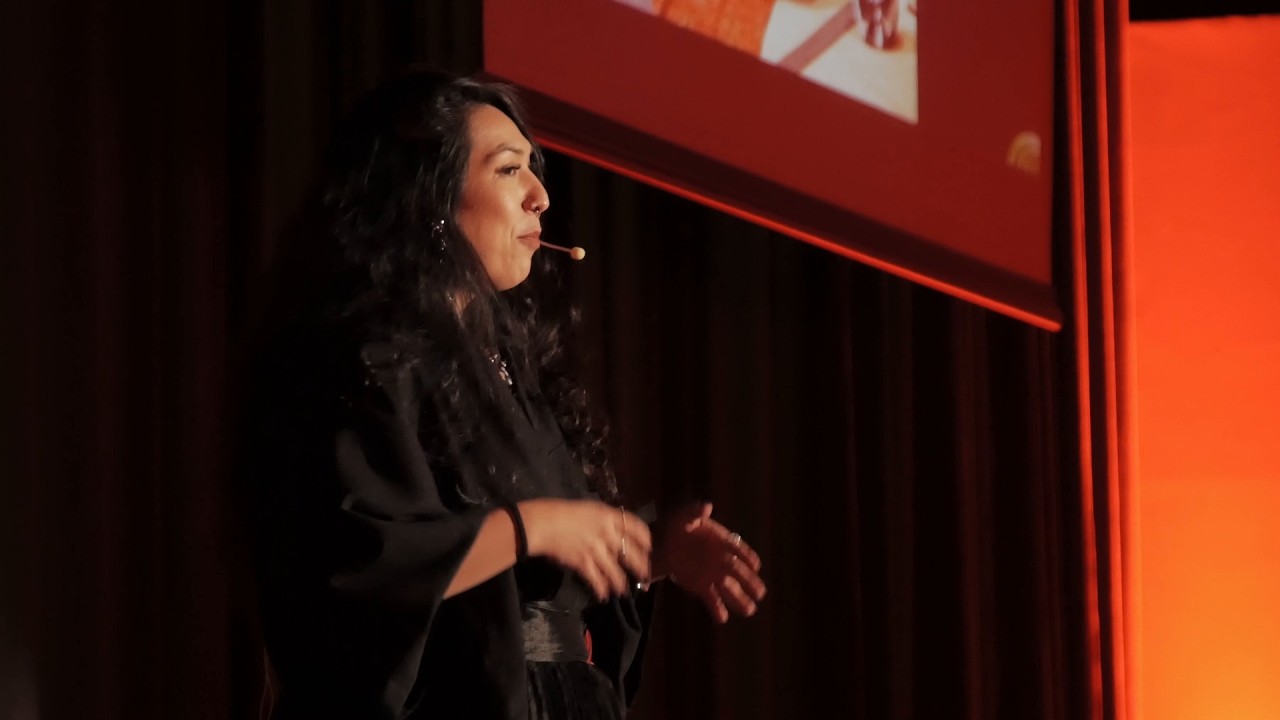
Furoshiki: o lenço japonês que pode substituir o plástico | Susan Eiko | TEDxIndaiatuba
Furoshiki: The Japanese fabric wrap that can replace plastic | Susan Eiko | TEDxIndaiatuba
Keywords
Summary
292 words
Critical Evaluation
Value of the Information & Strength of the Argument
The informational value here is primarily conceptual and practical rather than empirical. The talk supplies a compact, well-illustrated account of what a furoshiki is, how it functions as a reusable wrapping system adaptable to almost any object shape, and how it is embedded in a wider Japanese ethic of material thrift. The mottainai discussion is the strongest informational segment: it explains the practice as a response to real material scarcity, with the worn kimono cut into reusable squares as a concrete illustration, which gives the audience a causal explanation rather than a mere aesthetic. The professional case study is also informative in a design sense, showing how a traditional object was adapted (print motifs drawn from Japanese tattoo art, a softer fabric weight for fashion use, new tying configurations for urban contexts) to reach audiences outside the community of descent. The argumentative structure is that of a persuasive personal essay rather than a demonstration. Its central claim, that culture is alive and that respecting a tradition does not require repeating it identically, is asserted and illustrated but not tested against counter-arguments; the possibility that adaptation may dilute a practice is not examined. The environmental strand is the weakest argumentatively: the assertion that a furoshiki can substitute for plastic is supported by intuition and by its capacity to be washed and reused, but no comparison of impacts, no consideration of production and laundering footprints, and no discussion of scale is offered. The speaker herself concedes that the furoshiki is a concept that will not solve the world’s waste problem, which is an honest and correct limitation and improves the credibility of the whole. The final move, generalising from the cloth to a broader question about what each of us has stopped transmitting from our families, is rhetorically effective and emotionally grounded, but it shifts the register from demonstration to exhortation. Overall the argumentation is coherent, self-aware about its limits, and well served by concrete examples, but it relies on conviction and lived experience where evidence would be needed to sustain the environmental claims.
Scientific Rigor, Source Quality, Title Accuracy
No source is cited at any point. The historical claim that the furoshiki has roughly 1,300 years of history is asserted without reference. The quantitative claim that disposable plastic for delivery grew 46% between 2019 and 2021 is presented as something the speaker remembers from news coverage rather than as a specific report, which leaves the figure unattributable and unverifiable from the talk. The link between textile compostability and plastic persistence is directionally correct but stated loosely, and the claim that the cloth ‘will decompose much faster than plastic packaging’ conflates timescales that depend heavily on material and conditions. The only formal references are the generic TEDx institutional link and the UN Sustainable Development Goals, invoked as a framing rather than as an evidential basis. The talk is therefore rigorous as a first-person account of practice and weak as a documentary source: nothing in it is fabricated or implausible, but nothing in it is checkable either. On title-content adequacy, the title’s plastic-substitution promise is honoured but over-weighted relative to what the talk actually spends its time on, namely heritage, mixed identity and design.
540 words
Title / Content Match
The title promises a plastic-substitution angle, and the talk does deliver on that theme (reusable wrapping, delivery packaging, end-of-life decomposition), though the substitution claim is one thread among several. The core of the talk is actually about cultural transmission, mixed-heritage identity and design innovation rather than an environmental comparison, so the title is broadly faithful but narrows the content.
Quality & Reliability
5/10
A personal TEDx talk by a practitioner (creative director of a Japanese-Brazilian brand). It is well-structured and internally coherent, but the factual claims it advances (a 46% rise in plastic disposables between 2019 and 2021, the compostability advantage of cotton over plastic) are stated without reference to any study, report or dataset. No sources are cited beyond the generic TEDx link and a passing mention of the UN Sustainable Development Goals. The talk is a testimony about cultural transmission and design practice rather than a documented investigation, so its reliability as a factual source is moderate: the experiential content is credible, the quantitative content is unverifiable within the talk itself.
Key Moments
Markers derived by PSI from the transcript: the creator did not define chapters.
- Opening hook: the furoshiki is introduced as a technology that needs no internet, no battery and no update.
- Definition of the furoshiki as a square cloth used in Japan to wrap and carry objects, with different tying configurations demonstrated.
- Observation that the practice was little used even among Japanese descendants in Brazil, seen as old-fashioned, and the roughly 1,300-year history of the object.
- Family memory: the grandmother wrapping dishes in reused fabrics at family lunches, including non-Japanese prints.
- Explanation of mottainai and of material scarcity in Japan, with worn kimonos cut into reusable squares instead of being thrown away.
- First professional project: a fully plastic-free takeaway wrapping built around prints inspired by Japanese tattoo art.
- Contextual claim that disposable plastic for delivery grew 46% between 2019 and 2021 during the pandemic.
- Central question posed: does respecting a tradition mean repeating it exactly as it always was?
- New uses proposed for Brazilian urban daily life: fanny pack, hair scarf, turban, softer fabric weights.
- Closing question to the audience about what each of us is letting go of from what our families taught us, linked to the UN Sustainable Development Goals.
Cited Sources
- TEDx — official programme page — Institutional reference given in the video description, framing the talk as an independently organised TEDx event; not a source for any factual claim made in the talk.
- United Nations Sustainable Development Goals — Explicitly invoked near the end of the talk as the framework the speaker associates with traditional knowledge transmission (sustainable cities, responsible consumption, hunger and poverty eradication, climate action).
Concurring Sources
- Furoshiki — Wikipedia — Corroborates the description of the furoshiki as a square wrapping and carrying cloth with multiple tying methods and a long history in Japan.
- Mottainai — Wikipedia — Corroborates the speaker's explanation of mottainai as a culturally embedded aversion to waste, rooted in material scarcity, including textile reuse.
- Japanese Brazilians — Wikipedia — Supports the historical framing of Japanese immigration to Brazil and the existence of a descendant community in which the practice could be transmitted.
- United Nations Sustainable Development Goals — Confirms the existence and the content areas (sustainable cities, responsible consumption, climate action) that the speaker invokes at the end.
Dissenting Sources
- Reusable shopping bag — Wikipedia — Summarises life-cycle studies showing that reusable textile carriers only outperform single-use alternatives after a substantial number of uses, and that production and laundering carry their own footprint. This does not contradict the practice itself but qualifies the talk's implicit environmental equivalence between a cloth wrap and plastic packaging, which is asserted without any such quantification.
- Attribution of the 46% figure on delivery plastic growth — The speaker presents a 46% increase in disposable plastic for delivery between 2019 and 2021 as something remembered from news reports. No report, institution or dataset is named in the talk, so the figure cannot be traced or checked against any of the available candidates; it should be treated as an unverified order of magnitude rather than an established statistic.
Contribution & Novelties
The distinctive contribution is not a discovery but a transfer: it takes an object usually presented as a Japanese craft curiosity and reframes it three times over — as a reusable packaging system competitive with single-use plastics, as a design substrate that can be reworked for urban street culture, and as a vehicle for intangible heritage within a mixed-heritage identity. The most original element is the explicit articulation of the tension between conservation and renewal (‘does respecting a tradition mean repeating it exactly?’), illustrated by concrete design decisions: changing fabric weight for fashion use, borrowing tattoo iconography as a print language, and abandoning the lunchbox use case because it does not translate to Brazilian daily life. The talk also contributes a case study of how a minority community re-adopted a practice only after an outside designer reframed it, which is a useful counter-intuitive observation about cultural transmission. It offers no new data and no methodological apparatus, so its novelty is conceptual and narrative rather than empirical.
Further reading:
- Furoshiki — Overview of the wrapping cloth, its history and its tying techniques, useful for checking the historical and technical claims made in the talk.
- Mottainai — Background on the concept of avoiding waste that the speaker uses to explain the practice’s origin.
- Japanese Brazilians — Context on the community and immigration history referenced through the image of arrivals at the port of Santos.
- Life-cycle assessment of reusable versus single-use bags — the body of research that would be needed to substantiate the environmental substitution claim, cited here by name because no single canonical source can be pointed to with confidence.
- United Nations Sustainable Development Goals — The framework explicitly invoked by the speaker to connect traditional knowledge to global sustainability targets.
290 words
Radar Profile
The profile is lopsided in a way that matches the genre: technical level and quantified information are modest, while the qualitative dimensions (coherence of argument, cultural framing, illustrative richness) carry the talk. Reliability sits mid-scale because the experiential testimony is trustworthy but the few factual claims are unattributed. The overall shape is that of a design-and-heritage narrative rather than an evidence-driven exposé.