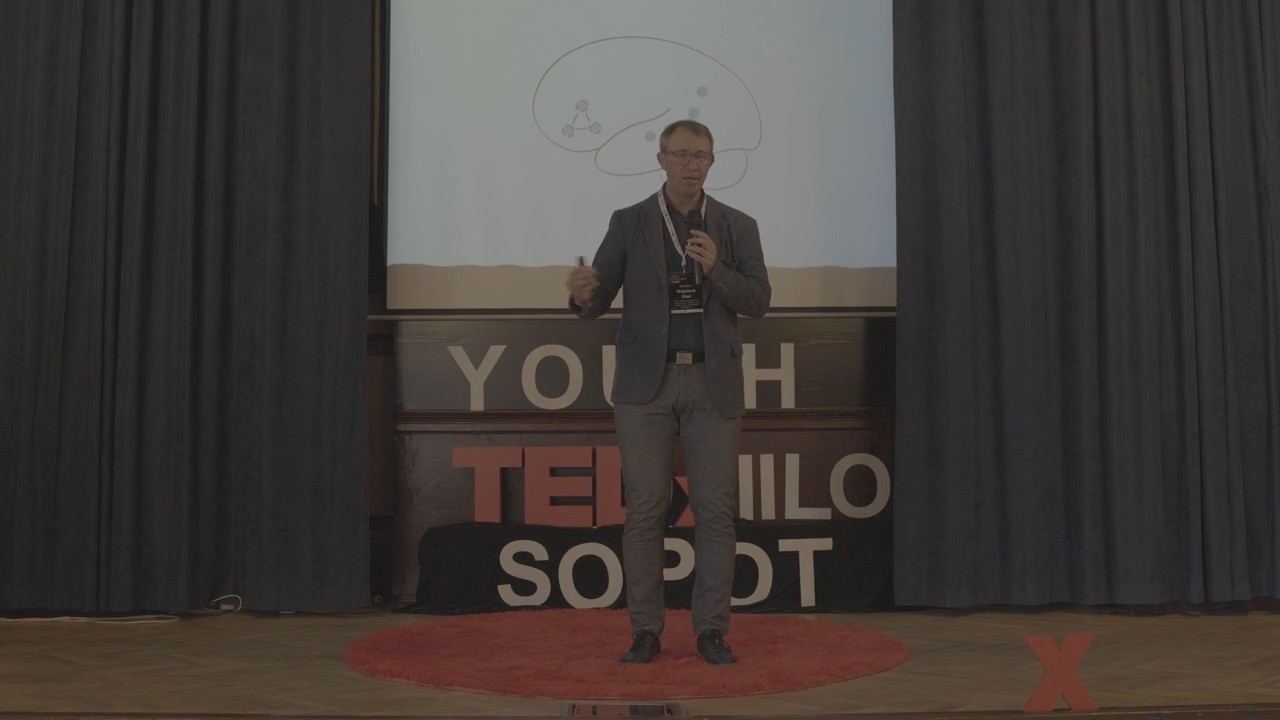
Ile prawdy, a ile wróżenia w tym, co świadomie postrzegamy? | Wojciech Glac | TEDxII LO Sopot Youth
How much truth and how much fortune-telling is in what we consciously perceive? | Wojciech Glac | TEDxII LO Sopot Youth
Keywords
Summary
241 words
Critical Evaluation
Value of the Information & Strength of the Argument
The talk offers genuine scientific value by synthesizing well-established findings in cognitive neuroscience into a coherent narrative accessible to a broad audience. The argumentation is well-structured: each section builds logically on the previous, progressing from perception delays to selective attention, then to predictive processing, decision-making, and finally learning through prediction errors. The use of concrete everyday examples (dropping an object, raising a hand, recognizing a lecture situation) effectively illustrates abstract concepts. The speaker explicitly acknowledges simplifications and presents the free-will question with appropriate nuance — saying the brain does not fully decide for us but rather prepares decisions that consciousness can veto briefly. The reasoning is internally consistent and aligns with the predictive processing framework in contemporary neuroscience, though the talk presents the framework as more settled than the actual scientific literature, which still contains competing interpretations and active debate.
Scientific Rigor, Source Quality, Title Accuracy
The talk demonstrates solid scientific grounding: the speaker, a university professor, accurately describes neural transmission delays, cortical connectivity patterns, and the role of attention in conscious access. The anatomical claim regarding frontal-to-posterior connections outnumbering the reverse direction is broadly consistent with current understanding of cortical hierarchy and predictive processing. The discussion of readiness potential echoes Libet-style experiments without overclaiming — the speaker correctly acknowledges the debate’s open status rather than presenting the findings as definitive. The title is faithfully and substantively addressed: the ‘fortune-telling’ (wróżenie) metaphor directly corresponds to the predictive framing maintained throughout. The only provided link is the official TEDx program page, which offers institutional credibility but no direct scientific references. The limitations lie in the absence of specific named studies and the natural simplification inherent to a 20-minute public talk format.
289 words
Title / Content Match
The title directly addresses the talk's central question — how much of conscious perception is genuine recording versus prediction — and the speaker answers it explicitly throughout the presentation.
Quality & Reliability
7/10
The speaker is a neurobiology professor at the University of Gdańsk, presenting established concepts from cognitive neuroscience (predictive processing, attention filtering, readiness potential) with appropriate simplification for a general audience. The content aligns with mainstream scientific understanding, though specific experimental studies are referenced only anecdotally without precise citations, and some nuances of the free-will debate are simplified.
Key Moments
Markers derived by PSI from the transcript: the creator did not define chapters.
- Introduction of the core question: do we see the world as it really is, or as a prediction, a form of fortune-telling?
- Neural transmission delays explained: 80 ms to register a change, up to 300 ms to understand what happened.
- Attention described as a zoom: only a narrow fragment of reality reaches consciousness; the rest is processed unconsciously.
- The brain extracts meaning rather than details from visual scenes, exemplified by recognizing a lecture situation.
- The predictive model: the brain anticipates future events to compensate for reaction delays and avoid missed opportunities.
- Anatomical evidence: prefrontal cortex has more connections projecting posteriorly (prediction) than the reverse (perception).
- Decisions prepared before conscious awareness: the brain readies actions, leaving only a brief window for conscious veto — the free will question.
- Prediction errors: surprise and disappointment serve as learning signals that refine the brain's model of the world.
- Conclusion: wishing the audience many prediction errors to build more accurate internal models and achieve a satisfying life.
Cited Sources
- TEDx Program — The talk was delivered at a TEDx event organized independently under the TED conference format; this is the official TEDx program page.
Concurring Sources
- Predictive coding — Neuroscientific framework consistent with the talk's claim that perception is primarily prediction-driven, with prediction errors driving learning.
- Benjamin Libet — Classic experiments demonstrating readiness potential preceding conscious decision, supporting the talk's discussion of decisions prepared before awareness.
Dissenting Sources
- Neuroscience of free will — Scientific literature contains significant debate about the interpretation of readiness potential findings; some researchers argue that consciousness retains a causal role, while the talk leans toward a more predictive-deterministic reading.
Contribution & Novelties
The talk’s contribution lies in its accessible synthesis of predictive processing theory applied to perception, attention, and decision-making, connected through everyday examples that make the concepts tangible. It does not present new research but effectively bridges several established findings — neural latency, selective attention, cortical connectivity asymmetry, and readiness potential — into a coherent explanatory narrative about the brain as a prediction machine.
Pour aller plus loin :
- Predictive coding — Directly relates to the talk’s central thesis that the brain generates perceptual predictions and updates them through prediction errors.
- Benjamin Libet — His classic experiments on the readiness potential underpin the discussion of decisions preceding conscious awareness.
- Neuroscience of free will — Explores the ongoing scientific debate the talk touches on about whether conscious decisions genuinely shape actions.
- Attention — Foundational concept behind the talk’s ‘zoom’ metaphor describing selective conscious access to information.
- Bayesian brain — A closely related theoretical framework for understanding perception and learning as probabilistic inference.
160 words
Radar Profile
The profile is fairly balanced, with the highest score on quality of information (8) reflecting scientifically grounded content, and the lowest on technical level (6) consistent with a public-facing TEDx format. Quantitative information (7) and reliability (7) indicate a moderately dense, credible presentation — appropriate for a conference talk aimed at general audiences.